
Travel: Lisbon and Surroundings Portugal, Sept 18 2016
- Sep 21, 2016
- 59 min read
Flying TLV to Lisbon

It was a wonderful surprise bumping into David ’s cousin Adi and her husband Dror from Rechovot, at the pre-travel group briefing meeting which took place at the Beit Hatefuzot (The UNU Museum of the Diaspora). I was so very glad to had the presence of these familiar cousins who joined the guided group trip, which departed from Israel to Portugal on 09/18th
Neither them nor I actually knew beforehand, that we were all due to track the the Crypto Jews who were banished or converted to Christianity following the 1496 expulsion..
Watercolour by Alfredo Roque Gameiro

Jews were officially expelled from Portugal by a decree signed by King Manuel I of Portugal in December 1496, largely due to pressure from the Spanish Crown to marry Princess Isabel,
Expulsion and forced conversions took place throughout 1497.
While many were forcibly converted to Christianity (becoming "New Christians" (cristãos-novos), this period marked the end of legal Jewish, Muslim, and Christian coexistence in Portugal.
Burning of Crypto-Jews

Prior to this, Portugal served as a refuge for many Jews expelled from Spain in 1492, before the 1496/1497 decree forced them out or into conversion.
The Inquisition was formally established in Portugal later, in 1536, initiating further persecution and burning of the forced converts.
The flight to Lisbon was much longer then expected. The San-Dor airline flight with its company’s staff, all “tender aged” stewardess, was quite a nasty one. Mostly bunched up Israelis, part of few operating organized guided tours, either kept non-stop walking through the plane, or congregating by the limited restrooms area, the entire flight ..
The frentic commotion felt more like at a train station then on an airplane flight.
.
The luggage at the arrival baggage claim’s carousel was trickling slowly and endlessly, but finally all the group's belongings were assembled and loaded with its owners onto the pre-ordered bus. A short drive from the airport, got us, closed to midnight to our bearable hote.l

R. São Sebastião da Pedreira 19
Not to be mixed with other 10 other Turim’s Hotels, this one a 4-star hotel situated in the very heart of central Lisbon, close to the Marquês de Pombal Square. is situated in the very heart of central Lisbon,


a central, bustling roundabout in Lisbon that acts as a focal point connecting Avenida da Liberdade to Parque Eduardo VII. It features a prominent bronze statue monument, erected in 1934, of Marquis Pombal, standing atop a 36-meter pedestal with a lion, symbolizing his power and authority, while looking down towards the Baixa district
The monument itself featuring motifs representing the rubble and destruction of the 1775 earthquake era
The square serves as a major transportation hub with a dedicated metro stop and is surrounded by hotels, banks, and corporate offices.
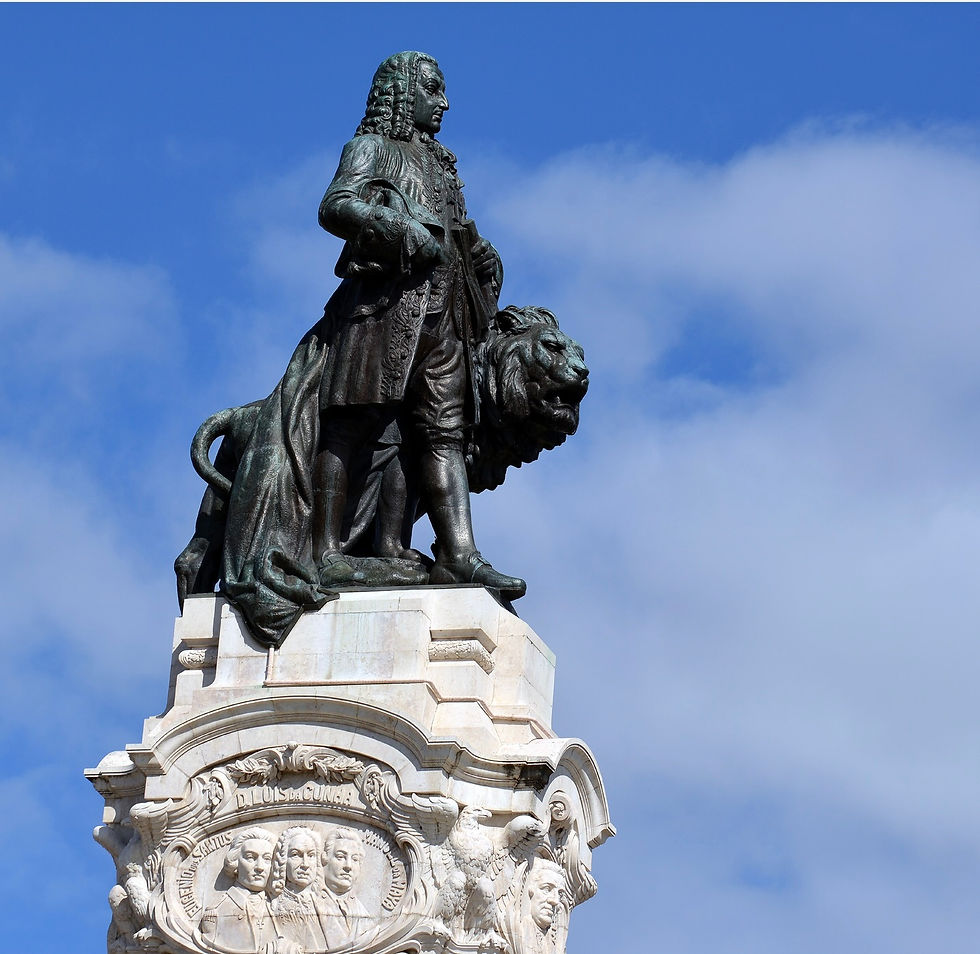
We got thoroughly acquainted with this famous admired Sebastião José de Carvalho e Melo, 1st Marquess of Pombal, 1st Count of Oeiras, the mighty prime-minister who ruled Portugal from 1750 to 1777 and rebuilt the city after the big earthquake of 1760 when most of the city center was ruined and many perished.
The rebuilt city after the 1755 earthquake, represents modern Lisbon's commercial and historical hub.
Lisbon’s accelerated reconstruction and remaking has brought the city in fast gallop to the 21st c modern most attractive coveted city to visit.
Following a very mediocre breakfast at the hotel, and a late bus arrival the group finally left the following day at 9:30am for the day, starting the tour with the quaint small towns and sites of Lisbon’s surroundings and only on the following day (09/20) resumed touring Lisbon itself. However, the account of what was visited in Lisbon will be mentioned first and complement what alaredy was reported at a private trip to
Lisbon's monuments
At my previous trip to France (Aug 2016) I mentioned that France should be rated highly on its architecture creative recycling … e.i. Modern Shopping Mall housed inside an old Pescaderia (Fish Market) structure, Hotels housed inside Convents estates, and Museum inside a Slaughter house building… well Portugal surpassed France for its creative urban recycling ideas....
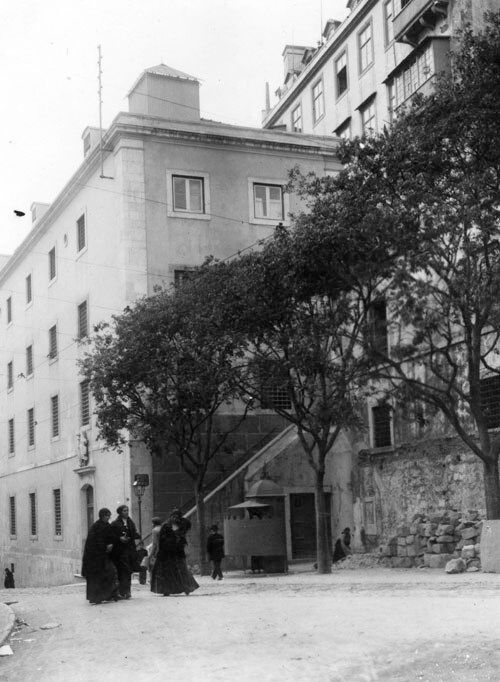
In Lisbon the former Cadeia do Aljube - the dictatorial interrogation cellars, are now housing the Aljube Museum – Resistance and Freedom, opened on in 2015,
The building from the 18th c has in reality older origins that date back to the Moorish occupation period, under the name "Al-Jubb." It was used for imprisonments of religious nature, as prison for women in the 19th c and jail for political prisoners during the dictatorship period, in the 20th c. Place of atrocities, privations and suffering through time, its six floors are now transformed in a testimony of resistance, the fight against dictatorship and freedom strengthening democratic values. .

Inquisition Palace- “The Dona Maria II National Theater”.
The Center of Lisbon is Rossio, the focal square bungled by transport and cable car lines and encompassed by shops, eateries and the stately 19-C theater, National Theater. planted at the square’s north end, on the site of the old Ministry of Justice, where mass constrained sanctifications of Jews were done in 1497 and where the Inquisition was later controlled

The former Inquisition Palace houses today “The Dona Maria II National Theater”. This beautiful building is the best representative of Neoclassical architecture of Palladian influence in Lisbon. The neoclassical front facade that dominates the northern side of Rossio square, was built in 1846 on the site of the old Palácio dos Estaus Palace.
The Palace was initially constructed in 1450 and was used by the Portuguese royal family to host foreign dignitaries and noblemen visiting Lisbon.
The history and reputation of the Palácio dos Estaus descended into dread and fear during the 16th c and the reign of King john III when the palace was used as the base for the Portuguese inquisitions. From the state rooms of the palace, men and women were sentence to death, while in the back rooms prisoners were tortured to extract forced confessions which would implicate others as heretics.
“São Domingos de Lisboa” Church/Convent

Right off the square is the São Domingos Church, a baroque structure, where sentences of the Inquisition were passed.
This incident took place at the , 30 years before the establishment of the Inquisition in Portugal and 9 years after the Jews were forced to convert to Roman Catholicism in 1497, during the reign of King Manuel I.
It was dedicated in 1241 and was, at one time, the largest church in Lisbon, Prior to the establishment of the modern Portuguese republic in 1910, the church typically hosted Portuguese royal weddings. Later many sentences of the Inquisition were passed in this macabre Largo São Domingos Church which was damaged by the 1531 Lisbon earthquake and almost completely destroyed in the 1755 earthquake.. and in 1994 the church was reopened.
Just outside the church, the Star of David monument (see below) is set.
"Tolerance Square "
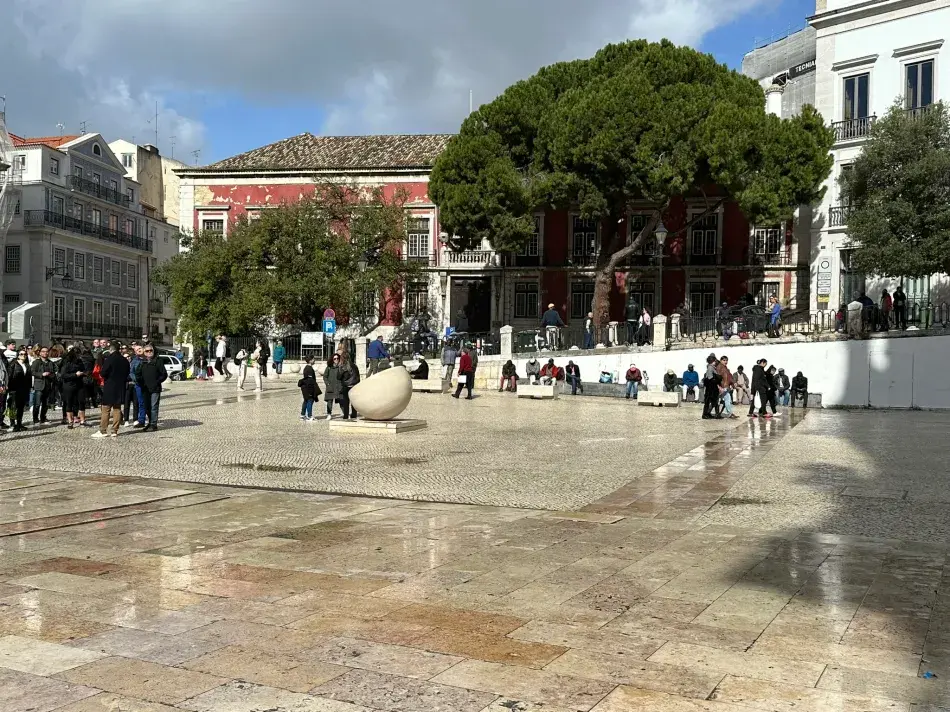
What today is called the “Tolerance Square” next to the National Theater, is the former site of the “Lisbon massacre”.
Alternatively known as the Lisbon pogrom or the 1506 Easter Slaughter, an incident from April, 1506, in which a crowd of Catholics, as well as foreign sailors who were anchored in the Tagus, persecuted, tortured, killed, and burnt at the stake hundreds of converts, who were accused of being Jews and, thus, guilty of deceit and heresy.
Maritime Museum (Museo de Marinah)
Our Israeli guide Shuki was a captivating talented story teller whose passion for Portugal history brought to life the Age of Discovery from 500 years ago,

The Age of Discovery (c. 1400s–1600s) was a transformative period of intensive European maritime exploration, expansion, and colonization, bridging the gap between the Old and New Worlds. Driven by the search for new trade routes to Asia, wealth, and technological advancements, explorers like Columbus, Da Gama, and Magellan mapped the globe, fundamentally creating early, globalized trade networks.
Shuki's strories brought into life and motion the amazing adventures, voyages, and marine advances of the known explorers of that times. as well as the new technologies territorial strategies and land disputes .

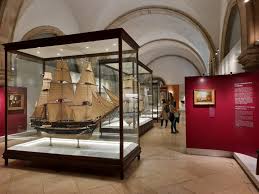
A lot can be seen on view at the fantastic Marine Museum, one of the oldest museum of its kind, dedicated to all aspects of the history of navigation
The history of the museum is connected to King Luís I (1838-1889), who had a strong interest in oceanographic studies. An accomplished navigator himself.
In 1863, he began collecting items related to the preservation of maritime history of Portugal


Other architectural work and memorial sights worth visiting

Belem an abbreviation for Beith Lechem there use to be 2 of them both on the north and south banks of the wide Tagus river. Built in 1515 in a Manuline style -
Portuguese late Gothic, sumptuous architectural form (c. 1490s–1520s) defining Portugal's Age of Discoveries,.

Characterized by intricate, maritime-themed stone ornamentation he fortress was built to guard the entrance to Lisbon's harbor, The Belem Tower, an UNESCO marked, was the starting point for many of the voyages of discovery, and for the sailors it was the last sight of their homeland.

Combatant Museum (Museu do Combatente)
Situated by the rive bank at the Forte de Bom Sucesso , (18C) slightly to the west of the Belém Tower in Belém
Crafted in the walls of the Fort, are the headstones with the names of the brave that died in the name of Portugal, inscribed in alphabetical order and with their military ran, many who fought in the First World War.

A tall monument, shaped like a ship's prow, stands at the marina in Belém,
The Discoveries Monument, built in 1960 on the north bank of the Tagus River to commemorate the 500th anniversary of the death of Prince Henry the Navigator and in honor of the 15th and 16th c Explorers
It represents a three-sailed ship ready to depart, with sculptures of important historical figures such as King Manuel I carrying an armillary sphere, poet Camões holding verses from

The Lusiads, Vasco da Gama, Magellan, Cabral, and several other notable Portuguese explorers, crusaders, monks, cartographers, and cosmographers, following Prince Henry the Navigator at the prow holding a small vessel.
The only female is queen Felipa of Lancaster, mother of Henry the navigator, the brain of the discoveries.
Vasco De Gama Prince Henry the Navigator, Ferdinannd Magellan
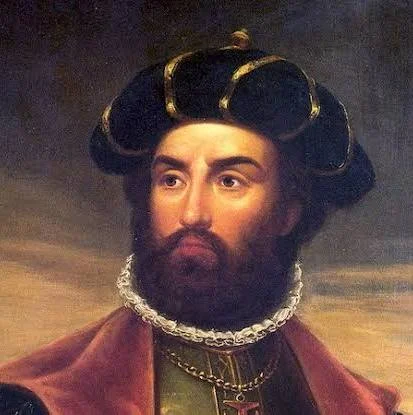
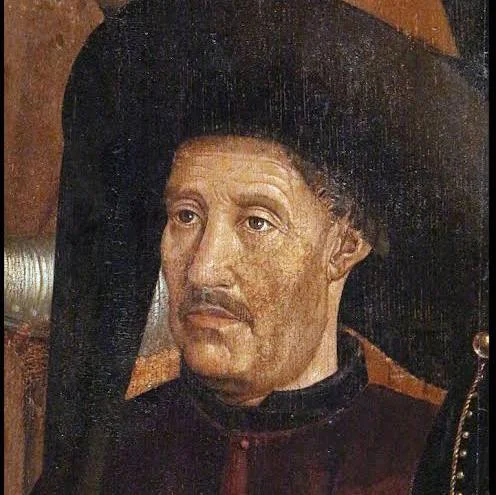
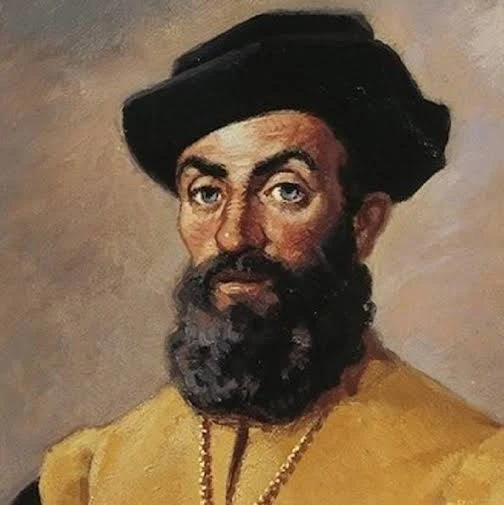

Absent from the monument is the known brilliant Jewish academician -Abraham Zacuto, so here it is now his name is reminded in this Travel Log:
(Hebrew: אברהם זכות, Portuguese: Abraão ben Samuel Zacuto, (Salamanca, August 12, 1452 – Damascus, probably 1515) was a Sephardi Jewish astronomer, astrologer, mathematician, rabbi and historian who served as Royal Astronomer in the 15th c to King John II of Portugal. The crater Zagut on the Moon is named after him, and Zacuto developed a new type of astrolabe, specialized for practical determination of latitude while at sea,
With the general expulsion of the Jews from Spain in 1492, Zacuto took refuge in Lisbon, Portugal. Already famous in academic circles, he was invited to court and nominated Royal Astronomer and Historian by King John II of Portugal, a position which he held until the early reign of Manuel I. He was consulted by the king on the possibility of a sea route to India.

A stunning giant marble Wind Rose is embedded in the pavement at the foot of the Monument to the Discoveries.
A map of the world at the center of the wind rose charts the Portuguese explorations, showing the most important dates in the history of the discoveries and ships mark the locations where Portuguese explorers first set foot on land.

While walking along the North river bank the magnificent and familiar sight of
“Ponte 25 De Abril” - Lisbon’s “Golden Gate Bridge" is in full view..
It is a suspension bridge connecting the city of Lisbon, to the municipality of Almada on the left (south) bank of the river.
The Golden Gate

It was inaugurated on August 6, 1966, and a train platform was added in 1999. Because it is a suspension bridge and has similar coloring, it is often compared to the Golden Gate Bridge in San Francisco, Bbuilt by the American Bridge Company which constructed the San Francisco–Oakland Bay Bridge, ( not the Golden Gate.)
Until 1974, the bridge was named Salazar Bridge. The name "25 de Abril" commemorates the Carnation Revolution - military coup code-named, by officers that overthrew the Estado Novo regime on 25 April 1974.

a UNESCO World Heritage site and a masterpiece of 16th-c Manueline (Portuguese late Gothic) architecture. Built in 1502 to commemorate Vasco da Gama’s voyage to India,
The limestone Gothic style monastery of the Order of Saint Jerome is situated near the Tagus river across from the Monument to the Discoveries,
The Jeronimos complex is the most impressive symbol of Portugal's power and prominence, funded by spice trade wealth.during the Discovery Era. King Manuel I .

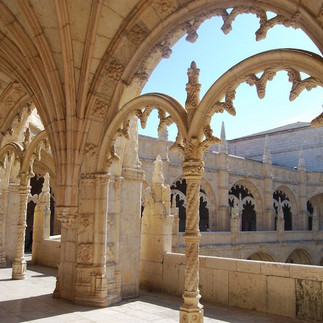
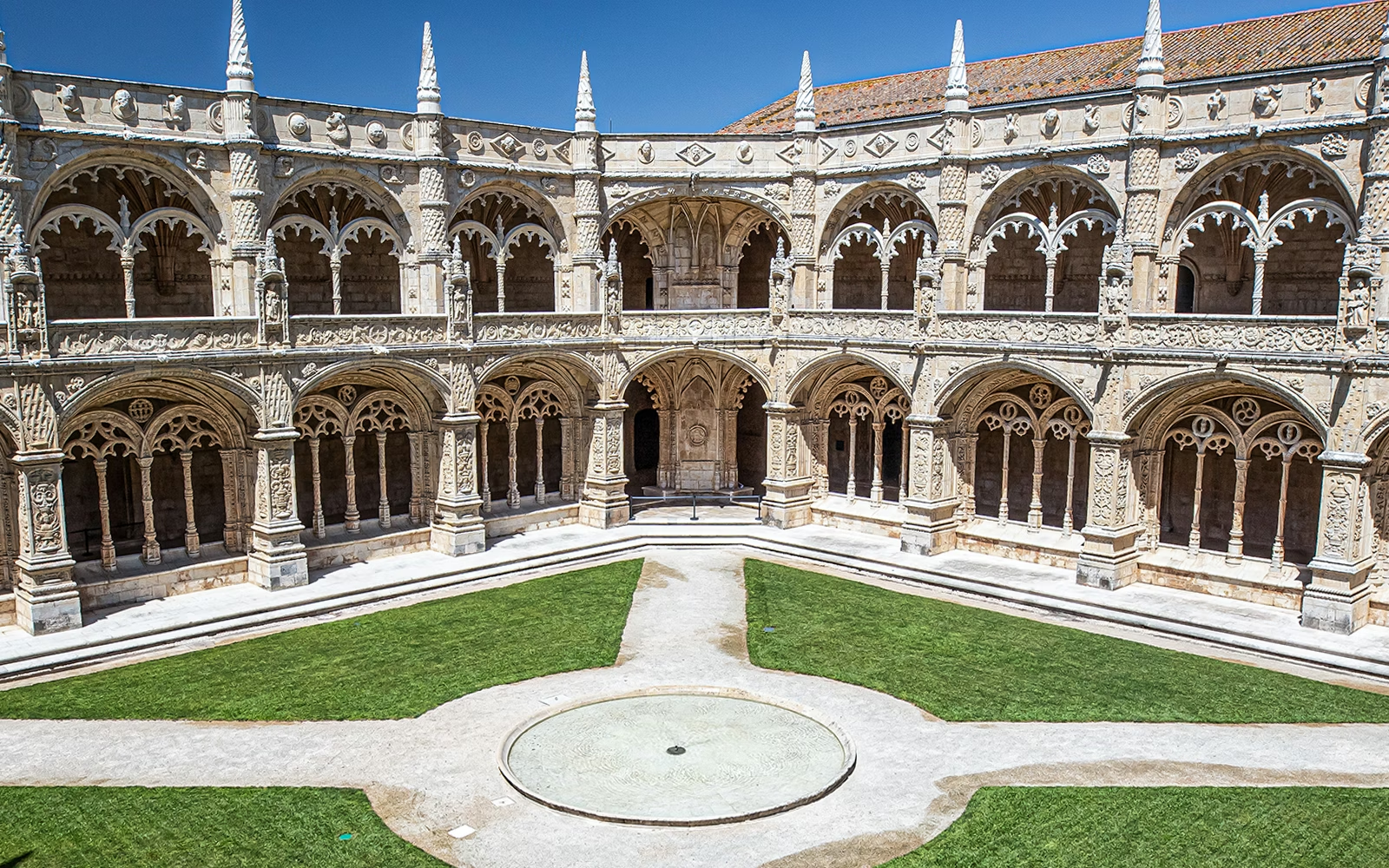


The ornate Manueline style, includes intricate maritime motifs, stone carvings of ropes, sea monsters, and nautical elements,

It was built on the site of a hermitage founded by Prince Henry the Navigator,
where Vasco da Gama and his crew spent their last night in Portugal in prayer before leaving for India.
It features a stunning cloister, and the Church of Santa Maria, which houses the tombs of Vasco da Gama and poet Luís de Camões.

Iron Tower Lift (Santa Just Elevator)
The charming loved landmarks also known as the "Elevator of Carmo," is an extraordinary structure 45-m tall, Neo-Gothic iron tower in central Lisbon, designed by Portugal-born French architect- Raoul Mesnier du Ponsard
an apprentice of Gustave Eiffel, explaining the structure's similarities to Paris' Eiffel Tower.
It opened in 1902. to connects the Baixa district to Largo do Carmo. (the lowest and highest points of the city) featuring two wood-and-brass carriages that offer panoramic city views to connect downtown to Bairro Alto .
“ Pasties de Belem” (since 1837)
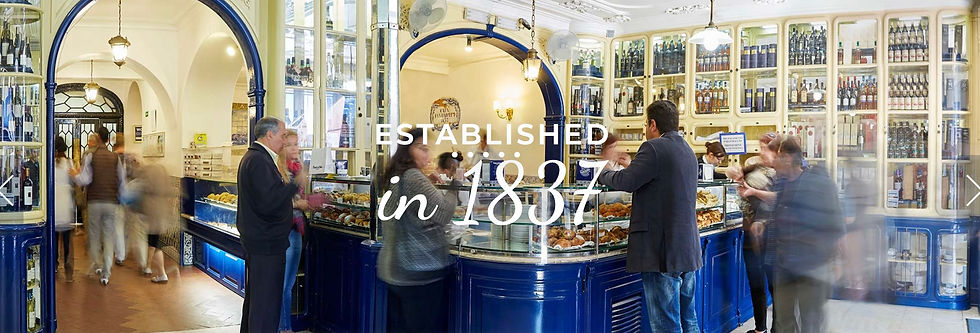
One can not miss a visit to Lisbon, without sampling its famous pastry establishment - “Pasties de Belem” and to have with coffee its delightful pastries

So that was exactly what we did at noon pause, when getting off our swollen feet, giving them a rest from the morning exploration, at this famous Cafe, restocking on our sugar level, and enjoying the ambiance and the beautiful blue and white tiles decorating this labyrinth of rooms Cafe.
Neighborhoods to Visit

Lisbon is composed of distinct, hilly neighborhoods, ranging from the historic, narrow streets of Alfama to the grand, central neoclassical downtown boulevards of Baixa and the trendy nightlife of Bairro Alto.
Key areas for visitors include the, sophisticated, artistic elegant Chiado, scenic upscale, trendy Príncipe Real, and riverside Belém packed with maritime history.

Alfama Niegborhood
Later in the afternoon when climbing up the hill at the “Alfama” Neighborhood we enjoyed the remains of the old citadel’s walls, once protected the Royal 11th-c São Jorge Castle

This old fishing suburb located at the foot of São Jorge Castle, between the hill and the ocean, also offers a beautiful vista of quint red tile roofs, and colorful houses, rolling from the top of the hill, into the bluish water of the Tagus river, to which its bank a few flight of steps lead. It is where Fado music was created back in the 1820s.
The historic Jewish Quarter (Judiaria) of Lisbon long gone, was also located in the Alfama district, the city's oldest neighborhood.

visiting Lisbon Jewish quarter, “ “Rua da Judiaria" was in a big contrast to both visiting Lisbon's exciting monuments and sites in honor of the Discovery era, .
In contrast to the heroic exploration legends the stories about cruel inhuman Inquisition and deportations which left the quarter void of Jews and thier
cultural presence, were heartbreaking.

Jewish Lisbon's, millennia-old history spanned from medieval Sephardic life and the 1497 forced conversions to the 1506 massacre and modern community revival of the 19th C
Its key sites include the Alfama district (historic Judiaria), the 1506 Massacre Memorial at São Domingos Square, and the Shaaré Tikvah Synagogue, with the new Tikva Jewish Museum .
diner which was included at the group’s package, served at the hotel, was an anti-climex disappointing as expected of this kind of mediocre establishment.
It is not worth to spend more time writing about,.
It would have been smarter to have dinner at a good typical establishment in the old center, not to mention it would have been so much moor friendly choosing a lodging closer to the old center.
remnants and historical sites, such as the Rua da Judiaria, are found within this area, which dates back to the 12th century
the 1506 Jewish Massacre Memorial near São Domingos Church.
Synagogues: The modern Jewish community is centered around the Shaaré Tikvah Synagogue (inaugurated 1904) in the Príncipe Real / Rato area.
Then back with the rush hour to Lisbon where our bus like a huge elephent sqwized ed through the narrow allies of the old center manuvering its way in and out with admirable skill
At "Luso Cafe" - Timeless restaurant in cellar & stables of 17th-century palace a Pado singing establishment in the heart of the gentrified Bairro Alto neighborhood, we heard at least 6 singers singing for 2 hours, while having reasonable diner served. http://www.cafeluso.pt/en/
A one time experience of this outing was more then enough.
On the way when strolling through the Bairro Alto neighborhood I coveted food served on the plates of the many eaters, and would like to sample, at this outdoors newly opened and promising restaurant I passed named “ Sinal vermelano”
Around Lisbon


Though, situated on forested hills, area, thus cooler, Sintra only 35 minutes away, is considered part of the Portuguese Riviera and is known for its many 19th-c Romantic architectural monuments, which earned its classification as a UNESCO World Heritage Site .
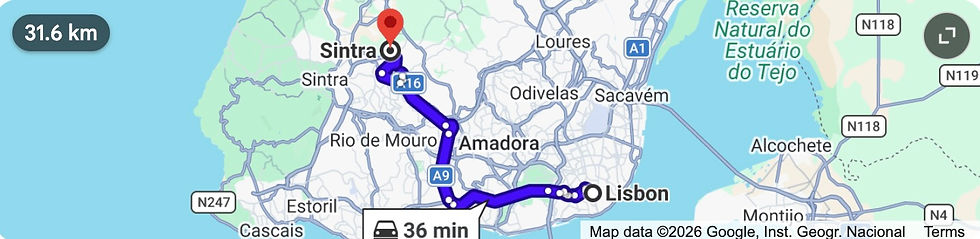

It is also known for its impressive Pena Palace Royal summer national palace, we visited with its overbearing kitchen's 2 chimneys. Originally founded on Moorish ruins parts of the 13th c and 19c structures which are inter-mingled now. offering a mix of history and nature.
Cabo da Roca (cape Roca)

The cape is within the Sintra-Cascais Natural Park, 42 kim west of Lisbon

This most western point in Europe coast is a mixture of sand beaches and rocky cliff promontories, reminded me of Ca Hwy 1 dramatic scenery.
As we lucked out on the weather, the excellent visibility, lack of strong winds and comfortable temperature, made the touring experience pleasant.

Cabo da Roca was known to the Romans as Promontorium Magnum and during the Age of Sail as the Rock of Lisbon.
The Cabo da Roca Lighthouse (:Farol do Cabo da Roca) is a beacon/lighthouse located 165 m above the Atlantic Ocean
After changing twice, the bus model , and playing "musical chairs" as there were dissatisfaction with the allocated bus size, the group was ready to have
lunch at a place not worth mentioning at the next visited charming town .
Cascais

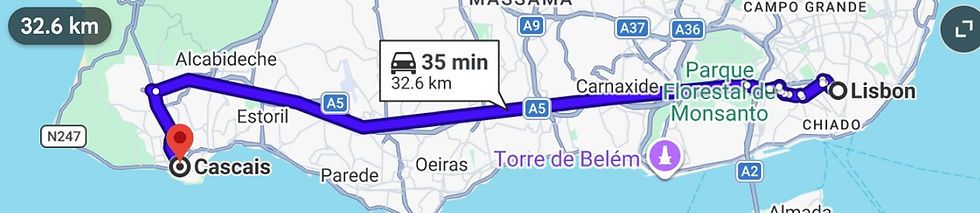

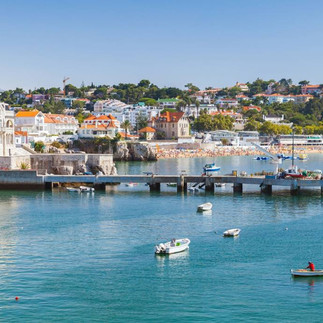
Cascais the coastal cosmopolitan resort town, 30 km west of Lisbon on the Portugease reviera. has been popular vacation spot for local and tourists.
The former fishing village gained its fame as a resort for Portugal's royal family in the late 19th c and as an espionage hub in early 20th c



The next town of:
Estoril

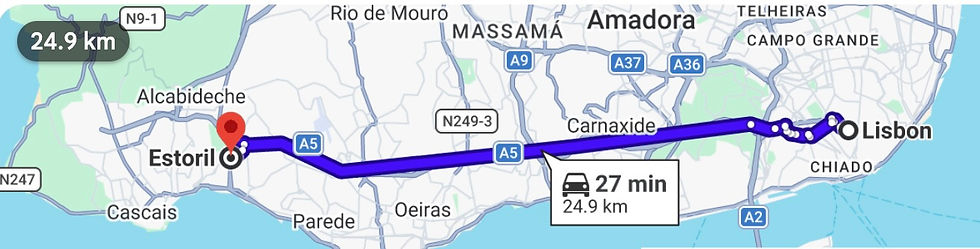

Estoril is also a coastal charming town, on the Portuguese Riviera. we toured,
This popular tourist destination, with hotels, beaches, and the Casino Estoril. has also been a magnet to numerous royal families and celebrities ande international intelligence agents.


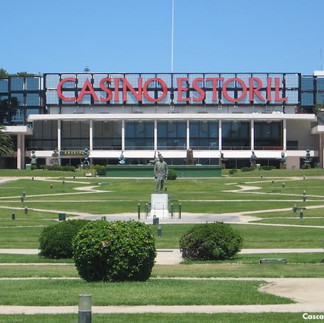


During World War II, Estoril served as a gathering spot for espionage agents, dispossessed royals, and wartime adventurers.
It was the inspiration for Ian Fleming's 007 novel Casino Royale
To be continued...
================
Travel Log - Sept 20 - Lisbon's monuments and stories
If you recall in my previous trip from Aug 2016 I mentioned that France should be rated highly on its architecture creative recycling … one can find Modern Shopping Mall housed inside an old Pescaderia (Fish Market) structure, Hotels housed inside Convents estates, and Museums inside a Slaughter house buildings… well Portugal surpassed France for its creative urban recycling ideas....
In Lisbon the former Cadeia do Aljube - the dictatorial interrogation cellars, are now housing the Aljube Museum – Resistance and Freedom, opened on the April 25th, 2015,
The building from the 18th century, has in reality older origins that date back to the Moorish occupation period, under the name "Al-Jubb." It was used for imprisonments of religious nature, as prison for women in the 19th century and jail for political prisoners during the dictatorship period, in the 20th century. Place of atrocities, privations and suffering through time, its six floors are now transformed in a testimony of resistance, the fight against dictatorship and freedom strengthening democratic values. .
(https://www.playocean.net/en/portugal/lisbon/museums/aljube-museum-resistance-and-freedom)
Also the former Inquisition Palace houses today “The Dona Maria II National Theater”. This beautiful neoclassical front facade dominates the northern side of Rossio square, was built in 1846 on the site of the old Palácio dos Estaus palace. The Palácio dos Estaus was initially constructed in 1450 and was used by the Portuguese royal family to host foreign dignitaries and noblemen visiting Lisbon.
The history and reputation of the Palácio dos Estaus descended into dread and fear during the 16th century and the reign of King john III as the palace was used as the base for the Portuguese inquisitions. From the state rooms of the palace, men and women were sentence to death, while in the back rooms prisoners were tortured to extract forced confessions which would implicate others as heretics.
(https://en.wikipedia.org/wiki/D._Maria_II_National_Theatre)
And what today is called the “Tolerance Squre” next to the National Theater, is the former site of the “Lisbon massacre”. (https://en.wikipedia.org/wiki/Lisbon_massacre)
Alternatively known as the Lisbon pogrom or the 1506 Easter Slaughter was an incident in April, 1506, in Lisbon, in which a crowd of Catholics, as well as foreign sailors who were anchored in the Tagus, persecuted, tortured, killed, and burnt at the stake hundreds of converts who were accused of being Jews and, thus, guilty of deicide and heresy.
This incident took place at the “São Domingos de Lisboa” Church/Convent, thirty years before the establishment of the Inquisition in Portugal and nine years after the Jews were forced to convert to Roman Catholicism in 1497, during the reign of King Manuel I.
Later many sentences of the Inquisition were passed in this macabre Largo São Domingos Church
(https://www.google.pt/search?q=S%C3%A3o+Domingos+Lisbon&biw=1331&bih=666&tbm=isch&tbo=u&source=univ&sa=X&ved=0ahUKEwj16PXnhJ_PAhXIvBQKHXnHD8kQsAQITQ&dpr=1)
(http://lisbon-portugal-guide.com/Baixa-Lisbon/Igreja-sao-Domingos-church-Lisbon.html)
(https://en.wikipedia.org/wiki/Portuguese_Inquisition)
Our Israeli guide Shuki is a captivating talented story teller whose passion for Portugal history during the age of Discovery of 500 years ago, brings into life and motion the amazing adventures, voyages, marine advances of the known explorer of that times as well as new technologies and territorial strategies and land disputes . Also his sharing on Lisbon’s execelarated reconstruction and remaking has brought the city in fast gallop to the 21st c modern most attractive coveted city to visit.
Added to our guide’s passionate sharing, we got to admire the architectural work of recognition and memorial sights definitely worth visiting:
Belem Tower (Belem an abbreviation for Beith Lechem) there use to be 2 of them both on the north and south banks of the wide Tagus river.
Built in 1515 in a Manuline style as a fortress to guard the entrance to Lisbon's harbor, the Belem Tower, an UNESCO marked, was the starting point for many of the voyages of discovery, and for the sailors it was the last sight of their homeland.
(http://www.golisbon.com/sight-seeing/belem-tower.html)
Combatant Museum (Museu do Combatente)
Situated by the rive bank at the Forte de Bom Sucesso
Crafted in the walls of the fort, are the headstones with the names of the brave that died in the name of Portugal, inscribed in alphabetical order and with their military ran, many who fought in the First World War.
(https://www.playocean.net/en/portugal/lisbon/museums/combatant-museum)
Discoveries Monument.
(http://www.golisbon.com/sight-seeing/discoveries.html)
A tall monument, shaped like a ship's prow, stands at the marina in Belém,
Unfortunately this monument is going through maintenance construction so though its impressive quality is very noticed yet it could not be fully appreciated.
The Discoveries Monument, built in 1940 on the north bank of the Tagus River in 1960 to commemorate the 500th anniversary of the death of Prince Henry the Navigator and in honor of the 15th and 16th c Explorers
It represents a three-sailed ship ready to depart, with sculptures of important historical figures such as King Manuel I carrying an armillary sphere, poet Camões holding verses from The Lusiads, Vasco da Gama, Magellan, Cabral, and several other notable Portuguese explorers, crusaders, monks, cartographers, and cosmographers, following Prince Henry the Navigator at the prow holding a small vessel. The only female is queen Felipa of Lancaster, mother of Henry the navigator, the brain of the discoveries.
Absent from the monument is the known brilliant Jewish academician -Abraham Zacuto, so here it is now his name is reminded in this Travel Log:
(Hebrew: אברהם זכות, Portuguese: Abraão ben Samuel Zacuto, (Salamanca, August 12, 1452 – Damascus, probably 1515) was a Sephardi Jewish astronomer, astrologer, mathematician, rabbi and historian who served as Royal Astronomer in the 15th century to King John II of Portugal. The crater Zagut on the Moon is named after him, and Zacuto developed a new type of astrolabe, specialized for practical determination of latitude while at sea,
With the general expulsion of the Jews from Spain in 1492, Zacuto took refuge in Lisbon, Portugal. Already famous in academic circles, he was invited to court and nominated Royal Astronomer and Historian by King John II of Portugal, a position which he held until the early reign of Manuel I. He was consulted by the king on the possibility of a sea route to India.
more can be read in the link below.
(https://www.google.pt/search?q=Abraham+Zakuto+navigator&biw=1331&bih=666&tbm=isch&tbo=u&source=univ&sa=X&ved=0ahUKEwiMnJmk7p7PAhWD1RQKHfqnBn8QsAQIMg)
Wind Rose
At the foot of the Monument to the Discoveries is a stunning giant marble wind rose embedded in the pavement. A map of the world at the center of the wind rose charts the Portuguese explorations. The map shows the most important dates in the history of the discoveries and ships mark the locations where Portuguese explorers first set foot on land.
(https://www.google.pt/search?q=wind+rose+lisbon&biw=1331&bih=666&tbm=isch&tbo=u&source=univ&sa=X&ved=0ahUKEwiPsaaH8Z7PAhUBaRQKHTNaA2YQsAQIGQ)
While walking along the North river bank the magnificent and familiar sight of
“Ponte 25 De Abril” (The Lisbon’s “Goldeb Gate Bridge”) is in full view.
(https://www.google.pt/search?q=lisbon+bridges&biw=1331&bih=666&tbm=isch&tbo=u&source=univ&sa=X&ved=0ahUKEwiNkYOd9J7PAhWBWBQKHaeLC4gQsAQIJw&dpr=1)
It is a suspension bridge connecting the city of Lisbon, to the municipality of Almada on the left (south) bank of the river. It was inaugurated on August 6, 1966, and a train platform was added in 1999. Because it is a suspension bridge and has similar coloring, it is often compared to the Golden Gate Bridge in San Francisco, US. It was built by the American Bridge Company which constructed the San Francisco–Oakland Bay Bridge, but not the Golden Gate.
Until 1974, the bridge was named Salazar Bridge. The name "25 de Abril" commemorates the Carnation Revolution.
Jeraniums Church/Monastery
(https://www.google.pt/search?q=hieronymus+Church+Lisbon&biw=1331&bih=666&tbm=isch&tbo=u&source=univ&sa=X&ved=0ahUKEwjJgsHM8Z7PAhUDthQKHWpyD-0QsAQILQ)
A Gothic style monastery of the Order of Saint Jerome situated near the Tagus river in the parish of Belém and across from the Monument to the Discoveries,
it is UNESCOWorld Heritage monument and Vasco da Gama's resting place
The Jeronimos complex is the most impressive symbol of Portugal's power and wealth during the Discovery Era. King Manuel I built it in 1502 on the site of a hermitage founded by Prince Henry the Navigator, where Vasco da Gama and his crew spent their last night in Portugal in prayer before leaving for India. It was built to commemorate Vasco Da Gama's voyage and to give thanks to the Virgin Mary for its success. Vasco da Gama's tomb was placed inside by the entrance, as was the tomb of poet Luis de Camões, author of the epic The Lusiads in which he glorifies the triumphs of Da Gama and his compatriots. Other great figures in Portuguese history are also entombed here, like King Manuel and King Sebastião, and poets Fernando Pessoa and Alexandre Herculano.
(https://en.wikipedia.org/wiki/Jer%C3%B3nimos_Monastery)
Martime Museum (Museo de Marinah)
(https://www.google.pt/search?q=maritime+museum+Lisbon&biw=1331&bih=666&tbm=isch&tbo=u&source=univ&sa=X&ved=0ahUKEwj71NLp8Z_PAhWDWhoKHUyQCwEQsAQIQg)
A fantastic and one of the oldest museum of its kind, dedicated to all aspects of the history of navigation in Portugal with very impressive displays.
The history of the museum is connected to King Luís I (1838-1889), who had a strong interest in oceanographic studies and an accomplished navigator himself. In 1863, he began collecting items related to the preservation of maritime history of Portugal
(https://www.google.pt/?gfe_rd=cr&ei=lyPiV5bfF-es8wfkl6iYDA&gws_rd=ssl#q=Marine+museom+Lisbon)
Iron Tower (Santa Just a Elevator)
(https://www.google.pt/search?q=iron+tower+lisbon&biw=1331&bih=666&tbm=isch&tbo=u&source=univ&sa=X&ved=0ahUKEwjSwL6j9J_PAhVD1RQKHYbCCJMQsAQINw)
The charming loved landmarks also known as the "Elevator of Carmo," is an extraordinary structure built at the turn of the century by the Portugal-born French architect Raoul de Mesnier du Ponsard (an apprentice of Gustave Eiffel, explaining the structure's similarities to Paris' Eiffel Tower), to connect downtown to Bairro Alto (the lowest and highest points of the city).
(http://www.golisbon.com/sight-seeing/santa-justa.html)
“ Pasties de Belem” (http://pasteisdebelem.pt/en/)
One can not miss on a visit to Lisbon, sampling its famous pastry called “ Pasties de Belem” and best to have it with coffee at a Cafe founded in 1837, bearing that name.
So that is exactly what we did at noon pause, restocking on our sugar level, while getting off our swollen feet giving them a rest from the morning exploration , while enjoying the ambiance and the beautiful blue and white tiles decorating this labyrinth of rooms Cafe.
(https://www.google.pt/search?q=pasteis+de+belem+lisbon&biw=1331&bih=666&tbm=isch&tbo=u&source=univ&sa=X&ved=0ahUKEwjD1oXV957PAhXJaRQKHbsmAoUQsAQINw&dpr=1)
Later in the afternoon we climbed up the hill at the “Alfama” neighborhood to enjoy the remains of the old citadel’s walls, once protecting the Royal castle and to view the beautiful vista from a top the hill, with its quint red tile roofs colorful houses, of the city rolling into the bluish water of the Tagus river, only to climb down through few flight of steps leading to the river bank, visiting where once the Lisbon Jewish quarter, “ “Rua da Judiaria “long gone, was standing.
(http://lisbonguide.org/alfama-jewish-quarter-rua-judiaria/)
In contrast to both visiting exciting monuments and sites in honor of the Discovery era, as well as great guiding and perfect weather and though the stories about lost explorers and cruel human Inquisition spirit were very sad and touching, diner which was included at the group’s package, served at the hotel, was an anti-climex disappointing as expected of this kind of mediocre establishment.
It is not worth to spend more time writing about,.
It would have been smarter to have dinner at a good typical establishment in the old center, not to mention it would have been so much moor friendly choosing a lodging closer to the old center.
More on Lisbon (http://www.lisbonlux.com/)
To be Continued....
=======
Travel Log Sept 21 - Lisbon to Obidos, Nazara and Tomar
I forgot to mention from yesterday a must visit at the Lisbon Maritime Museum and at least taking a look, as the lines are too long, at the Iron Tower at the old city
Martime Museum (Museo de Marinah)
(https://www.google.pt/search?q=maritime+museum+Lisbon&biw=1331&bih=666&tbm=isch&tbo=u&source=univ&sa=X&ved=0ahUKEwj71NLp8Z_PAhWDWhoKHUyQCwEQsAQIQg)
A fantastic and one of the oldest museum of its kind, dedicated to all aspects of the history of navigation in Portugal with very impressive displays.
The history of the museum is connected to King Luís I (1838-1889), who had a strong interest in oceanographic studies and an accomplished navigator himself. In 1863, he began collecting items related to the preservation of maritime history of Portugal
(https://www.google.pt/?gfe_rd=cr&ei=lyPiV5bfF-es8wfkl6iYDA&gws_rd=ssl#q=Marine+museom+Lisbon)
Iron Tower (Santa Just a Elevator)
(https://www.google.pt/search?q=iron+tower+lisbon&biw=1331&bih=666&tbm=isch&tbo=u&source=univ&sa=X&ved=0ahUKEwjSwL6j9J_PAhVD1RQKHYbCCJMQsAQINw)
The charming loved landmarks also known as the "Elevator of Carmo," is an extraordinary structure built at the turn of the century by the Portugal-born French architect Raoul de Mesnier du Ponsard (an apprentice of Gustave Eiffel, explaining the structure's similarities to Paris' Eiffel Tower), to connect downtown to Bairro Alto (the lowest and highest points of the city).
(http://www.golisbon.com/sight-seeing/santa-justa.html)
*********
Since the time in which Portugal joined the EU it has been going through very rapid transformation bringing it up to speed to the 21c. However for the massive funds it was given, and which had jump start a vast investment in tourism industry, and infrastructure of most modern hwys , tunnels , bridges and roads, connecting the most remote towns and villages to the main urban centers, its elder population literally, almost gave up on the core agriculture and fishing source of income.
Wood growth, Pine sap collecting for the adhesive industry, oil and wine making are still very few of the traditional industries maintained.
Obidos
(https://www.google.pt/search?q=obidos+portugal&biw=1331&bih=666&tbm=isch&tbo=u&source=univ&sa=X&ved=0ahUKEwjoibDasaHPAhUJXRQKHeqfADcQsAQILQ)
Opening the day by climbing up the steps and circulating in the company of Adi and Dror, on the well preserved walls of this quaint medieval town, with its pastoral surroundings. It was great morning energizing exercise.
Though early in the day, hearing Hebrew echoing all around, it felt as if half of the state’s Israelis raided Portugal. One could see the same touring groups with different guides, at every site, restaurant and hotel …
Obidos is a beautiful historic walled town one of the most picturesque in Portugal. It literally got emptied out of its older population who lost their sources of provision, and provide solely touristic services.
The name "Óbidos" probably derives from the Latin term oppidum, meaning "citadel", or "fortified city"
Obidos was traditionally owned by the queen of Portugal. In 1210, King Afonso II gave the title of this village to Queen Urraca. Since then, Óbidos has often been patronized by the Queens of Portugal, giving rise to its informal title as Vila das Rainhas (English: town of the Queens).
Each July Óbidos castle hosts a traditional 'Medieval Market'. For two weeks the castle and the surrounding town recreate the spirit of medieval Europe.
(http://www.obidosportugalguide.com/index.html)
Nazare (Nazare(th)
(https://www.google.co.il/search?q=Nazare+Portugal&biw=998&bih=500&tbm=isch&tbo=u&source=univ&sa=X&ved=0ahUKEwij_tGPwJPPAhVBHxoKHaRrDxcQsAQIKg)
Nazare, named after the Biblical “Nazareth” in the 4th century,
Once a costal traditional sleepy fishing village, Nazare has been going through a major transformation, like the rest of Portugal under the EU, with main focus shifting from fishing and fish salting onto tourism, and also becoming important in the world of big wave, tow-in surfing.
Riding the fani-cular from the above dramatic rock formation, down to the beach line, below, is the minimal fun activity, during the short visiting time, when not actually summer vacationing in this most popular seaside resorts of the Silver Coast/Costa de Prata,
Staying right on the beach, yet lunching in an in-doors fish restaurant, (though food was good) instead of an out-doors one, was a miss of the pleasant weather, scenery, and the beach atmosphere
(https://www.visitportugal.com/en/node/73770)
Tomar
(http://www.ezportugal.com/tomar-portugal)
A charming and historically outstanding town on the banks of the Nabão River. An enchanting town bursting with handsome architecture and historical significance.
It is dominated by a 12th-century Templar castle containing one of the country's most significant and impressive monuments, the Convent of Christ (declared a World Heritage Site by UNESCO).
At the foot of the hill below the castle lies the main centre of Tomar. The city boasts many old buildings, well preserved since their construction in the 17th and 18th Centuries.
(http://www.golisbon.com/portugal/cities/tomar.html)
In the heart of town on Rua Dr. Joaquim Jacinto is a well-preserved Synagogue, one of Portugal's oldest, built in 1430. The visit in it was very moving, since
it was last used as a place of worship in 1497, when King Manuel I expelled all Jews who refused to convert to Christianity.
It took one Jew from Poland - Samuel Shwartz - a mining Eng. to incidentally be invited about 60 years ago, to the remote Tomar, by the Portuguese Gov. for mining survey purposes, as to re-discover and reclaim this historic site.
The building was subdivided to several flats units , which Mr. Shwartz bought one by one, and after knocking walls,cleaning up and reconstructing , the Synagogue returned to its original grandness, and since has been open to the public. Upon Shwartz death the site was bequested to the Portuguese Gov, for future operation, however thanks to the volunteering amazing dedication of of a Morrano Jewish couple - The Vascos , who have been maintaining and keeping it open for visiting groups, it received a fantastic Trip Advisor rating, and has gained growing favorable visitors popularity.
The Jews who have congregated in Tomar up to the expulsion, were the elite academics, professional maritime experts, brought to support the growing demands of the Discovery era work promoted at the castle fort.
It has four tall towers and a vaulted ceiling, and holds a small Jewish Museum named after Abraham Zacuto, a famous 15th-century astronomer and mathematician, I already mentioned, and who when residing in Tomar helped build navigational aids for Vasco da Gama.
It contains 15th-century Jewish tombstones and sacred items donated by Jewish communities around the world.
(http://www.ezportugal.com/tomar-portugal/attractions-tomar-portugal/synagogue-tomar)
(http://www.golisbon.com/portugal/cities/tomar.html)
Convento de christo
In I983, UNESCO classified the Templar Castle and the Convent of the Knights of Christ in Tomar, a unique monument in the history of the western world, as world heritage. it is an exceptional monastic fortress constructed over the course of five centuries
Tomar castle was built in the 12th century, in order to house the Templar Order, controlling the connections between Santarém and Coimbra. The castle enlargement works, along with the construction of Convent of Christ date back to the Manueline epoch and to the ruling period of D. João III. It has an irregular plan, according to local topography. The view over the city and river Nabão is splendid from the walls.
On the east side of the river is a 13th-century church that was once the mother church for mariners in the Age of Discovery. The Church of Santa Maria do Olival has a Gothic façade and a distinctive three-story bell tower. Inside are the graves of Templar Masters and an elegant Renaissance pulpit.
The Order of the Knights Templar that helped the Portuguese fight the Moors in the 12th and 13th centuries were rewarded with extensive land and political power. King Dinis renamed it the Order of Christ and castles and churches were built to protect the Templars. One of those was the castle and convent of Tomar, one of Portugal's most brilliant architectural accomplishments that was built in 1162.
In 1418 Prince Henry the Navigator, Grand Master of the Order, built the extraordinary Charola and the Templars' fortress. In the 1550's the Great Cloister and Manueline flourishes were added.
(http://www.manorhouses.com/unesco/whtomar.html)
In Tomar the “Hotel Dos Templarios” were we stayed the night over, was a big improvement after the one in Lisbon
(http://www.hoteldostemplarios.pt/)
Tobe continued..
========
Travel Log Sept 22 - Tomar to Costelo de Vide + Belmonte and Tranocoso +Bussaco Forest.
Early morning heading toward the Western border corner with Spain, we crossed the the Tagus river and drove through the Serra da Estrela "Star Mountain Range") the highest mountain range in Continental Portugal formed of a huge granite ridge.
The scenery along this South West sunny bright rout, contained vast yellow patches of of withering vegetation, loosely populated Cork Oak trees as well as some pasture and agriculture fields and vineyards in between, when approaching bear by the remote villages.
The few defense stronghold towns, from South to North, along the Western border with Spain, and which once upon a time, not that long gone, were run by Religious Orders and Feudal Noblemen, were established around the 12th C
It is an impoverished geographical area inhabited by a diminishing population of mostly the elderly, as the younger leaves for bigger and better professional opportunities, since not all can survive of tourism.
It is documented that In 1320 about 17 Jewish families from Gibraltar moved into the area for it is rich with water sources needed for the textile industry they specialized in. A document from 1333 stated a Jewish request from the king, which was granted, to open a synagogue in the area.The Jews during the 14th +15c have relatively enjoy freedom and prosperity.
The Jews who were expelled from Andalusia Spain in 1470 knew of these communities, and had arrived to these medieval towns, after paying entry taxes, already several years, before the massive Spanish expulsion, which brought 80,000 Jews into Portugal in 1492.
About 4,000 who arrived in the towns we visited, settled in the formed Jewish quarters outside the Citadel, under the protection of the Citadel’s noblemen who taxed them. In addition to agriculture, commerce and free professions, they were known also for their expertise as metal workers .
With the rise of fanatic Catholicism and the Inquisition (1536) Portuguese Jews who were affluent, and could pay a heavy exit tax were aloud to leave to Izmir, or Brazil, but the majority were forcefully baptized to convert to Catholicism. As “New Christian” they were still suspected of practicing in hiding, Jewish customs and having thoughts against the new religion and church , thus thousand were persecuted, tortured , sentenced and burned on the stake.
First we visited the most remote small town of Castelo de Vide with a population of about 3,500
The pretty town of Castelo de Vide is of Roman origin, and nearby are the ruins of the Roman settlement
A strategic border fortress, since 1276 improvement were required when Castelo de Vide became its own municipality . The town’s walls were rebuild by king Denis and ultimately completed during the reign of Afonso IV, sometime in the 14th century.
These changes improved the defense conditions of the medieval stronghold, including moving a well into the interior and a new line of walls to protect the citadel and the houses outside the original walls.
Slowly, throughout the 14th century, the settlement expanded outside the castle walls. It was then dedicated to agriculture (cultivating vineyard, cotton, olives, fruits and cereals) and raising cattle, while watermills were constructed to mill along the ravines.
At the end of the 15th century, and beginning of the 16th century, the wool industry obtained an importance in the region, which resulted in its inhabitants being referred to as the Cardadores; and in a growth of the population due to the textile industry and commerce.
It's the sizable Jewish presence of the Middle Ages that the town is now known for.
There is an atmospheric medieval Judiaria, or Jewish Quarter, where time seems to have stood still, with cobbled streets and low whitewashed houses with wooden doors, from the 14th -16th c most of them with Gothic doorways and potted plants on the doorsteps.
It was really in the 14th century that this Jewish quarter began to consolidate itself', stretching from the Castle to the Fonte da Vila (the town's granite fountain) and as far as the Rua Nova.
The Jewish Quarter was extended after the expulsion of Spanish Jews in 1492 and alter some forced baptisms and conversion to New-Christians .
A careful look at the houses’ entrance reveals small indents on the granite threshold of around 10cm. These are "mezuzot" and clear evidence that the Jewish faith was practiced. Furthermore noticeable are chiseled hidden Jewish symbols, and curved crosses marked by the church authority, identifying a “New Chrestian” Jewish household to be on the watch.
The building which is generally considered to be the old synagogue is located in the corner of Rua da Judiaria and Rua da Fonte and has recently been completely restored.
It is the oldest in Portugal. There are few documents of the history of the synagogue but it was thought to exist in the middle of the 15thc century with the surrounding Jewish community having administrative and judicial autonomy and the freedom of teaching and religion given by royal consent.
The Jewish names that can be traced suggest trades like tailors, shoemakers and weavers and the proximity of the Spanish border probably helped with trade.(http://www.alentejo-property.com/castelo-de-vide-synagogue)
In addition to the space set aside for worship and the special compartment reserved for women, archaeological studies have permitted the discovery of three silos on the lower level, dug out of granite and used for the storage of grain. Next to this was a Mikveh , yet to be dug and restored. Also a school stood, with its entrance through a pointed arch, similar to the two that afford access to the entrance to the synagogue. Other buildings, in the same street, formed part of the complex that housed the civil and religious services of the local Jews.
After the order was given for the expulsion in 1496, many Jewish families remained in Castelo de Vide, converting to Christianity. Because of their high intellectual standing, distinguishing themselves in different activities, it is well known that the parents of of parents from Valencia de Alcantara and Albuquerque. of Garcia da Orta arrived in Vide. Da Orta a Jewish physician, herbalist and naturalist, a pioneer of tropical medicine, pharmacognosy and ethnobotany, working mainly in Goa, then a Portuguese colony in India, was born in Vide. He is the the author of "Colóquio dos Simples e Drogas da India," one of the most important works of medical and botanical science published in the 16th century. (https://en.wikipedia.org/wiki/Garcia_de_Orta)
We met with the ex Mayor ; Don Carolino Tapadech a child of a cripto Jewish family, who shared his Odessa to recover the Morrano Jewish heritage, past, and sites as well as educate the general public, since 1974, (when Portugal became a democracy).
The small shop of his grandfather, who was a metal worker, is now a museum displaying the old tools used in the profession and is worth visiting
Almost single hand Don Carolino most dear man, has worked relentlessly to collect Jewish artifacts from the crypt Jews of the area, had reconstruct the Synagogue and have been providing education and services , meeting with visiting groups as ours to share about the lives of these covered to Catholicism Jews , but still practicing hidden Jewish rituals .
It is suspected that the water basin to capture the local spring water, which later was used for christening the Jews, was a gift funded in the 14th c by the Spinoza family decedents, who later left to Izmir.
From the Judiaria it's a short climb to the 14th century castle that looks down on the town. Inside the walls is a medieval quarter that preserves an ancient atmosphere.
(http://www.golisbon.com/portugal/cities/castelodevide.html)
Next we visited Belmonte - a village with also about
3 500 inhabitants, as well as the birthplace of Pedro Alvares Cabral - (1468 – c. 1520) the great Portuguese nobleman, military commander, navigator explorer who discovered Brazil in 1500.
(https://en.wikipedia.org/wiki/Pedro_%C3%81lvares_Cabral)
The history of the village dates back to the 12th c . It is dominated by a 13th century castle/manor, formed by the Donjon vestiges and which was later owned also by the feudal nobel Cabral family- were the famous navigator grew up in.
The Pedro Alvares Cabral statue, is located in Largo António José de Almeida, 100 meters from the Town Hall, and close to the beautiful Republic Square, highlighting the building of the old House, with the clock tower and around, a remarkable set of houses.
Around the the castle is a modern outdoor amphitheater surrounded by imposing walls.
Also near by are the most pictures one story granite stone houses, with small gardens and many flower pots widening along the stone paved narrow allies. As is close by, the catholic cemetery, in which also the crypto- Jews were buried side by side, next to the true catholics believers. After 1974 the Cripto Jews started knocking off the Crosses from their family graves, substituting them with Magen Davids , Menoras and Hebrew inscriptions.
The old Jewish quarter, is home to one of the largest Jewish community in Portugal.
Certificates from the 13th confirms the existence of an already thriving Jewish community, responsible for the existence of a synagogue with an inscription “Morocco” dated from 1296, on a house in the Jewish quarter. Following the expulsion of the Jews from Spain is likely that this community has increased, until in 1496, King Manuel I decrees forced conversion to Catholicism, followed by a series of expulsions and the creation of a crypto-Jewish community that has survived over the centuries, keeping their rituals and traditions.
For centuries the Marranos of Belmonte maintained their almost intact Jewish traditions, making it an exceptional case of cryptojudaica community. Only in the 70s the community established contact with the Jewish Israel and officiated the Judaism as their religion.
The community Synagogue was inaugurated in 1997, and is currently one of the few communities with Rabbi.
In 2005 the Jewish Museum of Belmonte , the first of its kind in Portugal, was inaugurated in the city showing the traditions and day-to-day this community.
We stayed overnight at this fantastic hotel which also provided high end meals.
Pousada of Belmonte – Hotel Convento de Belmonte
(http://www.conventodebelmonte.pt/en/)
The luxurious Pousada of Belmonte is a former Convent - Nossa Senhora da Esperanca (Our Lady of Hope) situated on the slopes of the Serra da Esperanca in Central Portugal
The ecclesiastical origins of the convent have been maintained in this new, elegantly designed Hotel Belmonte.
Visiting Tranoco
This medieval yet another town a defense post along the mountainous ridge on the Portugeese border, had also a Jewish quarter with one story stone house marked by crosses to indicate the new Christians crypto Jews.
A synagogue was founded on the ruin of the old one by a dear Jose Domingo Levi a local journalist whose mother was a Jew from Izmir and father a crypto-Jew from the town.
He shared with us his childhood experiences growing up in a a small community of 5 families only with altogether 150 crypto- Jews, being always pointed out and being picked up at by the racist locals accusing them of “murdering Jesus”
The opening of the new synagogue has put this forgotten quint town on the tourist map and has given courage to other crypto Jews to expose their origins and frequent the site.
The original well which supplies water to what was the Mikve near the synagogue can be seen as well as one of the 4 pillars from the synagogue Heichal , standing as a decoration in one of the alleys of Jewish quarter
Across from the town's church the Shaming poll by which the accused crypto Jews were aloud to collect hands out, is still standing.
Lunch stop was at a small thermal spa town Called Luso Populated by quint manors and spa hotels
(https://www.google.pt/search?q=luso+portugal&biw=1331&bih=666&tbm=isch&tbo=u&source=univ&sa=X&ved=0ahUKEwj6o7miwqbPAhVCshQKHaKmC7AQsAQIJA)
This small town just north of Coimbra is famous for one thing in particular: water. Agua de Luso is synonymous with good quality mineral water in Portugal, and thousands of bottles of this precious liquid are consumed daily across the nation. It flows freely from fountains and springs in the town and is also renowned for its healing qualities, hence the fact that Luso is one of Portugal’s most important spa towns.
This precious water unfortunately didn’t “ induce health” onto our bus, which broke while we were on lunch break in town, and were compelled to hang around, much longer until a functioning replacement bus was sent.
When the replacement bus finally arrived we enjoyed the afternoon hours in the gorgeous Bussaco Forest.
(http://www.quintadoriodao.com/eng/out/bussaco.html)
In 1628 the virgin forest was conceded to the Barefoot Carmelites as answer for their wishes of having a spiritual hermitage of their own, to withdraw totally from the outside world, to suit their silent and austere lifestyle, and to dedicate their lives entirely to meditation. The monks not only built a convent but also created a luxurious garden with many species of trees, supposed to represent Mount Carmel (where the order was founded) and the Earthly Paradise. In order to isolate themselves and their forest from the outside world, they built a wall round their sacred forest. Ecologically minded they also planted additional trees each year, native species but also new varieties brought by the Portuguese navigators, so that the convent woods have long been famous for their cypress, planes, evergreen oaks, corks and other forest trees, many of which have stood for centuries and attained an immense size.
Part of the convent, including the church with Baroque altarpieces, is still preserved beside the todays Bussaco Palace Hotel (Palace Hotel do Buçaco).
(http://www.bussacopalace.com/pt)
At the entrance of the old convent, there is a plaque to the Battle of Bussaco which commemorates the fact that Viscount Arthur Wellesley, who later became the Duke of Wellington, spent the night in the convent after the battle on 27 September 1810.
The Carmelites left Bussaco in 1834,the religious orders having been dissolved in Portugal as result of a civil war. Monasteries were nationalized, the monks dispersed throughout the country, and the Monastery and the Forest of Bussaco handed over to the State. However the monastery's lack of wealth, the humbleness of the building and the loneliness of the area meant that Bussaco was not a attractive proposition. Therefore, in 1838, the last Prior received permission to return to his monastery with 20 of his monks to live out their days in their ''bos sacrum ''.
(http://www.bussacopalace.com/en/bussaco-forest.html)
We arrive late afternoon to Coimra, but it was too late to tour town so we checked straight into our hotel
Tivoli Hotel (nothing to write home about..)
============
Travel Log - Sept 24- Coimbra + Aviaro
Historical Actualia…
The news on Sept 23rd reported:
Inquisition-Era Torah Scroll Found in Portugal - Richard Zimler (Jewish Chronicle-UK)
(http://www.thejc.com/news/world-news/163641/huge-inquisition-era-torah-scroll-found-portugal?)
A Portuguese Torah dating from the time of the Inquisition was discovered by a builder while demolishing a house in Covilha, next to a 16th century church where descendants of Jewish converts were known to have worshipped.After discovering the document, the builder wrapped it in a sheet and brought it home where he kept it for 10 years. Six months ago, he showed it to specialists, and it is currently on display at Covilha's City Hall. It is in very fine condition and the letters are easily legible.Virtually all of Portugal's Jews were forcibly converted by King Manuel I in 1497 and, later, persecuted by the Inquisition, which lasted from 1536 until the 1770s.
A chapter in this hidden past of the crypto-jews is being revealed and exposed every day while we have been on the journey to be equanted with more:
COIMBRA
(https://www.google.pt/search?q=coimbra+portugal&biw=1331&bih=666&tbm=isch&tbo=u&source=univ&sa=X&ved=0ahUKEwjb6MOVj6bPAhVJSBQKHegrCSUQsAQIJQ)
The fourth-largest urban centre in Portugal (after Lisbon, Porto and Braga), is the largest city of its district. The city, located on a hill by the Mondego River, was called Aeminium in Roman times.
The medieval capital of Portugal for over a hundred years, and site of the country’s greatest university for the past five centuries.
Its atmospheric, beautiful historic core cascades down a hillside also through a studential setting on the east bank of the Rio Mondego . Students’ decrepit housing, throng bars and cafes with weird objects hanging from the windows, and graffiti scrawled outside repúblicas (communal student dwellings) address the political issues of the day. No students in sight were seen there as the school year has not yet began. Few can be observed at some touristic public areas preforming on a set of musical instruments for some handouts thrown by the passing by tourists.
We strolled with our local lovely tour guide Maria Abramo, down these narrow emptied allies and where once the Jewish quarter, outside the medieval city walls, existed.
Maria referred to herself as a decedent of a crypto jewish family, though she identifies herself Catholic and is married to one.
The oldest Jewish quarter was situated close to Santa Cruz, (Monastery founded in 1131) on the steepy slopes of Corpus Christi (Corpo de Deus). The Muslim quarter was situated in front of the Monastery. Concluding, there was a Christian Coimbra, a Jewish Coimbra and an Arab one. In June 1139, by order of Prince Afonso Henriques, the parish of Santa Cruz was limited on the south side by the Jewish slope. The written and the authorized records have no mention to the existence of gates or synagogue.
The “new christens” after conversion, were moved to down town by the river "Baixa" (downtown), the commercial heart of the city, Rue Visonde da Lus area now with lively cafes, pastry shops, restaurants, and boutiques, and were were once a month on a Saturday a Festival is taking place during the summer. Plenty of local pastry and crafts were being sold accompanied by various musical and dancer groupings preforming for the pleasure of the the passing spectating tourists.
Patio of the Inquisition
Following the street signs to “Patio Inqisicio” got us to a ruin of a building with some remains of the original Inquisition court where the Inquisition Court had worked after 1548. The in an unnoticeable square across the street from the Santa Cruz church and the Mango Garden. It was the setting for the trials held during the inquisition of the 16th century and many Jews who refused to convert to Christianity lost their lives here
The Patio of the Inquisition takes its name from the buildings, with historical and architectonic value. Houses are facing an interior patio that must have had a garden. Besides the building, that has been the siege of the Inquisition, the patio has also gathered the primitive College of the Arts, a cloister partially limited by 16th century ionic arcades and an interior patio, surrounded by several dependences of the Inquisition: jails, torture rooms and the houses belonging to the Inquisitors. The jails can now be seen through the thick glasses that they have as ceiling from which a hook for a rope can be seen. The square Consists of various buildings que where used to house the headquarters of the Christian order in this time from 1566 to 1821.
Before the Patio was abandoned, its housed during the first republic, a horse stables by the National Guards, and housing students who left the sign of their passage on a graffiti, as read on one of the walls: Liberdade Egualdade Fraternidade (Liberty, Equality, Fraternity).
At the moment much about this period is still being researched but the history of the Inquisition Patio remains an indisputable fact and along with Aveiro and Lisbon, Coimbra's role in the inquisition a darker chapter . Some of The Patio of the Inquisition (Inquisition Patio) buildings remain and Have Been completely renovated and rebuild in 2003 but most noticeable is the large and with age worn stone que still stands untouched on the left hand site of the Patio. It was the stone used to behead Those que would not convert to Christianity or where found guilty of acts against the church and later of sorcery.
(http://www.visitcentrodeportugal.com.pt/jewish-coimbra/)
Buildings from the period when Coimbra was the capital of Portugal (from 1131 to 1255) still remain. During the Late Middle Ages, with its decline as the political centre of the Kingdom of Portugal, Coimbra began to evolve into a major cultural centre
The establishment the University of Coimbra in 1290, the oldest academic institution in the Portuguese-speaking world granted the city a cultural bent. Apart from attracting many European and international students, the university is visited by many tourists for its monuments and history. Its historical buildings were classified as a World Heritage site by UNESCO in 2013: "Coimbra offers an outstanding example of an integrated university city with a specific urban typology as well as its own ceremonial and cultural traditions that have been kept alive through the ages.
Visiting magnificent Biblioteca Joanina is a special treat
Since October 1537, the University of Coimbra has occupied buildings, which for over four centuries, was the Royal Palace of Coimbra. In 1717, King João V sponsored construction of the library as part of his wide-ranging efforts to promote artistic, cultural and scientific endeavors. The library receives its name from King João.
A Baroque library situated in the heights of the historic centre of the University of Coimbra, by the university tower. It is a National Monument and has a priceless historical value being one of the main tourist attractions among the older monuments belonging to the university. It consists of three large salons with beautiful wooden bookstands. The doorways between the salons are decorated with coats of arms of the faculties
Italian cabinet-maker and wood-carver constructed the sumptuous bookshelves and large study tables using exotic woods and coated gold, brought from Brazil.
Housed inside are over 250,000 books, some handwritten, others printed, representing periods from 15th to 19th centuries. Among them are books on medicine, geography, history, humanistic studies, science, civil and canon law, philosophy and theology.
Several intriguing techniques for maintaining their book collection are used such as a colony of bats that live inside the walls of the library. The bats come out at night to feast on any potential book destroying insects.
(http://portugalconfidential.com/biblioteca-joanina-grand-historic-library-in-coimbra/)
St Michael’s Chapel of the University
(https://www.google.pt/search?q=coimbra+university+church&biw=1331&bih=583&tbm=isch&tbo=u&source=univ&sa=X&ved=0ahUKEwiHscmX8ajPAhVJuBQKHVumA40QsAQIKg)
The Chapel of the University of Coimbra – St. Michael’s Chapel – dates back to the 16th century, probably built upon an ancient chapel of the 12th century. It was built in Manueline style and underwent small renovations in the 17th and 18th c
When the University acquired the Palace it also acquired the Chapel, maintaining its royal privilege. The tile flooring of the main chapel dates from 1613, and the aisle is covered with “carpet” like tiles that were manufactured in Lisbon.
The magnificent Baroque organ with its horizontal pipes is decorated with Chinese motifs similar to those present in the Baroque Library shelves. This organ dates from 1737 and has about 2,000 pipes. Its acquisition was sponsored by King John V. The organ is still operational.
(http://www.visitcentrodeportugal.com.pt/st-michaels-chapel-of-the-university-of-coimbra/)
The view from the Law building next to the Library is beautiful as are the assembly graduation room located in the building. The basement floors of the complex served as dungeon for trouble making students , who would be brought to class and incarcerated immediately when class was over , for tardiness and vandalism of university property.
( http://www.lonelyplanet.com/portugal/central-portugal/coimbra/introduction#ixzz4L6aCUIN3)
(https://en.wikipedia.org/wiki/Coimbra)
The 3 important converted Jews known to be graduation Coimbra U are:)
Amato Lusitano -1511–1568), was a notable Portuguese Jewish physician of the 16th century. (https://en.wikipedia.org/wiki/Amato_Lusitano)
Pedro Nunes - Mathematician (http://pedronunes.fc.ul.pt/biography.html)
Gracia De Orta -
(https://en.wikipedia.org/wiki/Garcia_de_Orta)
And known Coimbra story..
The tragic love story of Pedro and Inês
Although he was in love with Inês de Castro (a Galician noblewoman), Pedro, son and heir of King Afonso IV was obliged to marry Princess Constanza of Navarre. When Constanza died, he went to live with Inês in Coimbra, but the king disapproved and wanted to put an end to the affair. Believing that her family was a potential threat to the Portuguese throne, he had her murdered in Coimbra's Quinta das Lágrimas in 1355. When the king died, Pedro succeeded to the throne and took revenge on the two killers by having their hearts torn out. Revealing that he had married Inês in secret in Bragança, he had her corpse exhumed and crowned. The court was forced to acknowledge her as queen by kneeling before her on the throne and kissing her decomposed hand. Their tombs are now in Alcobaça's abbey, where, at Pedro's wish, they are placed foot to foot so that when they arose on the Day of Judgement, the two lovers would immediately see each other. Both tombs carry the inscription "Até ao fim do mundo", "until the end of the world."
This dramatic story of love and revenge has been an inspiration to a number of writers and poets in Portugal and elsewhere in Europe.
(http://www.golisbon.com/portugal/cities/coimbra.html)
Coimbra likes to think of itself as a big city, but although it is in fact big on history, it really is a provincial town, especially during the summer months when the university's students have left the city.
Alviero
Portugal’s “little venice” an hour drive south of Porto is a quaint marine environment with ancient roots.
Aveiro is known as "The Portuguese Venice", due to its system of canals and boats similar to the Italian city of Venice.
Located on the shore of the Atlantic Ocean, Aveiro is an industrial city with an important seaport.
For a long period Aveiro was important economic link in the production of see weeds as agriculture fertilizer, salt sea mining, and commercial shipping.
We took a boat ride through the canals lagoon
(https://en.wikipedia.org/wiki/Aveiro,_Portugal)
Night was spent at
HF Fenix Hotel PORTO
==============
Travel Log - Sept 25- Porto
Porto
(https://www.google.pt/search?q=porto+portugal&biw=1332&bih=583&tbm=isch&tbo=u&source=univ&sa=X&ved=0ahUKEwiw6e2erKvPAhWLsxQKHSh0BOcQsAQIQg)
Porto is the second largest city in Portugal after Lisbon and one of the major urban areas of the Iberian Peninsula with a population of 1.4 million . It is recognized as a gamma-level global city by the Globalization and World Cities (GaWC) Study Group,the only Portuguese city besides Lisbon to be recognized as a global city.
Located along the Douro river estuary in Northern Portugal, Porto is one of the oldest European centers, and 2 of its historical cores were proclaimed a World Heritage Site by UNESCO in 1996
The history of Porto dates back to around 300 BC with Proto-Celtic and Celtic people being the first known inhabitants. Later it became an outpost of the Roman Empire. During the Roman occupation the city developed as an important commercial port, and later became world famous for originating and naming the desert Port wine industry influenced by the historical close contacts it maintained with England. The British infinite lust for this sweet aperitif delight put the city’s wine industry on the international pedestal.
Furthermore, variety of monuments by renowned world architects, from the past and the present, fantastic baroque carvings, an ancient Port and medieval core steeped in history and tradition as well as spacious parks and great vistas of and along the grand Douro river, all transformed Porto into one of Europe's most energetic, colorful highly atmospheric international cities
Few names and sites we toured/spectated are:
Gustave Eiffel's “Dona Maria Bridge”
(https://www.google.pt/search?q=dona+maria+bridge+porto&biw=1331&bih=666&tbm=isch&tbo=u&source=univ&sa=X&ved=0ahUKEwis36fT863PAhWMPBQKHYr_BlcQsAQIKg)
opened in 1886, when it held the record for the longest iron arch in the world.
There are four other bridges in the city, best seen on a Douro River cruise. An iconic bridge and most famous of all is the impressive Dona Maria Pia Bridge, also an iron railway bridge, completed in 1876. Designed by Gustave Eiffel before he built the famous Paris tower, and named after King Luis I's wife, it held the world record for the largest span for seven years. It remained in service until 1991 but today it stands as a national monument (http://www.gooporto.com/porto-sights/dom-luis-bridge.html)
Nicolau Nasoni's Toro dos Clerigos (Clerics Tower)
Between 1732 and 1763, Italian architect Nicolau Nasoni designed a baroque church with a tower that became its architectural and visual icon: (https://www.visitportugal.com/en/content/torre-dos-clerigos)
Rem Koolhaas' Casa da Musica,
An architectural marvels Modern twelve-storey, irregular-shaped building open in 2005 exclusively for musical performances.
(http://www.gooporto.com/porto-sights/casa-da-musica.html)
Soares Dos Reis Museum.
Portugal’s oldest National museum
his was Portugal's first designated national museum. It was founded in 1833 to showcase works of art from dissolved monasteries and convents
(http://www.gooporto.com/porto-sights/soares-dos-reis-museum.html)
Old Jail- City Center -now center of Photography
Close to Clérigos Tower, the “Cadeia da Relação” is an 18th century building, active as prison until the 1974 revolution in Portugal that ended the dictatorship.(http://www.spottedbylocals.com/porto/portuguese-centre-of-photography/)
In front of the Jail there is a beautiful bronze sculpture :Love is Doomed"
(https://www.luso-livros.net/biografia/camilo-castelo-branco/)
" related to
Camilo Ferreira Botelho Castelo Branco,1st Viscount de Correia Botelho Portugal’s famous witty proliphic poet and writer from the 19thc(1888-1935) . He was arrested twice; the first time for having unearthed the remains of his first wife (whom he had married at the age of 16, and who had died at 24) and the second due to his adulterous affair with Ana Plácido, who was married at the time.
(https://en.wikipedia.org/wiki/Camilo_Castelo_Branco)
(https://www.google.pt/search?q=sculpture+of+camilo+castelo+branco+and+Ana+Placido&biw=1331&bih=666&tbm=isch&imgil=qzMfo6BzB_oSGM%253A%253BK9uCPujmwbCBsM%253Bhttps%25253A%25252F%25252Fwww.luso-livros.net%25252Fbiografia%25252Fcamilo-castelo-branco%25252F&source=iu&pf=m&fir=qzMfo6BzB_oSGM%253A%252CK9uCPujmwbCBsM%252C_&usg=__yPySgj5D9omEr4ze5XoRkYX_z3U%3D&ved=0ahUKEwj3tPDelLDPAhVBsxQKHb0-BCwQyjcIPA&ei=YLjqV_eEFcHmUr39kOAC#imgrc=qzMfo6BzB_oSGM%3A)
Crystal palace in Porto Park
This pavilion was once home to Portugal’s very own version of Britain’s London-based construction of the same name. Like the original Crystal Palace, the Porto version did not survive, although it lasted longer than its counterpart, until 1956, when it was replaced by the current construction. Today a huge domed pavilion, the Pavilhao Rosa Mota, stands on the site, surrounded by the leafy vegetation of the expansive Crystal Palace gardens and used for concerts
(http://www.ezportugal.com/porto-portugal/attractions-porto-portugal/palacio-cristal-porto)
Palacio Da Bolsa ( The Bursae Palace)
This British Neoclassical monumental 19th-century building with a vast Neoclassical façade is the former stock exchange that was built to impress and earn the credibility of European investors.
A statue of. Henry the navigator is erected in front of. the Palace de Bolsa
(http://www.localporto.com/palacio-da-bolsa-porto-stock-exchange/)
Prince Henry the Navigator
The city also gave birth to one of world history's legendary figures, a 15th century Portuguese prince, who helped usher in both the Age of Discovery and the Atlantic slave trade.. He was born in Porto, in 1394. Although he was neither a sailor nor a navigator, he sponsored a great deal of exploration along the west coast of Africa.
(http://www.biography.com/people/henry-the-navigator)
Harry Potter
And in modern times allegedly also the birthplace of this world-famous fictional character, -- (author J. K. Rowling was living in Oporto as an English teacher when she started writing her first book).
The historic center of Porto - a World Heritage Site by UNESCO since 1996 comprises the medieval borough located inside the 14th-century Romanesque wall, where many of the city's oldest houses are at risk of collapsing and have been going under major preservation and reconstruction.
During the 18th and 19th centuries the city became an important industrial centre and saw its size and population increase.
The old Jewish quarter
(http://visitportoandnorth.travel/Porto-and-the-North/Visit/Artigos/The-Jewish-Inheritance-in-Porto-and-Douro)
Jewish presence and heritage filled with memories of Porto and the Douro river surroundings is found in the communities as they settled in this country between the 5th and 15th centuries.
Protected by the monarchy, the Jews – philosophers, humanists, scientists and merchants – were decisive in several important moments of Portuguese history, namely for their financial and scientific contributions during the Discovery era.
The Jews worshipped in secret even after the Portuguese kings ordered their deportation from the country, following the events in Spain in 1496. Some converted to Catholicism, becoming New-Christians many left the country, but many others stayed and kept their faith in secret as crypto jews.
Situated deep in the heart of the village, which, in the 12th century, was located near the Cathedral, in the area that is today defined by the ruins of the Convent of Monchique, by the Torre dos Clérigos, Sé, Alfândega do Porto and the square and tunnel of Ribeira
Trailing down along those streets where the community was born and developed. The place still comprises of houses from 14 to 16 c and considered UNESCO heritage. From those days, symbolic features, cross engravings to mark the new christians and Mezuzot carved on the buildings’ stone door frames, and some Jewish altars still survived in private estates can still be seen in the old Porto Jewish quarter. Also names of streets indicate the existence of a Jewish community, for e.g., Rua Nova, Rua Direita, Rua da Estrela or Rua Espinosa.
Porto’s first synagogue stood in what is today known as Rua de Santana and, as the city developed, the Jewish community spread towards the river toward Praça da Ribeira.
Another Jewish quarter once stood, with a synagogue in its centre when walking towards the area of Palácio da Bolsa, the Customs building, the old red Mercado Ferreira Borges,(now a concert hall) at what is today known as Rua do Comércio do Porto.
Then when facing the river from there, and walking along the river front by the stone fortification against the river’s floods we observed the tourist boats of all size uploading and downloading sheets of visitors on and from the river cruses, under the spectacular 3 bridges above. Also the landscape of the warehouses and Port wine cellars on the south bank of the Douro River can be seen.
In the Boavista area, the hub of Jewish life in the 17th and 18th centuries, the Kadoorie synagogue, a Jewish white temple built between 1929 and 1937 . Also known as Kadoorie Mekor Haim Synagogue (“Spring of Life”), the current headquarters of Porto Israeli Community is the largest synagogue in the Iberian Peninsula. The history of Kadoorie synagogue is inextricably linked to the history of its founder, Portuguese army officer Captain Artur Barros Basto, a Portuguese a crypto-jew returnee to Judaism.
(https://en.wikipedia.org/wiki/Kadoorie_Synagogue)
When we returned to the historical bustling centre of the city via Santa Catarina St we found “Cafe Magistic” an old The Belle Époque ' façade sand interior, establishment
(https://www.google.pt/search?q=cafe+majestic+porto&biw=1331&bih=666&tbm=isch&tbo=u&source=univ&sa=X&ved=0ahUKEwj7-IuIiK7PAhWDVRQKHVk7ApoQsAQIMQ)
And one can not miss the fantastic Amarillo Ice cream on that same street.
The famous Port wine tour and tasting took place across from Porto on the Gaia side at the famous CALEM winery (https://www.youtube.com/watch?v=LwZ9pVrfn18)
And last we took an excursion to the Matusonio beach town with its old fort outside of Porto.
I truly loved enchanting Porto, on its bustly atmosphere, majestic architecture wonderful art and fantastic vistas and was sad to depart. I hope to return one day..
Flying late from Porto that night, and arriving at 2:00pm to be welcomed by a very unfriendly staff at the “a faulty Tower" Hotel Madiera FourViews Monumental,
was a big fall..(http://www.fourviewshotels.com/archives/category/promocoes-monumental)
To be continued...
=============
Travel Log - Sept 26—27 -28 Madeira Island
(https://www.google.pt/search?q=madeira+portugal&biw=1331&bih=666&tbm=isch&tbo=u&source=univ&sa=X&ved=0ahUKEwjH0bydmbDPAhUrBMAKHTuiD9gQsAQIJw)
Group Agitation..
Since we arrived in the middle of the night into Funchal - Madira’s capital, and had checked into the hotel at 2:00am in peach dark, I could not see the spectacular view, which was revealing itself from my balcony facing the ocean, in its true magnificence, when I walk up very few hours later in the morning.
With all the natural and man-made beauty seen, I was still simmering because of the unhelpfullness of the hotel’s staff, from the night shift. Reluctance to put minimal effort in assisting with the luggage and a refusal to direct the newly arriving guests, through the hotel’s labyrinth to the spread out remote rooms had nerved many in the group. Many were displeased with the hotel choice and poor treatment.
The complains about the hotel inconveniences, which started upon check-in late night and spilled over into the next morning’s breakfast time, had mountained into a rioting avalanche on the bus, once we boarded for the day. Considering all were very exhausted and irritable from the previous shorten night sleep , matters could have gotten much worse. To add “insult to injury” the standards of the bus sent, and its audial system were of poor quality, and further inflamed the agitation.
By mid-morning, after all grievances got vented, and our guide reassured us that the bus will be changed, the “storm” had passed, and most managed to enjoy the days plan, and the stunning sightseeing beauty.
Madeira archipelago,
one of few Islands situated in the Atlantic Ocean, is located 520 km from the African coast and 1,000 km from the European continent (approximately a one-and-a-half hour flight from the Lisbon).
The island is situated at the top of a massive shield volcano that rises about 6 km from the floor of the Atlantic Ocean, on the Tore underwater mountain range. The volcano formed atop an east-west rift in the oceanic crust along the African Plate. Extensive erosion, produced two large amphitheatres open to south in the central part of the island. Volcanic activity later resumed, producing scoria cones and lava flows atop the older eroded shield. The most recent volcanic eruptions were on the west-central part of the island only 6,500 years ago, creating more cinder cones and lava flows.
At the end of this eruptive phase this tectonic work and erosion formed most dramatic breathtaking island scenery with very steep mountainous heights, narrow canyons and abysmal drops.
An island circled by reefs , with its marine vestiges are evident in a calcareous layer in the area of Lameiros, in São Vicente (which was later explored for calcium oxide production). Sea cliffs, such as Cabo Girão, valleys and ravines extend from this central spine, making the inland generally inaccessible.
Daily life is concentrated in the many towns/ villages at the mouths openings of the ravines, through which the heavy rains of autumn and winter usually rapidly gush to the sea.
Archaeological evidence suggests that the islands may have been visited by the Vikings sometime between 900-1030 AD. Madeira was claimed by Portuguese sailors in the service of Prince Henry the Navigator in 1419 and colonized by Portuguese settlers after 1420. The archipelago is considered to be the first territorial discovery of the exploratory period, and since then has been used as a navigation service stop station and coveted and conflict- visited by few competing nations like Spain, England, France and Germany which left its historical dents on the Island.
A comfortable Mediterranean warmest all year-round subtropical climate with winters being extremely mild and summers long but with relatively modest heat, was ideal agriculture. A micro climate related to the elevation created different agriculture belts in terraces and in small fields patches along with clear vegetation change, as we progress in altitude.
The island is greener on its Western side and much more dessert arid in its Eastern end.
The lovely local guide Ania (EniaGouvcia@hotmail.com) accompanying us during the 2 days visit in the Island pointed our attention to the growth of most aromatic and sweet Banana plants seen at the first 350 meter above sea level. Above it up to 700m planted are the quaint rolling vineyards . And further up over 1000m the vegetation changes to pasture, ferns and forests.
The field work is still done by older agriculture methods and tools, with no machinery nor modern equipment, as the steep and narrow topography dictates the work’s possibility and limits advances.
Also whale industry flourished here in the past and other fishing cultivation are still operating.
A dip water Fishing of the long black Shpaga- is very popular here, and the fish can be seen in every fish market and restaurants. Fish farming of Dourad fish can also be seen in ocean pools.
Originally, at an earlier point in the island history, when grain production began to fall along with other ensuing crisis, forced Henry the Navigator to order other commercial crops to be planted so that the islands could be profitable. The planting of sugarcane, and later Sicilian sugar beet, allowed the introduction of the "sweet salt" (as sugar was known) into Europe, where it was a rare and popular ingredient. These specialized plants, and their associated industrial technology, created one of the major revolutions on the islands and fueled Portuguese industry. The expansion of sugar plantations in Madeira began in 1455 and became the primary engine of the island's economy.
For that end, deforesting by fire, along the shore to evacuate much needed land plots for agriculture purposes, was used. Huge burning fires and smoke for about 7 years, had been seen from far by the passing ships.
The Sugarcane production had increased the demand for labour. African slaves were used during portions of the island's history to cultivate sugar cane, and the proportion of imported slaves, by the 16th century. reached 10% of the total population of the Island. After the 17th century, as Portuguese sugar production was shifted to Brazil, São Tomé and Príncipe and elsewhere, the slaves were resold or deported to Brazil, leaving the island black-free. In 1936 the last sugar plant was closed here.
With the years Madeira's economy has evolved and most important commodity product became its Madeira wine, and in modern times, with steady decline in agriculture work, Tourism took over.
20% of the inland’s 230,000 inhabitants (mainly Portuguese and many Brits ) are serving the industry. Madeira become a popular year-round resort, being visited every year by about one million tourists.
Endemic Vegetation
The island’s friendly weather, inviting beaches, dramatic scenery of fascinating volcanic landscape, and amazing vista points, as well as its flora and fauna, (80 endemic plants ) including a concentration of an endemic Laurel forest (Loura Silva) characteristic of this specific micro-climate and classified since 1999 as a UNESCO World Heritage Site, make a visit and touring of the island, most attractive and exciting.
The bus drive up the ridge and down the steep very narrow serpentine roads via the many recently added mountain tunnels and hanging bridges over the ocean
made the experience quite frighteningly thrilling.
Lavadas - drainage tunnel
A huge reinforcement of water lavadas - drainage tunnel for irrigation, designed to control the rapid flood water gushing down from higher elevations and mountainous slops during the rainy season can be seen everywhere. They don’t always prevent from flooding the villages below,and thus are under ongoing
reconstruction.
The island is wet and greener in the northwest but dry in the southeast. In the 16th century the Portuguese started building these levadas or aqueducts to carry water to the agricultural regions in the south. The most recent were built in the 1940s. Building the levadas in this mountainous area was difficult and often sentenced criminals or slaves were used. Many are cut into the sides of mountains, and it was also necessary to dig 40 km of tunnels, some of which are still accessible.
Today the levadas not only supply water to the southern parts of the island but provide hydro-electric power. There are over 2,170 km of levadas and they provide a network of walking paths. Some provide easy and relaxing walks through the countryside, but others are narrow, crumbling ledges where a slip could result in serious injury or death.
Two of the most popular levadas to hike are the Levada do Caldeirão Verde and the Levada do Caldeirão do Inferno which should not be attempted by hikers prone to vertigo or without torches and helmets. The Levada do Caniçal is a much easier walk, running 7.1 miles (11.4 km) from Maroços to the Caniçal Tunnel. It is known as the mimosa levada because mimosa trees are found all along the route.
(http://www.madeira-levada-walks.com/en/)
Documented Disasters…
Madeira Floods - Worst Storm in 100 Years
The 2010 Madeira floods and mudslides were the result of an extreme weather event that affected Madeira
(https://www.youtube.com/watch?v=hlWAoxnwuFM).
(https://en.wikipedia.org/wiki/2010_Madeira_floods_and_mudslides)
In October 2012, it was reported that there was a dengue fever epidemic on the island. There was a total of 2,168 cases reported of dengue fever since the start in October 2012.
Drought conditions, coupled with hot and windy weather in summer, have caused numerous wildfires in recent years. Beginning on Monday, 8 August 2016, and continuing through at least Thursday 11 August 2016, wildfires spread on Madeira and reached Funchal, killing three and destroying 150 homes.
Yet Madiera’s inhabitants do worry a Moroccan invasion should Portugal Gov weakens, which make the Maderiens identity with, and be supportive of Israel.
Places Visited:
Funchal
(https://www.google.pt/search?q=funchal+madeira&biw=1332&bih=666&tbm=isch&tbo=usource=univsa=Xved=0ahUKEwiNsLKW77LPAhVEXBQKHeGNAZoQsAQIIg)
Funchal is the capital and principal city of the Madeira Autonomous Region. Since 1976, Madiera has been along with Azores one of the two Autonomous regions of Portugal .
A modern city located along the southern coast of the island of Madeira within a natural geological "amphitheatre" composed of vulcanological structure and fluvial hydrological forces. Beginning at the harbour (Porto de Funchal), the neighbourhoods and streets rise almost 1,200 metres (3,900 ft), along gentle slopes that helped to provide a natural shelter to the early settlers. Its main harbour is the leading Portuguese port in cruise liner docking, being an important stopover for commercial and trans-Atlantic passenger cruises between Europe, the Caribbean and North Africa. (https://en.wikipedia.org/wiki/Funchal)
Along with sleeping 3 nights there at the FourViews Hotel, we also visited and tasted wine at a winery Pereira D’ Olivieras in Funchal
(http://www.lonelyplanet.com/portugal/madeira/sights/breweries-distilleries-wineries/pereira-d-oliveira)
Monte. Botanical Garden +Tobogun run basket cars
(https://www.google.pt/search?q=monte+madeira&biw=1332&bih=666&tbm=isch&tbo=u&source=univ&sa=X&ved=0ahUKEwjcoNP507HPAhVMaxQKHXw1DnwQsAQIGw)
A suburb of Funchal , 18.59 km away West . Locally, the parish is also known as Nossa Senhora do Monte (Our Lady of the Mountain). Created in 1565, turning itself into a summer refuge for many wealthy families of Funchal, who were looking to discover a mild climate in the summers, the community had constructed novo riche summer cottages along the steep hills. The oldest religious building, the main church Igreja de Nossa Senhora do Monte was constructed in 1741.
In 1850, the residents created an innovative method of moving rapidly between Monte and Funchal. These carros de cesto ( Tobogun run basket cars), wicker baskets with seats on wooden skis enables visitors to be transported 2 kilometres downhill to Livramento through the streets at fairly high speeds conducted by two drivers wearing the traditional white uniform with straw boaters began operating in the late 19th century.
Few in the group immersed in the pleasure of renting this old service, operating specially for the tourist now, and glided down voicing joyful noises all the way down.
Since Monte is noted for its older gardens and green spaces, with exotic plants and flowers open to the public, I declined the ride, and joined the rest left behind on short stroll of the nearby botanical garden, viewing with much enjoyment the same familiar vegetation so natural also to CA and which also is growing in my private home garden.
Between 1893 and 1943, Monte was connected to Funchal by Madeira's only cog railway, which used to carry people between Funchal and Monte, but also to Terreiro da Luta (at 867 m above sea level), but it was deactivated during the Second World War, and it is hoped to be activated again for the delight of the flocking tourist some time in the future
Buried in Monte is Charles I (Karl I), the last Emperor of the Austro-Hungarian Empire, who went into exile in Madeira, after his second unsuccessful coup d'état in Hungary. He died there on 1 April 1922.
Camara de Lobos
(https://www.google.pt/search?q=camara+de+lobos+madeira&biw=1332&bih=666&tbm=isch&tbo=u&source=univ&sa=X&ved=0ahUKEwjR5unY8bHPAhXKExoKHaq_D2EQsAQIGw)
(https://www.youtube.com/watch?v=mPJWYQpsfBc)
A beautiful enchanting town West of Punchal where most colorful boats can be seen peacefully floating in its small harbour and a place which Winston Churchill loved visiting and painting .
(https://www.google.co.il/search?q=Winston+Churchill++in+Madeira&biw=999&bih=500&tbm=isch&tbo=u&source=univ&sa=X&ved=0ahUKEwiD59bB87TPAhWHaxQKHT2qBOgQsAQIIQ)
Riberira Brava (Wild stream)
(https://www.google.pt/search?q=ribera+de+brava+madeira&biw=1332&bih=666&tbm=isch&tbo=u&source=univ&sa=X&ved=0ahUKEwjI_on477HPAhXFfxoKHXTGBuQQsAQILQ&dpr=1)
It is located along the southern coast (approximately center), and is west of Câmara de Lobos and the regional capital Funchal, and south of São Vicente .
Ravine and river valley extends from the slopes of the west-central mountains of Madeira. Its waters provide the primary sources of drinking-water (a small reservoir collects surface run-off) to the area and electricity to the island of Madeira.
Valley of the Nuns (Curral das Freias)
(https://www.youtube.com/watch?v=CdzRnCm-idg)
The Nuns Valley walk is situated right in the heart of the island, it weaves its way through dense forests, surrounded by high ridges, rural villages, fertile terraces, vineyards and ravines. This is the route the nuns took to flee the pirates more than 400 years ago.
(http://madeira-seekers.com/madeira-levada-walks/nuns-valley-walk/)
Cabo Giraou
(https://www.google.pt/search?q=cabo+girao+madeira&biw=1332&bih=666&tbm=isch&tbo=u&source=univ&sa=X&ved=0ahUKEwj_2dbF87LPAhXMJh4KHdnwDMsQsAQIGQ)
Is a lofty sea cliff located along the southern coast of the island of Madeira, a popular lookout point, especially after a glass-floored viewing platform was installed in October 2012.The location is a popular starting point for hikers.
(https://en.wikipedia.org/wiki/Cabo_Gir%C3%A3o)
Encumeada
(https://www.google.pt/search?q=encumeada+madeira&biw=1332&bih=666&tbm=isch&tbo=u&source=univ&sa=X&ved=0ahUKEwjU7s_K-bHPAhUDvBoKHWCbCjoQsAQIJg)
Climbing up the ridge brought us up to a watershed point, Mountainous planes with pasture for cattle mostly engulfed by clouds, fog and windy drizzle used for energy wind mills. it is situated at 1007 meters above sea level. This viewpoint offers a beautiful view over the north and south coasts of the island and valleys of Ribeira Brava and Sao Vicente.
(https://translate.google.pt/translate?hl=iw&sl=pt&tl=en&u=http%3A%2F%2Fwww.visitmadeira.pt%2Fpt-pt%2Fexplorar%2Fdetalhe%2Fmiradouro-da-encumeada)
Sixal view point
(https://www.google.pt/search?q=sixal+view+point+madeira&biw=1332&bih=666&tbm=isch&tbo=u&source=univ&sa=X&ved=0ahUKEwizz6WX9LHPAhUGrxoKHQ0QD7kQsAQIGQ)
(https://translate.google.pt/translate?hl=iw&sl=pt&tl=en&u=http%3A%2F%2Fwww.feriasemportugal.com%2Fseixal-madeira)
Porto Muniz
(https://www.google.pt/search?q=porto+moniz+madeira&biw=1332&bih=666&tbm=isch&tbo=u&source=univ&sa=X&ved=0ahUKEwjj46KG9bHPAhVKBcAKHYPIBaUQsAQIIw)
A village we had lunch on the second day at Restaurante Cachalote (Frente de Mar de Porto Moniz, 9270) situated on the grant rock by the water)
The natural saltwater pools of Porto Moniz were formed by volcanic lava where the sea comes naturally bringing clear water. It is most romantic spot by the sea. (https://www.youtube.com/watch?v=avfoa6ppDxs)
Soa Vicente -
(https://www.google.pt/search?q=Sao+Vicente+madeira&biw=1332&bih=666&tbm=isch&tbo=u&source=univ&sa=X&ved=0ahUKEwjN3pai97HPAhXK7hoKHfhPBtkQsAQIJw&dpr=1)
(https://translate.google.pt/translate?hl=iw&sl=pt&tl=en&u=https%3A%2F%2Fpt.wikipedia.org%2Fwiki%2FS%C3%A3o_Vicente_(Madeira))
Other Madeira View Points
(http://www.helloguidemadeira.com/en/places-to-see/viewpoints)
Another Crisis:
Later in the afternoon on the second day, another crisis had erupted due to the Tip collection for our tour guide.
The range of opinions from higher to lower sums was vast, and was accompanied by strong social pressure on those opinionated non-conformist who hold to the position that tipping is a suggestion not a duty… a view not shared by our tour guide…
Though he did received a very substantial tip sum and a fantastic verbal gratitude, he was compelled to share with us that the sum given didn’t match the caliber of his guiding excellence…Needless to say that his sourness had put off most of the group members, and had ignited additional uproar upon departing the island.
Back to Lisbon
We left the island this morning with no additional “surprises” and landed on time back in Lisbon mid-day.
As our continuation flight to Israel was due to depart later in the evening, a bus picked us up at the airport for a tour of the gorgeously renovated and architecturally gem :
“Vasco de Gama neigborhood”
(https://www.google.co.il/search?q=renovated+vasco+da+gama+neighborhood+lisbonne&biw=999&bih=500&tbm=isch&tbo=u&source=univ&sa=X&ved=0ahUKEwjJvJ_M6LTPAhXM6RQKHZSpDFgQsAQIHA)
Eastern Lisbon used to be an ugly industrial area until it was chosen as the site to host the last world fair of the 20th century, Expo 98. It has since been reborn into a futuristic glass-and-steel district, home to some wonderful examples of modern architecture. One of them is Oriente Station, a landmark designed by Santiago Calatrava. Another is Pritzker-award winning architect Alvaro Siza Vieira's fantastic Pavilhão de Portugal, known for its remarkable undulating roof.
(https://www.gojourny.com/stories/miguel-andrade/lisbon-by-neighborhood)
Vasco da Gama, commercial Shopping Center
The last chance to empty our wallets was given and those shop-chocoholics could acquire more merchandise at this humongous new founded shopping center , named after the famous explorer. The highlight of this renovated neighborhood bears unique architectural features as: Glass-roofed mall sheltering high-street stores, cinema and a food court – upper-level restaurants have outdoor seating with a view.
(https://www.google.co.il/search?q=centro+vasco+de+gama+lisbonne&biw=999&bih=500&tbm=isch&tbo=u&source=univ&sa=X&ved=0ahUKEwjW5vH85rTPAhWLNxQKHWnlASkQsAQINg)
Lisbon to TLV
With a slight delay, the fully booked plane, finally took off around 10:30pm. After yet another sleepless night, we made it safely back to Israel, before the deluge of dignitaries had arrived to pay the last respect to the legendary national icon - Past President - Shimon Peres who died on Sept 28th - the date of our return.
All in all
It was a fantastic educational seminar tour, very informative, thanks to most knowledgeable, passionate, gifted story telling, and very personable tour guide. Furthermore, it was well organized thanks to the endless efforts and deep caring of the tour operator.
I would full-hearty recommend such a trip to others.
THE END !
=========
Gulbenkian museum
Evora.
============
The Lisbon massacre, alternatively known as the Lisbon pogrom or the 1506 Easter Slaughter was an incident in April, 1506, in Lisbon, Portugal in which a crowd of Catholics, as well as foreign sailors who were anchored in the Tagus, persecuted, tortured, killed, and burnt at the stake hundreds of people who were accused of being Jews and, thus, guilty of deicide and heresy. This incident took place thirty years before the establishment of the Inquisition in Portugal and nine years after the Jews were forced to convert to Roman Catholicism in 1497, during the reign of King Manuel I.
Background
In the years that followed the banishment of the Jews from Castile and Aragon in 1492 by the Catholic Monarchs, about 93,000 Jews took refuge in neighbouring Portugal. King Manuel I was by far more tolerant toward the Jewish community but, under pressure from Spain, made their conversion to Roman Catholicism compulsory in 1497.
The massacre
Epistola de victoria contra infideles habita, 1507
The massacre began, as it is reported, in the São Domingos de Lisboa Convent on Sunday, 19 April 1506. The faithful were praying for the end of the drought and plague that swept the country when someone swore they had seen the illuminated face of Christ on the altar — a phenomenon that could only be explained by the Catholics present as a message from the Messiah, a miracle.
A New Christian, one of the converted Jews, thought otherwise, and voiced his opinion that it had been only the reflection of a candle on the crucifix. The men gathered for Mass, hearing this, grabbed the man by his hair and brought him outside the church where he was beaten to death by the crowd and his body was burnt in Rossio (one of the main squares of central Lisbon).
From that point the New Christians, who were already not trusted by the population, became the scapegoats for the drought, famine and plague. Dominican friars promised absolution for sins committed over the previous 100 days to those who killed the "heretics", and a crowd of more than 500 people (many of them sailors from Holland, Zeeland and Germany) gathered and killed all the New Christians they could find on the streets, burning their bodies by the Tagus or in Rossio. That Sunday, more than 500 people were violently sent to their deaths.
The Court and the King had earlier left Lisbon for Abrantes in order to escape the plague, and were absent when the massacre began. King Manuel I was in Avis when he was informed of the event in Lisbon, and dispatched magistrates to try to put an end to the bloodbath. Meanwhile, in Lisbon, the small group of authorities present were unable to intervene, as the crowd grew and the violence spread.
By Monday, 20 April, more locals had joined the crowd, which carried on the massacre with even more violence. The New Christians, no longer found on the streets, were dragged from their houses and from churches and, along with their wives, sons and daughters, were burnt in the public squares alive or dead. Not even infants were spared, as the crowd ripped them to pieces or threw them against the walls. The crowd proceeded to loot the houses, stealing all the gold, silver and linens they could find. More than 1000 people were killed on the second day. There is also record that more than Jews were killed that day. Some accused their neighbours of heresy, and these unfortunates met the same fate as the New Christians.
On Tuesday, members of the court arrived at the city and rescued some of the New Christians. João Rodrigues Mascarenhas, the King's Squire, was killed by mistake in the massacre, and this triggered the arrival of the Royal Guard. The death count had, however, already reached more than 1,900. Aires da Silva and D. Álvaro de Castro, head of the Lisbon Freguesia and Governor, respectively, were among those who tried to stop the crowd, and they were backed by the Prior of Crato and D. Diogo Lopo, Baron of Alvito, who had special powers from the King to execute members of the crowd.
Aftermath
Monument in Lisbon in memory of those lost. It reads: "In memory of the thousands of Jews who were victimed by intolerance and religious fanaticism, killed on the massacre that started on 19 April 1506, on this square". The base has a verse from the Book of Job etched onto it: "O earth, cover not thou my blood, and let my cry have no place."
Some Portuguese were arrested and hanged, while others had all their possessions confiscated by the Crown. The foreigners returned to their ships with their plunder and sailed away. The two seditionist Dominican friars who had incited the massacre were stripped of their religious orders and were burnt at the stake.
There are reports that the São Domingos Convent was closed down during the eight years that followed, and all the representatives of the city of Lisbon were expelled from the Council of the Crown—Lisbon had had a seat in the Council since 1385, when King John I gave the city that privilege.
Following the massacre, a climate of suspicion against New Christians pervaded Portugal. The Inquisition was established thirty years afterward; many families of Jewish ancestry either escaped or were banished from the country. Even banished, they still had to pay for their emigration; they had to leave or sell their properties to the Crown, travelling only with the luggage they could carry.
After the massacre New Christians of Jewish ancestry still felt deep allegiance to the Portuguese monarch.[1]


Comments