
Travel:TLV to Palermo, Sicily. Italy Nov. 2nd -8th/ 2026
Updated: 10 minutes ago

The necessity to vote in the recent tremulous Israeli Election, landed us specially in Israel for a short visit of 12 days only. (here)
The drum-beat of another round of war which both Israeli and US leaders kept echoing, right prior to the US mid-term election (Nov 3rd), convinced us to depart Israel on Nov 2nd, before the next alleged "apocalypses" could have have had materialized.
Since our continued flight (via Rome) and back to the US was not due for another week (Nov 9th) in the debate between where to stay during that time - Torino -North Italy or Palermo - in the South... the later in Sicily, won the verdict.
In the mean time, although we departed Israel, the evolving Israeli political saga hasn't lost its grip off us,.. and has kept our attention also during the week in Italy

After President Herzog completed his consultations with the Knesset factions,
67 MK representing the Change Block recommended Eisenkot to form the next government, while only 46 representing the Extreme Right, recommended Netanyahu,

Thus on Oct 8th the president allocated the right to form the new Gov. in the hands of Eizenkot, who was given 28 days (with 14 days extension if needed) to successfully complete this complicated task. Though we wholeheartedly wished him all the luck in the word, battling against false accusation of alleged rigged elections by the Arab parties,
combating Netanyahu's on going inciting poisonous machine, divide and rule tactics, and the fickleness of the Ultra orthodox parties, cast much doubt.
+++++++++++++++++++
We visited Sicily, which we love very much, at least 3 times in the past, touring mainly the east end of the Island, thus staying on the North West end seemed a great idea, .

The drizzle which welcomed our landing in Palermo coincided, also with the big loss to the Republicans and the land-slide victory to the Democrats at the US Mid-Term Elections of Nov 3rd
Italy Sicily Palermo
Palermo


Palermo -the capital of the Italian island of Sicily. is set on the northwestern coast Gulf of Palermo along the Tyrrhenian Sea.
The enclosed inland of a fertile plain known as the Conca d’Oro (Golden Shell), is planted with citrus groves and is backed by mountains. Mount Pellegrino rises to a height of 606 m north of the city.

The charming city founded in 734 BC by the Phoenicians is a striking blend of Arabic, Roman, and Norman architecture, of chaotic street markets, and offers some of Italy’s most distinctive delicious food,
After 22 invading civilizations and monarchs that conquered and ruled it throughout history, only 200 hundred years ago, the city joined the united kingdom of Italy, after, Giuseppe Garibaldi seized Palermo, in 1860.
The city was severely bombed in July 1943, and 70% of the city was damaged when it was taken by Allied troops.
Parts of old Palermo, where buildings were destroyed during the war remained un-restored into the 1990s

The city's population approximates 626,273. Most with-whom we interacted during our stay, were most hospitable friendly and helpful, as well as very proud of their city and its long remarkable history.
Palermo port was built on a peninsula bordered by two streams—the Kemonia in the south- also known as Cannizzaro or "bad weather river" (due to its frequent flooding) one of the two ancient underground rivers that shaped the foundation and natural harbor of Palermo, The second in the north— the Papireto, fed into the natural extension of the harbor -now the oldest U-shaped harbor and historic La Cala marina

Red Yellow 3 leg Medusa Flag seen all over Palermo

Bisected diagonally into two triangles – respectively red and yellow – and in the center, 3 legs burgeon from a Medusa's head surrounded by lustrous curls and a pair of wings. with 3 ears of wheat make the exotic-looking montage flag
These 2 colors represent the cities of Palermo (red) and Corleone (yellow) that were the first to rise up in insurrection against the Angevins in 1282 in the episode that has come to be known as the Sicilian Vespers. The 3 legs are a variant on a symbol known as the triskele which is found in a variety of forms throughout the ancient world, associated with Sicily since at the least the Greek times, and is found on coins minted in Siracusa from the 4th BC.
The Free Walking of the Historic Center
It is recommended to take a Walking Tour as a great way to orient oneself, and/or
also use other transportation means to do so.

Kairos Sicily. Free Walking Tours
Duration: Around 2 hours (Daily and evening options available)
Price: Free (tips-based, with around €20 per person commonly suggested)
Highlights: Covers top attractions, local history, street food tips, and mafia legacy stories with local guides.
Check the calendar on Kairos Sicily.
The tour was guided by the highly recommended Claudio Bartolotta
The guide made sure to tell us the sordid history of the Sicilian Mafia
Palermo serves as the historical capital and birthplace of the Sicilian Cosa Nostra, where centuries of organized crime, state resistance, and street-level extortion have shaped it.
Anti-Mafia Walking Tours: Visitors can walk through the historic center around Quattro Canti and Piazza Pretoria with local guides exploring Palermo's mafia history and civic resistance
Getting Around
Taxi rides within Palermo city is insanely expensive, because the of the obligatory high license cost to operating a taxi (300 per month) thus it makes sense to use public transportation. Reluctant to rent a car or pay inflated taxi fees, we took advantage of the city's buses .
AMAT City busses: 6 Euro ticket per person allows 2 full days unlimited rides
Bus booth selling tickets and giving info exist in almost every main intersection/square.
or tickets can also be purchased at Tobacco stores
Buses # 104 or # 108 from the Di Massimo Opera theater in the old center takes to Independence Square, from where bus 389 gets loads of visitors to Monreale (here)
Bus # 389 to Montreale (mountainous village) from Indipeneza Square
Bus # 806 to Mondello (village &Beach) (here) depart from central Palermo from Piazza Sturzo takes about 20 to 30 minutes
Tuk-Tuk Ape Taxi
Giovanni. +39 327 93 39 471 One hour site seeing cost Euro 120
City Cho-Cho Sightseeing Train (Trenino Turistico), an hour Train ride, to orient oneself cost 10 Euro per person, for the day allowing 3 stops to get on get off to visit monuments.
We really enjoyed that ride and recommend it.
+39 340 3839 771 easyservice.schimmentis6@gmail.com
Historic Center of Palermo- Quattro Canti

Born from the 16-c division, the
historic center of Palermo is divided into 4 historic quarters (known as mandamenti), which meet at the central baroque square of the Quattro Canti.
It is advisable to start the visit at this point- 4 Corner, where 2 main axes -
primary commercial and traffic- Via Roma and Via Emanuel Vittorio intersect
The four buildings concave, symmetrical Baroque facades of the Quattro Canti (also known as the Theater of the Sun or Piazza Vigliena) are richly decorated in a tiered, ascending symbolic program designed by sculptor Giulio Lasso and architect/painter Mariano Smiriglio in the early 17th c.
Each identical four-story/tiered facade rises through three classical architectural orders (Doric, Ionic, and Corinthian) and features a detailed vertical scheme

*Lowest Level -Fountains & Seasons features wall-mounted fountains at the base representing the four seasons and ancient rivers of Palermo:
Spring (Albergheria / South-West): Venus adorned with flowers.
Summer (Seralcadio / North-West): Ceres with fruits and crops.
Autumn (Castellammare / North-East): Bacchus with grapes/wine.
Winter (Kalsa / South-East): Aeolus with a lantern.
*Middle Level (Spanish Monarch) Features niches with standing statues of the Spanish Rulers of Sicily: Charles V (South-West) Philip II (North-West) Philip III (North-East) Philip IV (South-East)
Top level - Patron Saints: features statues of the four female patron saints of Palermo, each corresponding to one of the city's ancient historical districts:
Santa Cristina (Albergheria) Santa Ninfa (Seralcadio) Santa Olivia (Castellammare)
Sant'Agata (Kalsa)
Roof-line is crowned with the respective coats of arms of the Spanish kings, decorative balustrades, columns, and wrought-iron lanterns suspended above the balconies.
Quattro Canti. divides the historic center into 4 distinctive quarters,
Kalsa, Albergheria, CastelMare and Capo,
Each mandamento (quarter/district) has a character all its own, shaped by: churches, noble palaces, narrow widening street, allies, bistros, bookshops, concept stores trinkets stands, as well as 3 of most lively Food Markets, which are a must visit.
There is also an Antique/Flee Market,- Mercato delle Pulci - between Piazza Peranni and Piazza del Papireto for those interested.
Kalsa (Southeast quadrant)

Officially Tribunali, the Islamic-origin and Arab-Norman heart of the city, is known for its restored historic palazzi, quieter residential lanes, and proximity to the seafront. Originally founded in the 9th c as the fortified Arab administrative city
al-Khāliṣa ("the chosen one"in Arabic) -"the pure", for this is where the administrative citadel of the Emirate of Sicily once stood.
It is the most captivating quarter for atmosphere of a Palermo that is artistic, and now filled with art galleries, palaces, and Baroque churches.
Walking a bit north from the 4 corners center, on the main pedestrian artery of Corso Vittorio Emanuele, our attention was captured by image of Fernando Botero and landed us at a Modern Art Museum
Riso Modern Art Museum

Palzzo Belmonte Riso RISO, Museo d'Arte
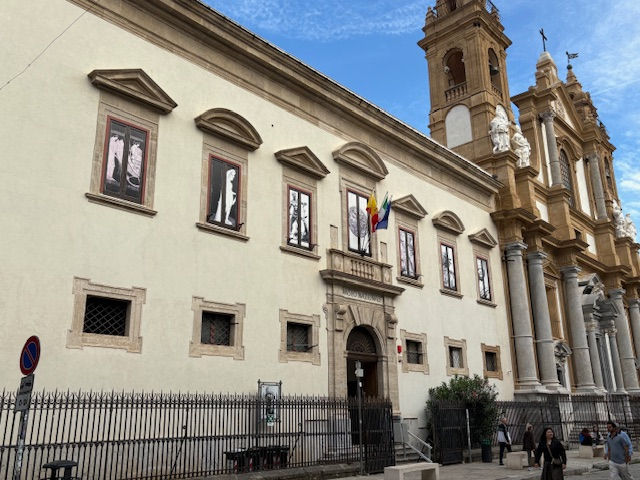
This regional contemporary art museum is housed in the historic Palazzo Belmonte Riso, an 18th-c noble palace situated along the pedestrianized Corso Vittorio Emanuele
The building was designed by the architect Giuseppe Venanzio Marvuglia,
in 1784 and is an example of late Sicilian Baroque transformed to Sicilian neoclassical style.
It became a property of the Prince of Belmonte, and in the 19th c it passed to Baron Riso.
Botero Exhibit July 24, 2026, through January 10, 2027
The Fernando Botero exhibition in Palermo, is titled Fernando Botero. Il peso dei sogni (The Weight of Dreams) at Palazzo Riso (Museo Regionale d'Arte Moderna e Contemporanea di Palermo),
12 selected works, including paintings, drawings, watercolors, and a notable bronze sculpture (Serpente) from the Fernando Botero Zea Collection and family estate. seen.

During World War II the building was damaged by Allied bombing. later restored from the mid-1990s, and since 2008 it has become a contemporary art museum.
The Colombian painter and sculptor is known for depicting people and figures in large, exaggerated volume. but using humorous grace in contrast to British Jenny Saville (here) whose depiction of large figures, is brutally blemished and exaggerated.
Piazza Bellini
The piazza is a medieval historic center in the heart of the city, near the central
Via Maqueda (16 c) and Piazza Pretoria and by some visible ruins of Punic walls,
Two important churches stand there, of Arab-Norman architecture dating back to the time of the Norman Kingdom of Sicily, illustrating the stylistic hybridization that marked Palermo in the 12th c. Both are UNESCO World Heritage Sites as part of Arab-Norman Palermo and the Cathedral Churches of Cefalù and Monreale.
And a third church from the Barque era.
1.Santa Maria dell’Ammiraglio, more commonly called “La Martorana”,
2.San Cataldo with its 4 red domes
3.Saint Catherine of Alexandria (Santa Caterina d’Alessandria), a Baroque church is set on the other side of the square . There is a recommended bakery inside this church / Monastery, known as I Segreti del Chiostro known as La Dolceria di Santa Caterina.
Church of Martorana Church of San Catald0 Church of Santa Caterina
Martorana
San Catald0

Bellini Theatre is also set on the square. Initially a 17th-c theatrical establishment known under various names, was renamed in honor of Vincenzo Bellini- an Italian opera composer in the 19th c. It is one of the oldest theaters still present in the historic center
Piazza Bellini is also a favorite spot for
opera singers who practice their operatic singing talent for free, to audience of hundreds incidental visitors that pilgrimage daily to the charming square.
Piazza Pretorio

The historic public square in the heart of Palermo, is located just a few meters from the famous Quattro Canti intersection and Bellini square.

The centerpiece of the square is a monumental 16th-c Renaissance fountain. Fontana Pretoria (also known as the Fontana della Vergogna or "Fountain of Shame")
Designed in 1554 by Florentine sculptor Francesco Camilliani,
The fountain was originally commissioned in 1554 by Francesco Camilliani for a Florentine villa, then purchased by the Senate of Palermo in 1573, shipped in hundreds of pieces to be reassembled. on site by 1581. It is carved from white Carrara marble and features concentric basins, staircases, animal heads, and prolific number of nude mythological figures, nymphs, satyrs, and river gods, for which the locals of 18th-c - either scandalized by local nuns, from the nearby convent—or, alternatively, pointed to local political extravagance and corruption, dubbed it the Fontana della Vergogna.
Town Hall

The square is enclosed by the 14th c Palazzo Pretorio -the town hall,
and the historic 16th-c Neoclassical palace baronial palaces -
Palazzo Bonocore - that houses the interactive multimedia exhibition :
"Palermo Felicissima" on the city's Belle Époque, as well as rotating art.
After changing few owners, In 1873, Salvatore Bonocore a wealthy merchant bought the palace and since 2015, the palace has sponsored a multimedia program about history and culture.
Also the historic 16th c Baroque Palazzo Bordonaro. originally built by the Di Carlo Family.
Palazzo Bordonaro. Piazza Pretorio Palazzo Bonocore
Palazzo Abatellis Museum
Walking down south the narrow streets toward the port landed us at a medieval
Palazzo Abatellis, - Museum
Palazzo Abatellis: the Galleria Regionale della Sicilia,the Gallery of Art for the Sicilian region was designed in 1490-95 for admiral Francesco Abatellis,
During the night between 16 and 17 April 1943, the palace was bombed with serious consequences. and the authorities decided to renew it and to turn the palace into a gallery of medieval art. which now houses a collection of sculptures and paintings .
Its most famous works of art are the monumental fresco "Triumph of Death" (c. 1446-49) and Antonello da Messina’s "Virgin Annunciate" (1474).
Along the Port
The Jewish Neighborhoods

The historical Jewish quarter - Giudecca or Hârat al Yahûd or Meschita neighborhood was located adjacent to the Cassaro-now Corso Vittorio Emanuele, near the ancient Porta di Ferro and part of the broader Harat al Masgid area. It was also situated near the historic Ballarò market quarter, and beyond the southern city walls along the Kemonia river, with parts overlapping areas close to the Kalsa historic quarter
Dates back to the 6th c under Pope Gregory the Great, the Jewish presence in Palermo, grew into the largest and most influential Jewish community on the island. The community thrived in trades such as: silk weaving, dyeing, medicine, and general commerce.
Palazzo Chiaramonte-Steri.

By the late 15th c, the Jewish population in Palermo reached roughly 3,000 to 5,000 people. The vibrant community thrived for centuries until 1492, when Jews under Alhambra Decree / Spanish rule of Ferdinand and Isabella, faced forced conversion, heavy taxation, trials and expulsion
Thousands of Jews were expelled or forced to flee Sicily. in 1492–1493, leaving behind a legacy largely obscured by centuries of urban change and renaming (such as the Meschita area). Inquisitorial trials and imprisonment took place at sites like Palazzo Chiaramonte-Steri.
Palazzo Marchesi

The ancient area includes landmarks like the medieval mikveh (ritual bath) found in a courtyard beneath the 15th c
Palazzo Marchesi which was the seat of the Inquisition in the 16th c.
Oratory of Santa Maria del Sabato

And the Oratory of Santa Maria del Sabato, also known as Santa Maria delle Grazie) built in 1617, was once a location of a synagogue - in the historic Meschita (Giudecca) medieval Jewish quarter, tucked into Vicolo Meschita. on Via Calderai, 72
This site. is a 17th-c Baroque building i designated now to become the city's first modern-day synagogue
Synagogue of Palermo

The space is housed within the
de-consecrated Baroque Oratory of Santa Maria del Sabato (part of the larger Chiesa di San Nicola da Tolentino complex on Via Maqueda),
Oratorio di Santa Maria del Sabato: historically sat atop or adjacent to the ruins of Palermo's ancient Great Synagogue
In 2017, following a landmark memorandum of understanding between the Municipality of Palermo, the Archdiocese of Palermo, and the Union of Italian Jewish Communities the Archdiocese of Palermo led by Archbishop Corrado Lorefice the former unused oratory in the historic Vicolo Meschita Jewish quarter, was granted on free loan to the local Jewish community, more than 500 years after the 1492/1493 expulsion of Jews from Sicily by Spanish rulers, to serve as a modern synagogue, marking a symbolic historic return to rebuild a spiritual and cultural center.
Tthe local community is (represented by the Istituto Siciliano di Studi Ebraici and supported by Shavei Israel

When entering from Calderai street/ Via lampionelli entrance to Masqueta,
trilingual street signs (in Sicilian, Hebrew, and Arabic) mark the old Giudecca, and cultural routes spanning the old Kalsa and historic center.
Archives of the expulsion decree can be found at the Archivio Comunale
Synagogue Restoration Project:
Only 50 Jews currently reside in Palermo. A formal agreement signed in late 2024 by the Municipality of Palermo (Mayor Roberto Lagalla), the Archdiocese, the Union of Italian Jewish Communities (UCEI), and the Naples Jewish Community committed the city to covering all restoration costs to transform the building into an active Jewish place of worship and cultural life.
The Palermo synagogue which was closed for years, to Jews and bolted by the oratory and slum housing, is now under restoration with the city’s blessing, and will be open to the public in Dec 2026.
More information and updates on local heritage sites can be followed through the Palermo Tourist Portal or coverage via Moked - Italian Jewish Community Portal
When we visited on site we were denied entrance to the construction site, but were lucky to run into Assoc. Prof. Luciana Pepi, who is involved in the project and welcomes any inquiries on the history of Palermo Jews/synagogue. To our amazement she was familiar with a relative of ours from Israel. who is also a prof. of Italian Jewish Communities Studies.

Associate Professor at the Università degli Studi di Palermo (University of Palermo) in the Department of Culture and Society (
Filosofia Ebraica Amedioevale
University Degli Studi Di Palermo
Tel:3496784093 luciana.pepi@unipa.it
Albergheria (Southwest quadrant)

The oldest neighborhood in Palermo, where the Phoenician founded the city, and which the Arabs knew as Seralcadi. is also where the Norman royal palace is hosted.
Despite this rich history, today’s Albergheria is one of the most run-down sections of Palermo.
The Quarter is home to:
Palermo Cathedral Ballaro Market Norman Palace

The majestic 12c Palermo Cathedral,- church of the Roman Catholic Archdiocese of Palermo, was erected in 1185 and is among the most important monuments in Sicily, also housing royal tombs,
A rooftop walk along the building's high terraces, metal catwalks, and elevated path offers 360-degree panoramic view over Palermo's terracotta rooftops

Palazzo dei Normanni - Norman Palace & Cappella Palatina
It was the seat of the Kings of Sicily. and served afterwards as the main seat of power for the subsequent rulers of Sicily. Since 1946 it has been the seat of the Sicilian Regional Assembly
The building is the oldest royal residence in Europe and is a mixture of Byzantine, Norman, and Fatimid architectural styles,

The palace contains the crown jewel - Cappella Palatina the royal chapel, the best example of the Norman–Arab–Byzantine style that prevailed in the 12th-c Sicily. where Byzantine mosaics shimmer beneath an Islamic-style wooden ceiling.
Porta Nuova

Situated right beside the Norman Palace at the edge of a major historic square Piazza Indipendenza, and marking the western entrance to the Cassaro (Via Vittorio Emanuele), Palermo's oldest street, is the majestic Gate Tower
- Porta Nuova -
Originally built in the 15th c as the Porta dell'Aquila, it was rebuilt in 1583–1584 under Viceroy Marcantonio Colonna to commemorate Holy Roman Emperor Charles V's triumphal entry into Palermo in 1535 after his conquest of Tunis.
After a fire damaged it in 1667, it was reconstructed in its current triumphal-arch style by architect Gaspare Guercio and completed in 1669
The outer facade features four colossal stone telamones (atlas figures) depicting bound, turbaned Moors. and it is crowned by a distinctive pyramid-shaped roof covered in glittering green and yellow majolica tiles

+ The famous open -air Ballarò market,-is the commercial heart of the quarter, the city's liveliest and most ancient historic market with narrow lanes filled with vendors selling everything from fresh produce to great street food, .
We found it too busy and touristic, and preferred the 2 other smaller food markets.
Castellammare (Northeast quadrant)
The quarter officially known as Castellammare o Loggia, stretches from the Quattro Canti intersection down to the old port harbor of La Cala. now a tourist marina, with historic merchant streets nice for a stroll, and a major hub for nightlife, and street food,

The area is known for Castello a Mare
an ancient fortress that guarded the entrance to the port in La Cala
Extensive remains are visible, some of which are open to the public
The fortress gave its name to the city's historical quarter of Castellammare.

The quarter is also known for the lively open air market in Piazza Caracciolo. -Vucciria marketplace ,Palermo dialect word meaning "noise," "confusion," or "uproar", echoing the rowdy shouts of
traditional vendors, with roots dating
back over 700 to 1,000 years,
Salinas Museo Archeologico Palermo
The Regional Archeological Museum Antonio Salinas also located in the historic center of Castellammare / Loggia quarter at Piazza Olivella, 1/Via Bara all'Olivella 24 . and is Sicily's oldest and most important archaeological museum,
The fountain at the entrance to the nuseum is a habitat to delightful live posing water turtles,

It is housed in the 17th-c former monastery complex of the Oratory of Saint Philip Neri (Padri Filippini) and is home to the famous Metopes of Selinunte (monumental Greek temple sculptures), the Palermo Stone (an ancient Egyptian slab bearing royal annals from the Old Kingdom), an ancient bronze Ram from Syracuse,(3rd BC) and Punic/Phoenician artifacts.
Historic shopping Arcade


Galleria delle Vittorie is also located in the historic district of La Loggia at Via Maqueda 301. Renowned for its Art Deco architecture, it was built as a commercial mall, designed by architect Paolo Bonci and inaugurated in 1935 during the Fascist era,

The five-story rationalist commercial arcade with its central courtyard, open roof, (once cover with glass) engulfed by residential building on top of it, has deteriorated over the decades, though restoration was attempted.
It has sat abandoned since the 1970s and reopened 10 years ago
The arcade was once a bustling commercial hub and has recently been revitalized to restore its former glory.
It now hosts a variety of shops, cafes, and cultural events, making it again a vibrant part of Palermo's urban landscape.
Food on Via Maqueda
Capo (Northwest quadrant):

Known as Seralcadio or Monte di Pietà,
the quarter is a lively working-class neighborhood, famous for its Baroque churches, proximity to major landmarks. and its famous 900-year-old busteling open air Arab-style street market,
Capo Market (Mercato del Capo) that offers street food. then in the other ones.
Porta Carini Enterance to Market

The Capo food market stretches from the ancient Porta Carini entrance - one of the surviving medieval gates in the city’s old fortification system, and through alleys like Via Sant'Agostino and Via Cappuccinelle. It is busy from morning until early afternoon,(roughly 7:00 AM to 2:00 PM Busiest on Saturdays.)
It is best explored on foot. and cash is heavily preferred by vendors.
It is more neighborhood-oriented and local than Ballarò market, (the larger one) featuring fresh Mediterranean seafood (swordfish, red prawns, sardines), giant produce pyramids, spices, and traditional friggitorie (fried-food stalls).
The quarter als0 feature Noble palaces along Via Volturno and Via Cavour: 19th c facades, monumental doorways and inner courtyards.
Directly opposite. Mercato del Capo, sits Porta Maqueda - a private palazzo noble residence (specifically the piano nobile or main living floor) of a 19th-c historic palacea and now boutique guesthouse, at Via Cavour, 118
Warped around the area the market leads up right at the northern edge of this quarter. to Teatro Massimo


The Neoclassical and Sicilian monumental style, Teatro Massimo Vittorio Emanuele located in the historic center (Centro Storico), facing Piazza Verdi, is dedicated to King Victor Emanuel II. It is the biggest in Italy, and is Europe's third-largest opera house, after the Palais Garnier in Paris, and the K. K. Hof-Opernhaus in Vienna
It is the city's great symbol, known for opera performances. and for its perfect acoustics.
It was designed, and overseen between 1875 and 1897 by the Italian architect Giovan Battista Filippo Basile, and completed after his death by his son, Ernesto Basile
It was originally planned to hold around 3,000 people. Following modern safety regulations and renovations, its current seating capacity is 1,381 to 1,387 seats (with official venue details noting it holds around 1,247 to 1,300+ guests depending on the specific configuration of stalls, boxes, and gallery)
It opened in 1897 with Giuseppe Verdi's Falstaff
Verdi's bust Roof can be opened Lions in the front
A female figure (Music) on a lion playing a horn, sculpted by Mario Rutelli -on the left side when facing the entrance and a figure (Tragedy) with a drama mask on a lion, sculpted by Benedetto Civiletti -on the right side when facing the entrance.

The interior of the theater is stunning.
The Foyer features grand sculptures & glistening bronze-decorated candelabras.
The Great Hall & Auditorium, red velvet armchairs, multi-tiered boxes, golden stuccoes, Murano glass elements,& the iconic symbolic wheel ceiling fresco with a rope-operated ventilation system.
Pompeian Rooms & Royal Box circular, acoustically unique Pompeian Room (known as a whisper gallery) and the ornate Royal Box that can seat about 30 people.

Visit tours inside this amazing opera house, which are offered daily is really worth while. Standard guided tours last about 40 minutes and are offered in Italian, English, French, Spanish&German Availability and direct booking on the Fondazione Teatro Massimo Guided Tours Page.
Booking & Info # +39 091 32 67
Tickets are sold also at the theater site.
The opera season would open only on Nov 22nd, and after we would already depart so we missed its opening (here) with Samson et Dalila (composed by Camille Saint-Saëns, with a French libretto written by Ferdinand Lemaire

Gelato Fest - November 13–16, 2026
Just across from the theater, in piazza Verdi and Via Maqueda, advertisements and arrangements were in the making for the traditional Gelato-Sherbet Fest.

Etna snow enticed the first Gelato .
Arab conquerors (9th–11th c) brought cane sugar and sherbet-making techniques to Sicily, using ice and snow from Mount Etna to chill fruit juices and wines, creating early sorbets and granita
The gelato festival happening in Palermo this November is the Sherbeth Festival 2026, the 18th International Artisanal Gelato Festival with closing events at the Teatro Politeama Garibaldi.
60 International Gelato Masters/ Artisans from around the globe will craft and churn fresh gelato on-site. The official competition for the best artisan gelato maker, is judged by a technical and critical jury.
Unfortunately we missed the event as we departed town on Nov 8th before it started.

Teatro Politeama Garibaldi

A short walk from Teatro Masimo on the seam-line between the historic and new town of Palermo, by Piazza Ruggero Settimo, another elegant theater Teatro Politeama - can't be missed.
The theater is the official headquarters and concert hall of the Orchestra Sinfonica Siciliana, hosting a year-round seasonal calendar of musi performances.
Piazza Ruggero Settimo commonly called Piazza Politeama

The 19th c Teatro Politeama Garibaldi is Palermo's second-most important theater after the Teatro Massimo, with approximately 950 seats
It was designed by Giuseppe Damiani Almeyda, starting in 1865, inaugurated incomplete in 1874, and officially completed for the 1891 National Exhibition, and named after Giuseppe Garibaldi in 1882

The neoclassical triumphal-arch entrance, a circular Greco-Roman design was inspired by Roman amphitheaters, and a rooftop bronze quadriga (The Triumph of Apollo and Euterpe) sculpted by Mario Rutelli accompanied by bronze horses by Benedetto Civiletti.
Since we manged to get tickets to a concert one night, we could appreciate
the Pompeian-style polychrome interior, a horseshoe-shaped hall auditorium which includes tiered boxes and elaborate gold-leaf and frescoed ceiling details. Disappointingly the ceiling is very dilapidated and in much need of refurbishing.

This central area on the seam-line between the historic and famous Teatro Massimo and Teatro Politeama, a few steps from the pedestrian area of Via Principe di Belmonte is full of clubs, cafés, restaurants and shopping streets. Though a very central location, it is far from the confusion of the historic center yet very close to the city’s main places of interest.
Via Papierreto
Located within the Capo district is Via Papireto an historic curved street runs from Via Matteo Bonello (near the Palermo Cathedral) to Piazzetta Porta Guccia
The street is named after the Papireto, one of the 2 ancient rivers (along with the Kemonia) that once flowed through and framed parts of Palermo.

One of the street's most prominent landmarks is the 1880 historic building - Palazzo Fernandez (located at Via Papireto, 22) which has served for over a century as a cultural hub and the home of the ABAPA) Accademia di Belle Arti di Palermo -Palermo Academy of Fine Arts founded in 1780
Palazzo di Giustizia (Palace of Justice) and Palazzo della Poste
Fascist Architecture

Located in Piazza Vittorio Emanuele Orlando, near the Il Capo neighborhood and the Politeama district. is the massive Palazzo di Giustizia (Palace of Justice)
a monumental example of Italian Rationalist architecture from the Fascist era, which was Designed by Ernesto Rapisardi and Gaetano Rapisardi. Constructed started in 1938 under the Fascist regime, then was halted during World War II, and resumed in the early 1950s, until finally was completed in 1957

.Like other official regime buildings of the 1930s such as Palermo's Palazzo delle Poste the structure emphasizes imonumental, symmetry, clean geometric lines, and a forbidding, austere presence, designed to project the power and order of the state.
Beyond its architectural heritage, the building is closely tied to the courageous anti-mafia trials and the work of magistrate judges like Giovanni Falcone and Paolo Borsellino , they were both killed in 1992, a few weeks apartassassinated by the Corleonesi Mafia in the Capaci bombing, on the A29 motorway near the town of Capaci.
Hotel we stayed at

We stayed in a hotel set at at the seam-line between the historic and new parts of the spread town.
Via R. Wagner 2 39 091336572. Inf0@grandhotelwagner.it
classic Art-Nouveau style from the 1900 the Neo-classical palace was later transformed and renovated into a luxury hotel.
Next to the Wagner there is also a recommended less plush but very good
Hotel Federico II central Palace
via Principe de Granatelli 60 +39 091 749 50 52, info@hotelfedericopalermo.it
Since 2003 and later renovated in 2013
Around the Hotel Area
Via Principe di Belmonte

Close to the Grand Hotel Wagner, and nestled between Teatro Massimo and Teatro Politeama is Via Principe di Belmonte a primary lively pedestrian street ,Known locally as a pleasant pedestrian island -isola pedonale, lined with outdoor cafes, bars, restaurants, and specialty shopes, and where Aparol is being sipped aall day long.
Food/Dinning
Spinnato - Antico Cafe & Chocolate from l 1860
Via Principe di Belmonte 108
Restaurants
Osteria Ballaro - V. Calascibetta, 25, +39 091 326488
Sicilian antipasti, pasta & mains, creative twist, in the former stables of medieval palace
Osteria Mercede - Cucina di Mare , Via Sammartino 1 091 33 22 43
Classic, blue-&-whitewashed eatery serving generous seafood & pasta dishes amid nautical decor.
Aja Mola - Via dei Cassari, 39, +39 091 729 6599
Quatro Venti Via Enrico Albanese, 30, +39 091 625 9187
City Sea (Chef Natale Giunta) Via Filippo Patti, 30, +39 091 685 9939
Sapori Perduti V. Principe di Belmonte, 32, +39 091 327387
Trattoria Corona. Via Guglielmo Marconi, 9 +39 091 335139
Antica Gastronomia Palumbo Via Lanciadi Brolo 177. 091 5075370
Trattoria Al Cancelletto D"Aragona Via Ottavio D"Aragona 34
Osteria al Cassareccio vucciria Via Maccherronai, 47, +39 327 622 1144
For Pizza
Il Cappero Pizza a Cucina. V. Generale Vincenzo Magliocco, 26/28,
Pizzeria Tondo – Piazza Ignazio Florio angolo via P.pe di Granatelli +39 091 328254
To Be Continued....


Comments