
Travel: Antarctica, Crossing the Drake Channel. Oct 27-28/2025
Updated: Dec 20, 2025
A continuation of a trip to Antarctica and other parts of Chile which includes posts from Oct 22nd -Nov 23rd
Santiago -10/ 23-26 (here)
Santiago Surroundings 10/24 (here)
Puerto Williams 10/26 & 11/6. (here)
Silver Wind the cruise ship we chose and which was thoughtfully refitted for polar travel in 2021, set sail, at midnight of Oct 26th, from Port Williams to Antarctica,
after all passengers were flown from Santiago and orderly boarded.
Once the the cruise ship got the "green light" for the crossing, it departed the small marina by the Beagle Channel and slowly proceeding toward the Drake Passage.

The Beagle Channel, the Straits of Magellan to the north, and the open-ocean Drake Passage to the south are the 3 navigable passages around South America, between the Pacific and Atlantic Oceans.
Ushuaia in Argentina followed by Puerto Williams in Chile. are the biggest settlements on the channel and are amongst the southernmost settlements in the world.
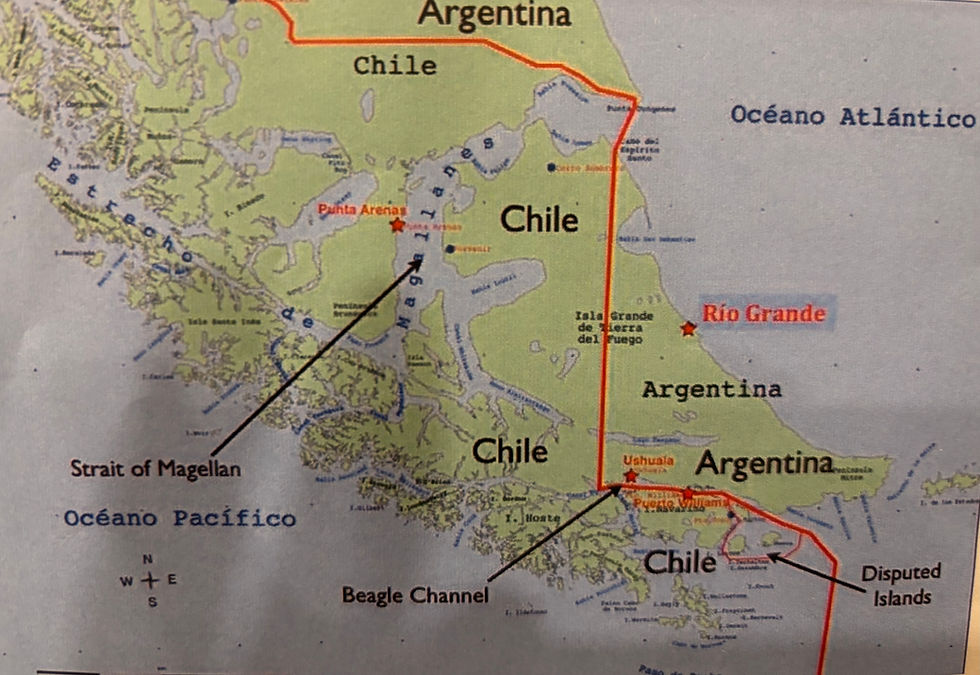
Named after the ship HMS Beagle during its first hydrographic survey of the coasts of the southern part of South America which lasted from 1826 to 1830
The channel which is 240 km long and 5km wide, stretches in the Tierra del Fuego Archipelago, on the extreme southern tip of South America between Chile and Argentina
Drake Passage - "Shake or Lake" - Storms & Earthquakes
Named after the 16th-c English explorer and privateer Sir Francis Drake.
the body of water, which stretches between Cape Horn in Chile at the southern extreme of the South American mainland, and the South Shetland Islands of Antarctica. connects the southwestern part of the Atlantic Ocean (Scotia Sea) with the southeastern part of the Pacific Ocean and extends into the Southern Ocean

The presence of the Drake Passage allows the three main ocean basins -Atlantic, Pacific and Southern- to be connected via the Antarctic Circumpolar current (ACC), the strongest most turbulent oceanic current
This flow is the only large-scale exchange occurring between the global oceans, and the Drake passage is the narrowest passage on its flow around Antarctica
The Drake Passage is considered one of the most treacherous voyages for ships to make. The Antarctic Circumpolar Current, that flows clockwise from west to east around Antarctica , meets no resistance from any landmass, and can creates waves top 12 m high.

Known for its rough waters ("Drake Shake"), where strong low-pressure systems circle Antarctica and can create huge shaking wave swells , we were hoping for a "lake" crossing.
The weather was cold , grayish, rainy at times, with wavy sea water and bad visibility. Not really a "lake" but luckily not a "shake" either.
The waves were only as high as 2- 3 m, facilitating a relatively "friendly" comfortable sail,
Considering that a 7.5 earthquake struck the Drake Passage on Aug 22/2025 generating a small tsunamis and another massive shaking of 7.8 occurred on Oct 10th, I was far from being thrilled in anticipation of this crossing
On board of Silver Wind

As was already mentioned in the previous post, Silver Wind is a small cruise ship operated by Silversea Cruises, a luxury cruise line. The ship entered service in 1995 and can accommodate 296 guests. There were only 197 of us passengers, with almost the same number of outstanding staff members, and personal butler service.
The ship's staff, especially that of the Expedition Team, were mainly from the English speaking countries : South Africa, Australia New, Zealand and UK.
Over 30 of them, comprised of Environmentalists, Geologists, Ornithologists Biologists and other scientific fields. They were most knowledgeable of their topics, and with great presentation skills. All the guides, zodiac handlers, and speakers were led by the Expedition Team's Head - Werner, who was an outstanding caring leader and most professional, as well as highly regarded both by his staff and the passengers

The staff was introduced earlier in the evening, after dinner, and after a compulsory safety drill on the ship's rules and regulations of iAATO association were shared.

The crossing's sailing time, during the first 2 days, was mainly filled up with all inclusive massive food consumption, attending lecture presentations, getting to know the amazingly service oriented staff, and waddling between the 9 ship's decks.
There were no other vessels seen during that crossing.
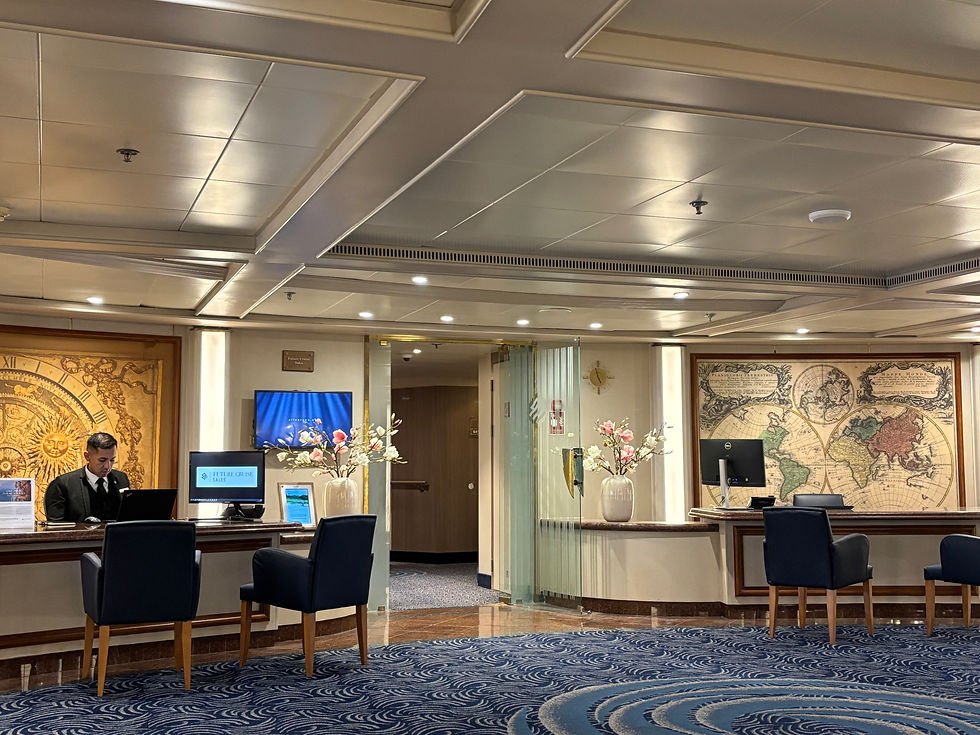
Silver Wind which was launched in 1995, lost long ago, its newness allure, but is still an elegant, comfortable and cozy vessel, which, provided great safe cruising experience..
The ship and our room accommodation were nice, but a bit outdated,
The balcony attached to the room, adds to the visibility of the exterior, though the Arctic weather, didn't make it that appealing for frequent usage
The food in the ship's 4 restaurants was amazing, masterfully presented and more than plenty. The fact that we enjoyed it, even during the crossing, as many others, tells it all.
Caviar, Foei-gra, Lobsters and Steaks are more then I can stomach on a daily basis..
One comment worth mentioning is that the cakes and desserts, I care the most about, could be improved.
Since I am not into alcohol consumption and care much less about that aspect which often is very important to other passengers, there is not much to comment on the ship's several, bars, that seemed always serving those who frequented them
The crossing was the only time during which if one was seriously intoxicated from
loads of free alcohol consumption, one didn't look suspicious as a drunk, when waddling through the rocking ship's corridors...
The ship's stuff shared that at the previous sail round the waves' swell reached 6m and non could walk straight on the ship, nor visit the dining rooms where dishes were flying...
due to motion.-sickness.
Luckily our sailing toward Antarctica was relatively smooth with a mild swell
However on the way back , the "shake" was much more vigorous with waves of 3-4m, through gusty winds of 20-30 nautical knots of a grey raining stormy weather.
Though I didn't, David did suffer of sea sickness the first night, but luckily, an anti nausea Scopolamine transdermal patch which prevents vomiting caused by motion sickness. was given to David by one of the other passenger, we befriended.
He inserted the small patch behind his ear and the miraculously it did the trick.
The butler's service especially during the crossings, but all throughout the sail was amazing, so helpful and so very much appreciated.
Antarctic's Dress Cod for the Butlers
The other passengers we had met, were from all over the world. with majority from US , UK Australia and Spanish speaking countries. We were the only Israeli on board.
Furthermore, also what made this voyage so memorable and enjoyable was encountering these special adventurous, well traveled, people we befriended, and spent some time with. So a big Thank You to:
Michael and Marita and Christen from Australia, Beatrice from Brazil, Luis and Clarisse from Mexico city, Steven and Tina as well as Corrine from London, Marlene and Sam from Toronto, Aubrey and her father from St Luise, Susan and husband from Miami Jeff and Peggy from Nevada, Dian and Jeff from Carolina Rob and Tamara from Minneapolis-St Paul,
Antarctica
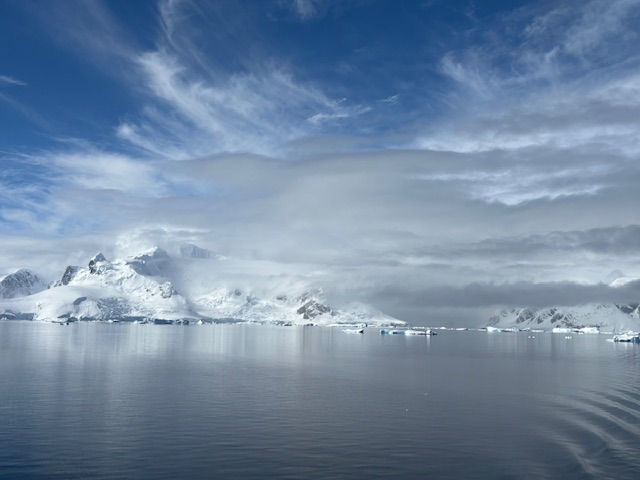
Antarctica, the seventh continent larger then Europe, is the coldest, most desolate place on Earth, The large Glacial Desert is a land of barren mountains buried beneath, with two-mile thick ice cap. large straits, channels, bays and coves filled with floating icebergs and shapeless shuttered ice pieces, between islands,
Its shores, are all battered by freezing below minus temperatures, and by week-long blizzards, of gusty winds, that frequently sweep its glaciers.
We had only a small taste of this Glacial Desert Experience

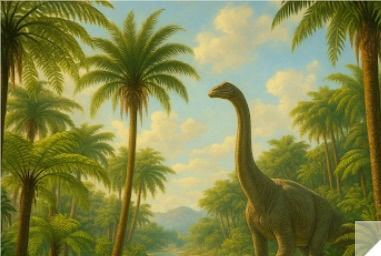
It is hard to conceive, however the South Pole was once a tropical, ice-free paradise, 100 million years ago, with average annual temperature of about 16∘C, covered in diverse rain forests and as fossil evidence shows , also.home to a variety of wildlife,
This was due to its past position as part of the super-continent Gondwana and higher atmospheric carbon dioxide levels, which created a warm greenhouse effect.
Recommended Books about Antarctica
The heroic age of Antarctic Exploration - lecture

This era in the exploration of the continent of Antarctica which included the race to the South Pole, was covered in the presentations during the crossing,
It began at the end of the 19th c and ending after the First World War; produced a massive amount of publications and stories of heroism
The Shackleton–Rowett Expedition of 1921–1922 is often cited by historians as the dividing line between the "Heroic" and "Mechanical" ages
During the Heroic Age, the Antarctic region became the focus of international efforts that resulted in intensive scientific and geographical exploration by 17 major Antarctic expeditions launched from 10 countries with the help of Dogs and sleds.
The common denominator in these heroic pioneering expeditions was the limited nature of the resources available to them before advances in transport and communication technologies which revolutionized the work of exploration.
Thus each of these expeditions became a feat of endurance that tested, and sometimes exceeded, the physical and mental limits of its personnel with some of whom did not survive the experience.
Both the geographic and magnetic South Poles were reached for the first time during the Heroic Age
To their honor and in memory of these major Polar pioneers: researchers, explorers Sealers and Hunters, the following names bear mentioned.:

Sir James Cook (1768, 1779) British Royal Navy officer, explorer, and cartographer who led three voyages of exploration to the Pacific and Southern Oceans
Fabian Gottlieb Von Bellingshausen (1880) a Russian cartographer, explorer, and naval officer of Baltic German descent,
Eduard Bransfield (1820) a British Royal Navy officer
John Davis - a US Captain, sailor and seal hunter from Connecticut,
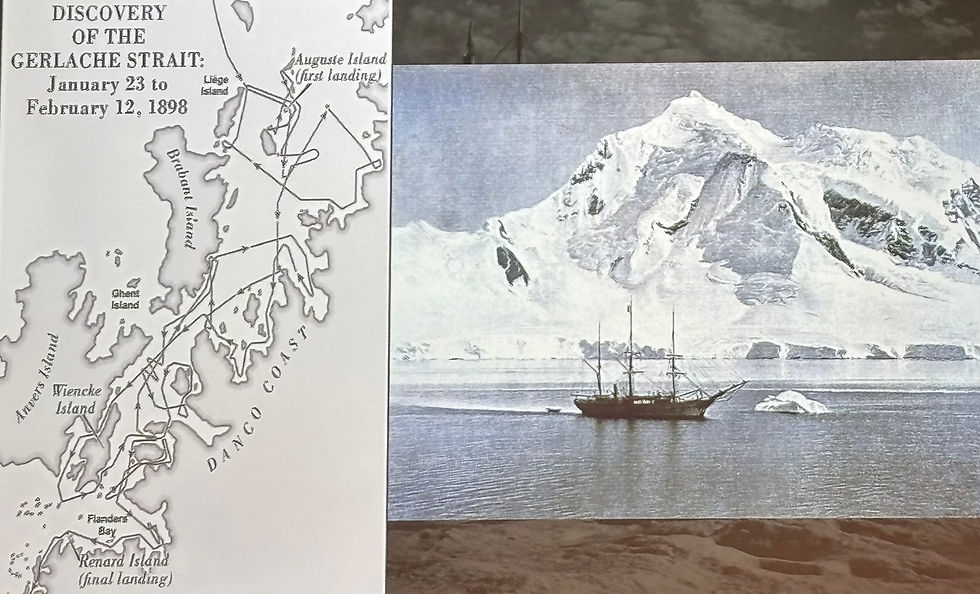
Adrien de Gerlache (1897-99 ) Belgian Royal Navy Officer who led the first Antarctic Belgian Antarctic Expedition ship – the Belgica
Ronald Amundsen (1897–1899) Norwegian polar explorer Belgian Antarctic Expedition
First to reach the South Pole and the North Pole

Frederick Cook (1897–1899) American explorer, medical doctor and ethnographer, on the Belgian Antarctic Expedition ship – the Belgica

Carsten Borchgregink. (1889-1900) Norwegian polar explorer and Antarctic pioneer traveler. The first to overwinter on the Antarctic mainland,
He inspired Sir Robert Falcon Scott, Sir Ernest Shackleton, Roald Amundsen,
Sir Robert Falcon Scott, (1901–04) British Royal Navy officer and Polar explorer
the Discovery expedition and Terra Nova expedition of 1910–13.
Sir Ernest Shackleton a British Royal Navy officer and Polar explorer led 2 expeditions the Discovery expedition of 1901–04 and the Terra Nova expedition of 1910–13
Nimrod Expedition of 1907–1909 otherwise known as the British Antarctic Expedition,
Carl Anton Larsen - Antarctic explorer and Otto Nordenskjöld - Swedish geologist and geographer. The first ever Swedish Antarctic Expedition of 1901–1903
Sir Douglas Mawson - an Australian geologist, Antarctic explorer, and academic.
the Nimrod Expedition in 1907–1909)
Women Researchers in the Antarctic
Women were excluded from Antarctic expeditions and scientific research almost up to the 1970th. That changed with the pioneering work of Dr. Lois Jones

Dr. Lois Jones (1934 – 2000)
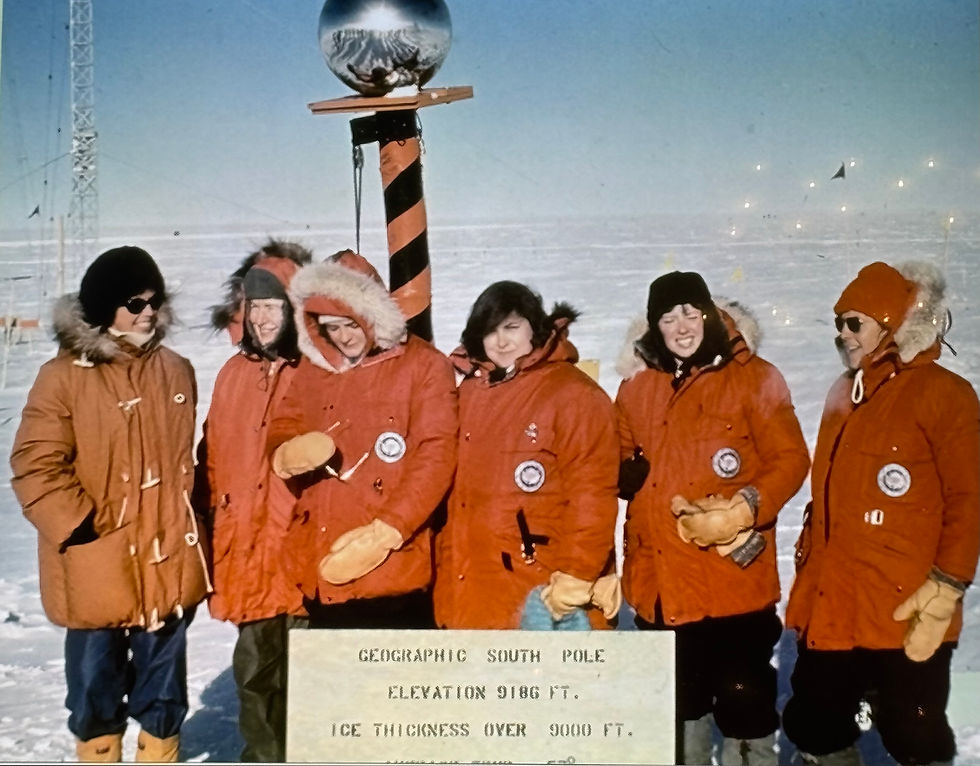
was an American geochemist who led the first all-woman science team to Antarctica with the US Antarctic Research Program in the 1969–1970 season.
They were also the first women to reach the South Pole.
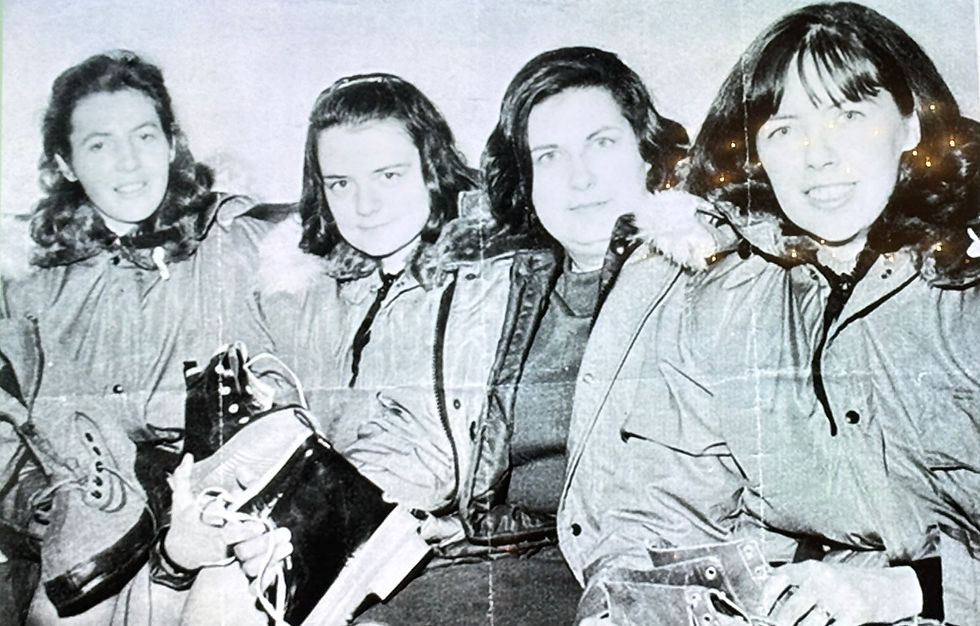
Jones was well regarded for her contribution to geological research in the McMurdo Dry Valleys, one of the few ice-free areas of Antarctica, and published many papers and abstracts.
All needed to be known about Penguins
Other fascinating presentations, given during the crossing, prior to live-encountering of these elegantly waddling, funny, flightless, semi-aquatic, sea birds, shuttered my notion of their appeal.

They live almost exclusively in the Southern Hemisphere,
Vasco da Gama - a Portuguese mariner, explorer and nobleman, was the first to report on Penguin species. A member of Vasco da Gama's crew recorded the first European sighting of penguins, specifically African penguins, near the Cape of Good Hope in 1497.
It was described : "birds as big as ducks, but they cannot fly"
The account of this sighting was included in the travel log thought to be written by Álvaro Velho, a fellow traveler on the historic voyage that established a sea route from Europe to India


Experts, agencies, and scientists recognize 18 distinct species worldwide. 7 of them lives in the Antarctic,
Ice loving polar penguins who thrive in the coldest windiest environment,
They feed primarily on small crustaceans called Antarctic Krill (small shrimp like)
Although penguins are generally known for their striking black and white tuxedoed plumage, each species, boasts its own unique traits.
Mitochondrial and nuclear DNA evidence suggests the genus split from other penguins around 38 million years ago, about 2 million years after the ancestors of the genus Aptenodytes.
We would encounter mainly the arctic "Brush Tailed Penguins"
The genus Pygoscelis ("rump-legged") contains 3 living species collectively known as "brush-tailed penguins". All have black backs, mostly black heads, and white bellies.


Adélie Penguin (Pygoscelis adeliae)
The Adelie penguins split off from the other members of the genus around 19 million years ago
Adélies are arguably the dapper of penguins. have vivid white rings around their eyes, and their waddling gait, is exaggerated by their short legs. they are a favorite prey of leopard seals. .
They nest on rocky beaches, building nests out of pebbles.

Chinstrap Penguin(Pygoscelis Antarcticus)
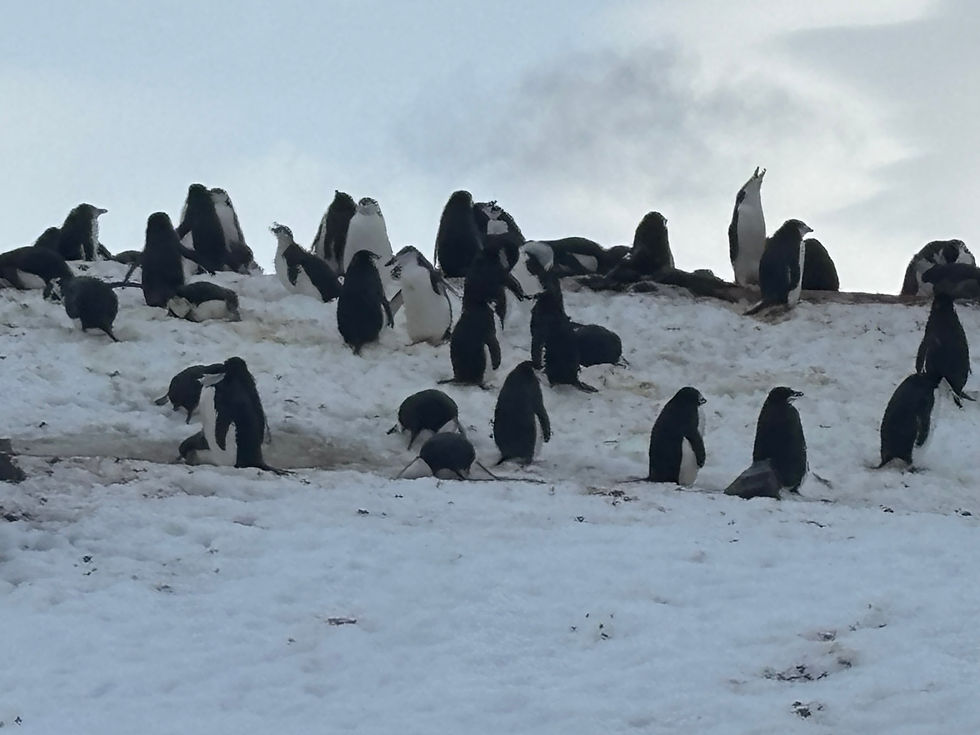
Chinstrap penguins are most commonly found on subantarctic islands, although some colonies can be found on rocky Antarctic beaches. Their key identifying feature is the distinctive black line drawn from ear to ear across its white throat under their chin,
They are agile climbers, and prefer nesting sites higher up on rocky slopes and headlands.

Gentoo Penguin(Pygoscelis papua)
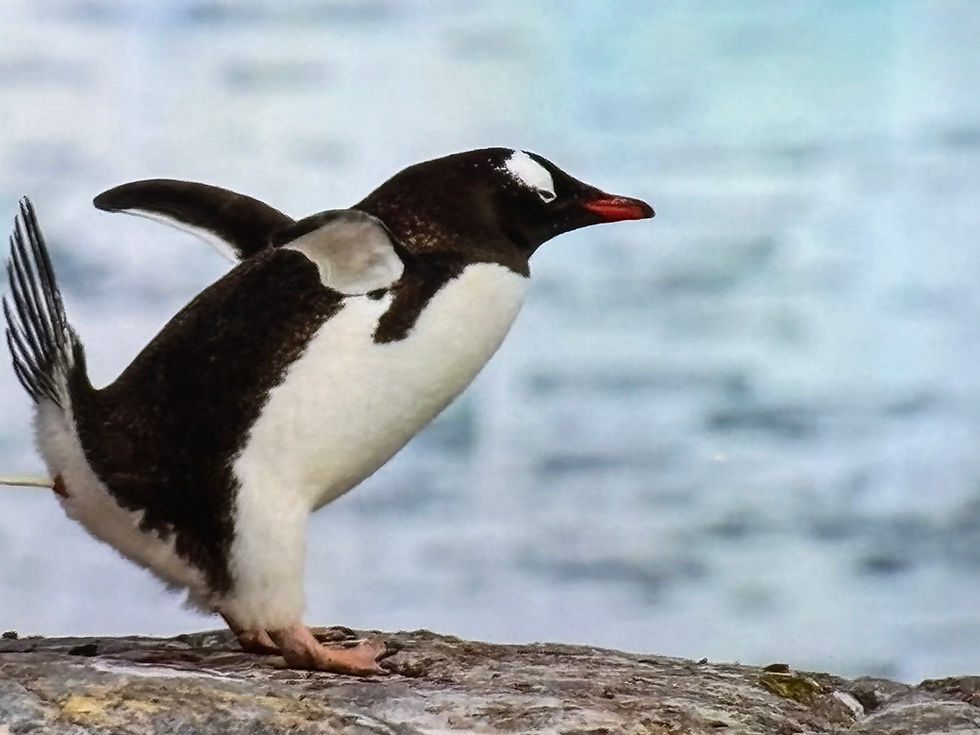
Common across the subantarctic and Antarctic Peninsula, These penguins are the fastest-swimming penguin on the planet. They are distinguished by a triangular white flash above each eye. with added color of bright orange feet and red “lips”
They are gregarious birds that do not stray far from their breeding areas, even in winter.
Gentoo nests are generally found on lower ground, closer to shore.
Penguins Projectile Defecation
Funny enough, one of the presentations
was about Penguins engagement in projectile defecation, or "poop cannons," To keep their nests clean and protect eggs/chicks from contamination and cold, they use high rectal pressure to shoot feces up to a meter or more away, a feat that earned researchers an Ig Nobel Prize in Fluid Dynamics for studying the physics involved.
This clever adaptation allows them to relieve themselves without leaving their vulnerable nests unattended during breeding season, utilizing powerful muscle contractions to launch their droppings
Encountering them at the beginning of the touring season, we saw less quantity of them however were, also sparred of the terrible stink odor their massive volume generates
First Cruise landing


This northernmost part of mainland Antarctica. is known as O'Higgins Land in Chile, and Tierra de San Martin in Argentina, and originally as Graham Land in the UK and the Palmer Peninsula in the US,
The Antarctic Peninsula is currently dotted with numerous research stations, and nations have made multiple claims of sovereignty. Disputed and overlapping claims have been made by Argentina, Chile, and the United Kingdom.
Beneath the ice sheet that covers it, the Antarctic Peninsula consists of a string of bedrock islands; separated by deep channels whose bottoms lie at depths considerably below current sea level , They are are joined by a grounded ice sheet.
The Antarctic Peninsula is 522,000 km in area and 80% ice-covered.
The marine ecosystem, has been subjected to rapid climate change. displacing over the past 50 years, the once dominant cold, dry continental Antarctic climate.
The warming has caused multi-level responses in the marine ecosystem such as increased heat transport, decreased sea ice extent and duration, and local declines in ice-dependent species
Since the relatively good weather allowed smooth sail and arrival to the South Shetland Islands (located in the Drake Passage) earlier in the day then expected, the ship's Captain gave his permission to this unplanned first landing and visit at Half Moon Island

This minor Antarctic island, in the South Shetland Islands of the Antarctic Peninsula region, is a regular stop during Antarctic cruises,
The island has been identified as an Important Bird Area a breeding colony
of south polar skuas. chinstrap penguins snowy sheathbills and seals.
The Argentine Cámara Base is located on the island

Lowering the Zodiacs from the Ship into the freezing Sea water
Getting off the ship via the exit Platform and into the Zodiac
Landing on Half Moon Island shore and climbing up the Hill
Once landing on the Island's shore, freely walking between the marked red flags, that the Expedition Team set, was safe in avoiding the danger of ice creases
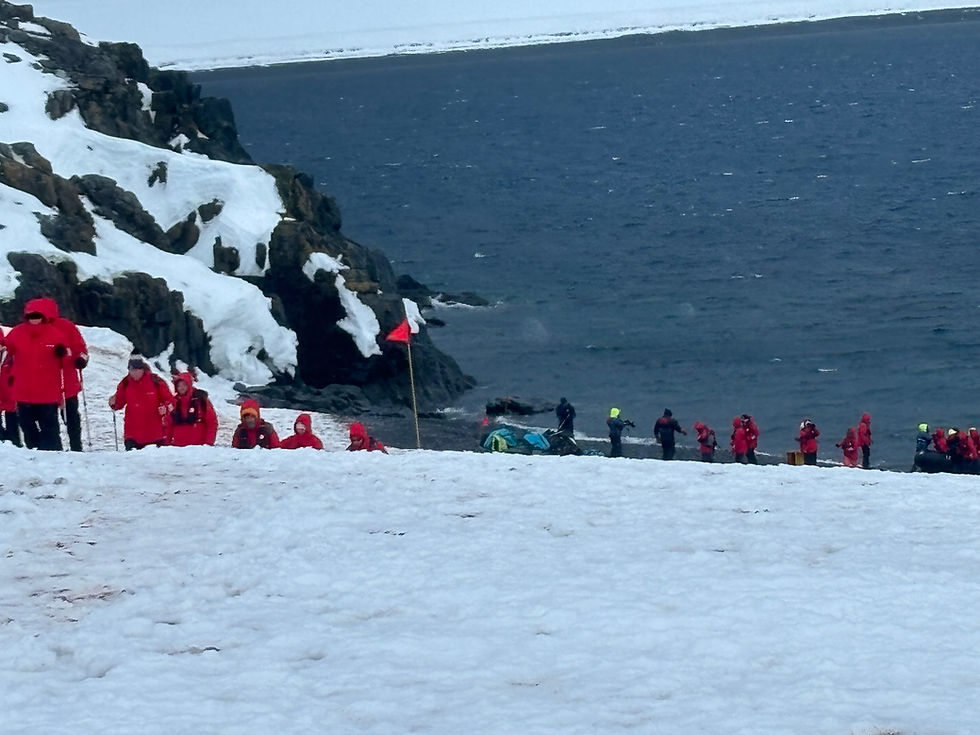
Each landing or sea excursion didn't exceed the max 75 minutes outdoors stay
It is definitely sufficient time to explore, as well as preventing turning into icicle. under these subzero temperature. which even the red protective Parca gifted by Silver sea,
should staying longer., can not safe-guard against,
As we were early in the season, and all by ourselves with no other ship seen on the glacial horizon, the scenery of capped snow mountains' peaks, the virgin white carpeted land, dotted by the dress in red passangers, aginst the grey pebbled beach and sea water, and the toxidos pinguins waddeling down the hill, was absolutely stunningly magical , as was fantastic, our much needed outdoors walking on land.


Back to the Ship
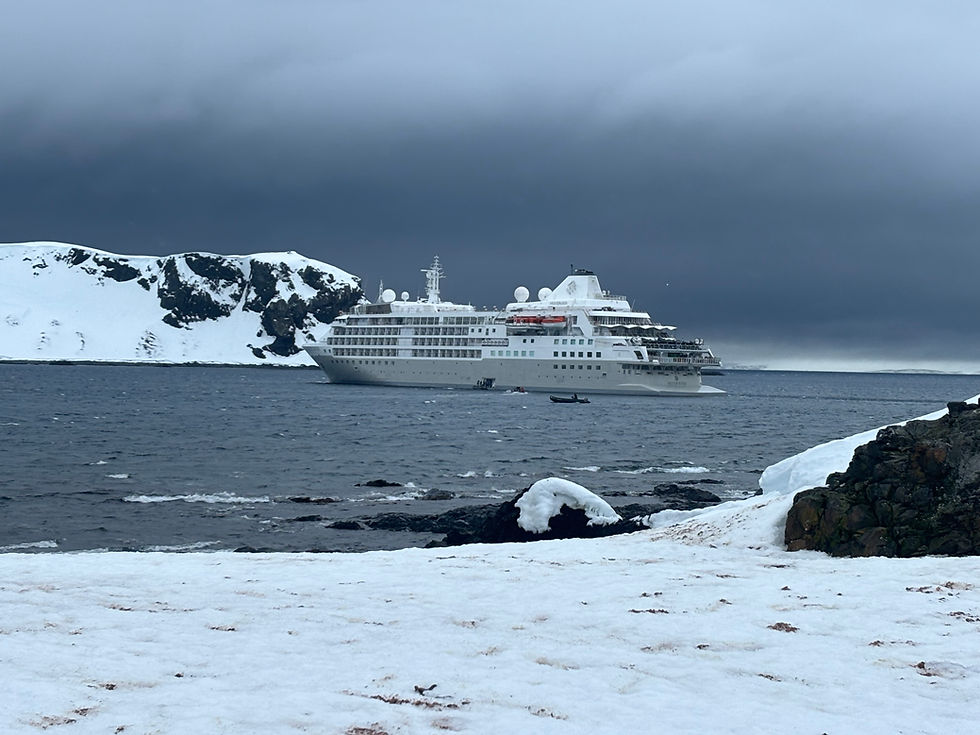

And thus, the routine of dressing up in heavy layers topped with coat Red, getting off the ship and being loaded to the zodiacs, for morning and afternoon excursions, (should the weather permits,) sailing through ice glass sea water full of icebergs and icicles, and getting on & off shores of eerie desolated glacial lands, where being greeted mainly by penguins communities, was set for all other days,
And always being greeted, by delicious hot chocolate drink whenever back from the freezing outdoors excursions, boarding the ship, was most comforting consolation

Different stop stations, surprising zodiac excursions, encountering wild life and other unexpected twists and turns.. will be further reported...
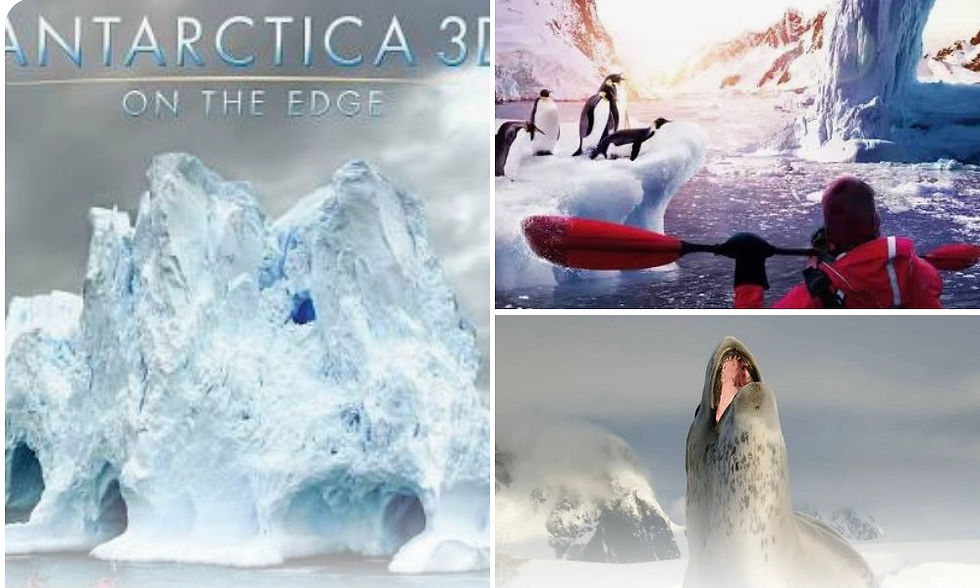
Gary, an acquaintance of mine with whom I have shared my passion for movies and annual attendance to the Palm Springs International Film Festival, was in his past the Executive Producer on the first digital 3D film ever shot in Antarctica, On the Edge
Antarctica 3D : On the Edge. - Trailer . The film was licensed to NBC Universal
To be Continued...


Comments