
Travel:I-Art Biannale 61. Venice, Italy. "In Minor Keys"🎼 . Giardini Oct.10-14/2026
Updated: 2 days ago

David and I boarded a flight to Italy. a day after marking the 3rd year's anniversary commemoration of the 10/ 7th/2023 horrific butchery of Israelis by Hamas murderers, and only one week after another jihadist terrorist, an Omani co-pilot, who underwent a process of radicalization in Syria, luckily failed an attempt to hijack and crush (Sept 30th) a passenger plane, while aboard a Flydubai Flight FZ1073, from Dubai to TL-Aviv ending in a miraculous safe landing...
Remembering Oct 7th

About 3000 Hams terrorists invaded 28 border communities & 11 army bases.
1,200 civilians Israeli and other nationalities and soldiers were killed in their homes, communities and in confronting Hamas terrorists
Hamas murdered women, babies, the elderly rescue teams and civilian fighters.
.

How ludicrous is the blunt lie that tiny Jewish Israel of only 10 million, is a threat to the vast surrounding Muslim sphere of almost 400 Million, the majority of which is bent on erasing it from the Middle east map ??
Oct 7th was the biggest barbaric savagery in history against Israel, The slaughtering, burning, and raping Israeli citizens, young and old, accompanied was done with sadistic gleefulness and by uploading the massacres' footage in real time while in action.
251 were kidnapped to Gaza of which only 168 returned alive, some after almost 2 years in starvation captivity.
344 Murdered, mostly young Israelis at the Nova music festival, by Gaza border..
457 Soldiers and Security forces killed in action and 3031 wounded
31,500 rockets, missiles , drones and projectiles launched from Gaza
232,500 citizens evacuated and internally displaced
300,367 Reservist reported to duty within the first 48 hours of the terror attack.
Gaza paid a very heavy price with about 70,000 lost lives (not yet entirely confirmed) and a major destruction to its territory..
Agent of Chaos

Both atrocious events against Israel were executed during the Jewish Holiday of Sukkot . The blame, lays on the shoulders of not only the monstrous jihadists, majorly culpable, but also is pinned onto failed Israeli Defense & Intelligence services, under the leadership of inept Israeli Gov. and the mastermind behind the warped conception, that "Calmness on the Border" allegedly can be bought by funneling Qatar's bribe funds, to Hamas terrorists Thus the disastrous results to these mega national security botches, made the state head fully responsible, yet he has been the only one nor to resign, up to date.
The upcoming Israeli crucial elections due on 10/27, raises hope for healing & change.
Flying Out from the San Francisco Area
The attraction of a visit to Venice helped us to overcome the fear of flying


As we landed late on Oct 9th, we stayed for 1 night, at a very reasonable hotel near the Venice airport
Via Enrico 26 Maroin VE + 39 041 596 2301. Palace@antonypalace.il

Ever since its foundation in 1895, the Art Biannale in Venice has been one of the most prestigious cultural institutions in the world, in the avant-garde, promoting new artistic trends and organizing international contemporary art events, in accordance with Immersive and Intellectual multi-disciplinary experiences.
This is my second visit to the Bianale. The first was in 2022
This visit is not in an organize guided group setting, but a private one.
The 61st International Art Exhibition of the Venice Biennale (05/09 - 11/22- 2026)
+39 041 5218828 promozione@labiennale.org

Art on display across the traditional settings of the Giardini and the Arsenale, at the Castello District, as well as various locations throughout Venice.
100 countries and 110 artists participate at the central international exhibition across all national pavilions, alongside 31 collateral events, and external venues, featuring a record-high African presence and 7 first-time national participants : Nauru, Guinea, Equatorial Guinea, Somalia, Sierra Leone and Vietnam

How to get to the Main Central Locations
From Piazzale Roma (bus station) and Ferrovia (train station):to
Giardini: Actv lines 1, 2, 4.1, and 5.1 (line 6 from Piazzale Roma only)
Arsenale: Actv lines 1 and 4.1
In Minor Keys 🎼
"In Minor Keys," the title of this year's Biennale was conceived by the late curator Koyo Kouoh. Her title's intention wass to shift away from loud spectacle and fast consumption, and instead to highlight subtlety, healing, and beauty. Focusing on works of subtraction, intimate acoustic/aural spaces, and restorative oases, meant to resemble studies, courtyards, and communal gathering spaces conducive that evoke the idea of quiet oases and distinct rich ecosystems where the dignity of all living beings is safeguarded. and which facilitate resilient communities in times of tragedy, rather than overwhelming encyclopedic displays.
visitors are encourage to slow down and tune into sensory experience, memory, and intimate human connection, rather than dominant, fast-paced global narratives.
All this to be achieved by featuring a distinct reduction in human figuration, and moving toward fluid identity, inclusiveness and universality with focus on mending fractures between humans, nature, and living ecosystems.
The "zeitgeist " - spirit of time - is focused on correction of historical transgressions, during which Third world countries - The Global South, were banned from world's stage. Slavery, colonialism and abusing of nature are engraved in the collective memory of the recent years. Now those countries have come back on the world stage sounding their voices, and leaving their distinct mark in art.
The main Narratives include:
Foreigners Everywhere giving a voice to the Global South countries and artists from the Third World who immigrated to the West where nationalism is decomposing, and Trans nationalism is on the rise, but still those artists represent their homelands cultures. through a dichotomy between the Global South and North in the post colonialism era., and with a clear blur between art and craft.

YET, with the passing of times, the Politicization of the Biennale has only become noisier and uglier. despite of the refusal efforts of President of the Bianale - Pietrangelo Buttafuco - to surrender to politicization.
There are hardly any representation of European artists, whose voices has been. deliberately silenced during this "zeitgeist " regardless of their art's magnificent and meaningful quality.
A disproportionate voice has been given in this year's Biannale to the Palestinians.

The undeniable terrible suffering of this group, has in large part, been inflicted upon the people, by their own culpable inept or radicalized leadership, but, also it has been propelled by a tainted national culture, committed more to the destruction of another nation, rather than to building a functional state, of its own, side by side.
Furthermore, this has definitely not been, the sole suffering tragedy, among groups around the world, all deserving as much justified attention in sounding their voices.
There are approximately 130 active armed conflicts occurring around the world today, with 60 countries currently caught up in these wars. according to data from the International Committee of the Red Cross
In early May 2026, pro-Palestinian groups led by the" Art Not Genocide Alliance "(ANGA) staged massive protests and a 24-hour strike at the Biennale.
Demonstrators blocked the Israeli pavilion demanding its closure, and thousands marched through Venice accusing organizers of "art-washing genocide".
Roughly a dozen to two dozen national pavilions closed fully or partially in solidarity.

Discriminatory elimination or hushing voices of other oppressed, persecuted & murdered groups, from around the world, as well as a void in protesting against false dehumanizing narratives, as well as deliberate silencing the voice of terrorized Jews, is not human, nor such practice sounds a “minor key" tonality, It only echoes absence of deep
"harmonic blend" and lack of empathy.
In fact, it sounds an intentional jarring cacophony in major hypocracy key accord,
a loud, harsh unsettling societal transgression, of pure antisemitic tonality.
Furthermore , it was reported that the Biennale faced "intense geopolitical debate and unprecedented chaos as Russia’s participation sparked boycotts, jury resignations and funding cuts amid global political tension. Lithuanian, Latvian, and Estonian Pavilions Staged Pro-Ukraine Procession During Venice Biennale. (Major Protests)

And last, strangely this Biennale has been inflicted with unusual several Morbid cases of artists' Deaths.
In addition to the chief artistic curator - Koyo Kouoh, who passed away on 05/10/ 2025 at age 57 , German artist Henrike Naumann, chosen to represent Germany died at age 41 on 02/14, 2026,
.
The Bianale Curator - Koyo Kouoh (1967–2025)
The prominent Cameroonian (born)-Swiss Art Curator and the Executive Director of the Zeitz Museum of Contemporary Art Africa (Zeitz MOCAA) in Cape Town. (2019) was named in 12/ 2024, the artistic director for the 61st Venice Biennale set for 2026, She made history as the first African woman to curate the main exhibition, before her untimely passing,. and before she knew she was suffering of cancer
Koyo died suddenly at age 57 from a very recent and rapid cancer diagnosis.
Her husband, Philippe Mall, confirmed that she passed away at a hospital in Basel, Switzerland, shortly after learning of her illness.
Her death came as a profound shock to the international art community, arriving just months after she was named the artistic director for the 2026 and only days before she was scheduled to publicly announce the exhibition's theme.
Raised in Cameroon and later Switzerland. as an adult, she moved to Dakar, Senegal, to build an art career, working as an independent curator and founding an artist's residency and exhibition space. She Believed that art opens up and influence social and political consciousness/awareness. A cultural activist giving a voice to those in the social margins, she was annually named from 2014 to 2022, as one of the 100 most influential people in the contemporary art world by ArtReview.

Naming the Exhibit - "In Minor Keys" intended to bring voices from the far & silenced countries of the global south, Also taking a pause, listening, taking- in, and internalizing the art on display.
Such internal processes echoes African practices of "Pole Pole" - Go Slow, which has became also a trends in the West in the form of "Slow City" - with no cars , no screens, no fast food..
Yet, there is nothing quiet nor calm in the 2026 "Minor keys" experience, of this extremely politicized, crowded and noisy exhibit spaces, that have been over-flowing with simmering activists, dense art pieces ,and never ending stream of visitors.
Furthermore, the conceptional presence of vocal art diplomacy and fractured cultural- political representation as are displayed in the art, or shifting History & Memories of lost homelands, movements and immigration, are only conceptual burdens not associated with tranquility, nor such conceptual content evoke peace of mind.
At the GIARDINI

The Giardini is the traditional site created at the beginning of the 19th c when Napoleon decreed that Venice should be furnished with public gardens on the Parisian model. In the Castello district he had churches, monasteries and a hospital demolished and replaced with a public garden. At the end of the 19th c the Giardini became the stage for the new International Art Exhibition: the Biennale opened in 1895,
The first national pavilion followed in 1907 with Belgium, and other nations followed suit. Today 30 national pavilions stand in the Giardini – each owned by its country and operated at its own expense. (Map)
Entrance Area of the GiardiniI

Just outside the Giardini's main gates, installed inside the Biglietteria Scarpa which was designed in 1952 by architect Carlo Scarpa, the disused ticket booth features a nautical-themed canvas, boat-shaped roof on wooden columns over low concrete walls,
Th artist collective "fierce pussy" displayed "we are here" (2026),
a deconstructed Palestinian flag made of cut-out red, black, green, and white fabric.
How ridiculous and ignorant it is that the "fierce pussy group of lesbian artists" is entrenched in standing by and supporting an intolerant Palestinian culture that its people habitually abhors/ persecutes queers and majorly supports terrorism..
Past the entrance gates the newly renovated Central Pavilion, facade features a major site-specific installation by Nigerian-Belgian artist Otobong Nkanga

Otobong Nkanga, (b. 1974)
the Nigerian-born visual artist, tapestry maker and performance artist, based in Antwerp, Belgium, rapped the pavilion's front four white Modernist columns with hand made Venetian bricks, with glass terrariums, clay flower pots, and wooden bee hotels.
The flowerpots made of African pumpkins are an homage to the silenced political voices, and taking over of nature resources.
Two distinct artwork displays in front of the central pavilion entrance
Central Sculpture - a Traveling Deer sculpture
Orogami Deer installation - work by Zhanna Kadyrova for the Pavilion of Ukraine.


Ukraine doesn't have a national dedicated permanent, Ukraine Pavilion building in the Venice Biennale Giardini. Instead, its national exhibitions are hosted in temporary spaces or set up rented venues (such as the Arsenale) each year.
Ukraine first began participating with official national presentations in 2001/2003,
Even during Russia’s invasion, Ukraine continues to protect its culture, support its artists, and speak to the world through contemporary art.
This year the exhibit "Security Guarantees" is split across two locations.
At the Arsenale - materials and video documentation archival are housed.
In the Giardini - the Origami shaped Deer - a cement sculpture which was evacuated from a park in Ukrain because of the war. it was installed by Zhanna Kadyrova - (b. 1981)
as part of this year's highly charged geopolitical showcases.
The Ukrainian born artist working in sculpture,installation, and public art. is representing Ukraine with her project titled "Security Guarantees". It had focused on the 1994 Budapest Memorandum and nuclear disarmament

The Deer is displayed on a truck-mounted crane. Like many people left hanging and displaced in life, due to the war, the Deer is dedicated to drawing world attention to the despair in which the country has been.
Solidarity actions and supportive processions took place during the opening previews of the 2026 Venice Biennale, most notably a dedicated solidarity march organized by the Baltic pavilions (Lithuania, Latvia, and Estonia) in support of Ukraine
Large Outdoor Bronze Sculpture
The Outdoor large monumental bronze sculpture is placed on display right outside the entrance area of the Central Pavilion.
The sculpture is part of his larger multimedia installation titled "On How I Became Witchcraft: A Survey of Colonial Libraries, 2026" featured in the main international group.
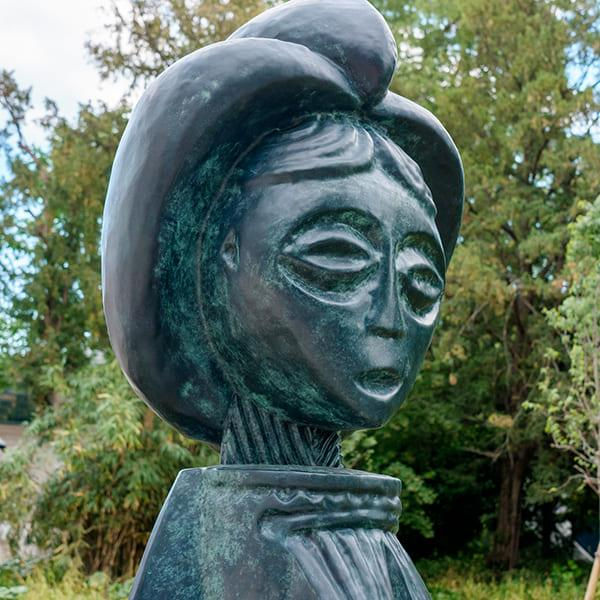
Sammy Baloji (b. 1978 in Congo)
Lives in Brussels, Belgium, and Lubumbashi
A Survey of Colonial Libraries, Multimedia installation: Baloji presents 3 bronze sculptures and sixteen framed collage prints. highlighting the Western after lives of colonialism which robbed Congo of its natural resources and minerals ,(uranium) ,
It is modeled after an item originally held in a Renaissance "cabinet of curiosities" and features sharp geometric inclusions resembling uranium crystal structures
Inside the Central Pavilion are the remaining two bronze companion sculptures and his 16 accompanying collage prints displayed within the galleries
At the Giardini - The General Exhibit - Main Central Hall - Highlights
The main exhibition at the Giardini, is showcased in the Central Pavilion (Padiglione Centrale). The white building (designed by architect Carlis Carpa) reopened in March 2026 following a major 16-months architectural restoration. financed by Italy. and resulting in a monumental octagonal entrance hall and flexible, modernized gallery spaces. It intends to feature multi-sensory "oases" from diverse geographies and generations. focusing on intimacy, memory, and introspection, rather than on spectacle.
It highlights works by 110 international participants, including installations by:
Central Exhibit Hall

Ebony G. Patterson (b. 1981)

The Jamaican-born and US residing visual artist and educator. as well as a designer of costumes for cultural parades in new Orleans, is known for her large and colorful tapestries created out of various materials such as, glitter, sequins, fabric, toys, beads, faux flowers, jewelry, and other embellishments.
As the third World often is the garbage dump of the world , the recycled material is a match to the tropical forest, full of camouflaged presences, also symbolizing wealth.

A prominent display which incorporates layered textiles with numerous stuffed red gloves, immersive sculptures and installations mean to symbolize both natural abundance and the waste (poverty) left behind by modern consumer culture.The red gloves brings into light surrealist dualistic Traibal traditions on memory and facts
Issa Samb (1945–2017)

Born in Dakar, Senegal African Samb occupies a singular position within contemporary African art as a painter, sculptor, performance artist, playwright, and poet.
Drawings, paintings, objects, and video documentation is utilized
Beverly Buchanan (1940–2015)

Beverly Buchanan an American artist known for her multidisciplinary practice encompassing sculpture, painting, drawing, photography, and land art. Her work explored themes of memory, place, and identity through the lens of Black Southern communities and landscape
Her iconic 'shack' sculptures and environmental interventions. often address issues of social and economic adversity with a focus on impermanence and resilience.
Her legacy continues to gain significant posthumous attention, with the notable inclusion of her work in the 2026 Biannale .She is one of two artists, alongside Issa Samb, to be honored with a dedicated "shrine" in the Central Pavilion.

Seyni Awa Camara (1945-1926)
( Senegal)
Late Senegalese terracotta surrealist sculptor is featured posthumously in the central exhibition hall
Tribal fertility goddess creatures under the main dome

Celia Vasquez Yui (b. 1960)
The Peruvian Amazonian artist who created "The Council of the Mother Spirits of the Animals" assembled a ceramic Animal Parliament highlighting ecological disruption

The artist, is Indigenous rights activist, and political representative of the Shipibo-Conibo People of Peru
70 zoomorphic sculptures Installation: coil-built pre-fire slip-painted clay, vegetal resins
Animal of distinction the harm of mankind to nature. Concept of Animism a cultural belief that every cosmological living thing and object has an Anima soul requiring respect and preservation.

Behind the Animal parliament
"Anatomy of the Magnolia Tree for Koyo Kouoh and Toni Morrison "
The couple born in Cuba. and Philadelphia and reside in Nashville, USA
created a monument in floral form, painting and sculpture of Magnolia flowers
8 tall panels hold portraits of Toni Morrison, (1931-2019) the first Black woman to win the Nobel Prize in literature, and Kouoh, the first African woman to curate the Biennale
7 sculptures in resin and glass express forms of the magnolia, the iconic flower of the American South., a tree associated with the Afro American slavery a homage and in solidarity to the black women .

Further at the Central Exhibit
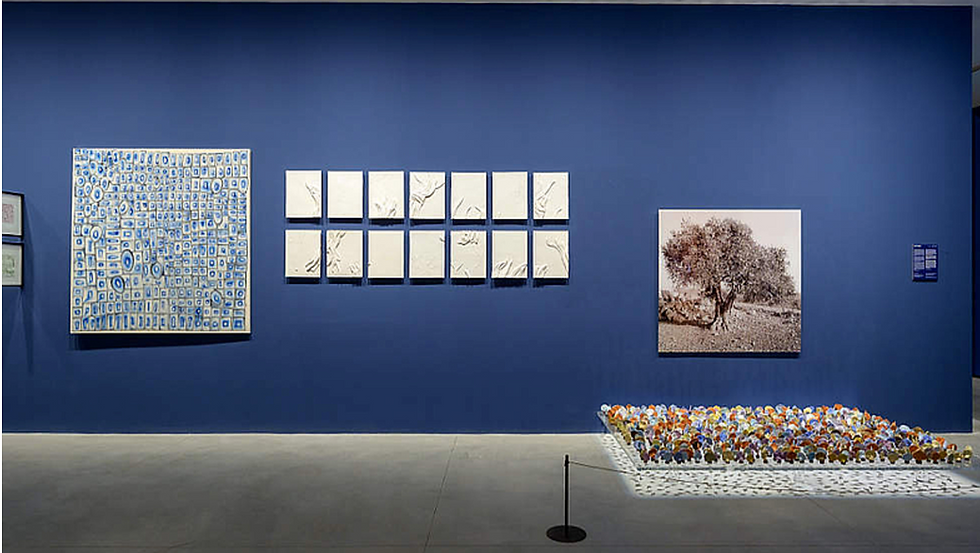
Vera Tamari (b.1945)
The Palestinian from Ramama created small clay relief sculptures,
small sculptures of Olive Tree that were uprooted in the West Bank associated with the land and uprooting .
Wangechi Mutu features in both the Giardini and the Arsenale .
Her multi-part presentation spans both primary locations of the international exhibition

Wangechi Mutu (b.1072)
The Nairobi Kenyan artist presents in the installation named " The End, Where All began, EdEN" a cosmological assumable that re-images Black Adam and Eve homage to the African Garden of Eden. inspired by the origin story of her ancestral people and filtered through an eco-feminist, African diasporic lens. Mutu’s hybrid creatures and ecologies, and her female-focused creation mythology, are acts of African, feminist resistance and restoration.
SimbiSiren (in Arsenale)
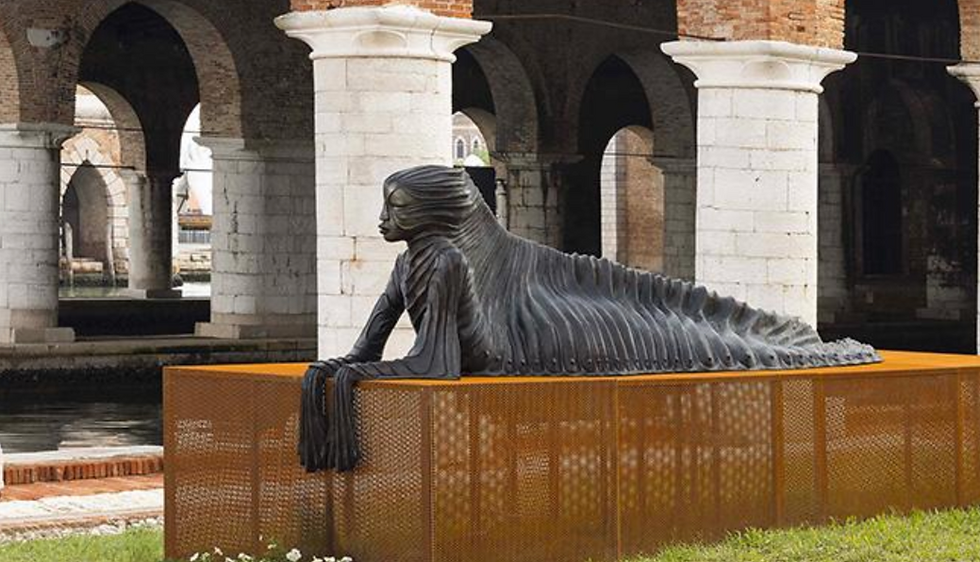
Bronze sculpture iteration of aquatic creatures fusing woman, animal and supernatural
Few other picks at the Central Exhibit that Captured my Attention

At the National Pavilions
30 Nations own their pavilion buildings are housed in the Giardini (list)
The standout national pavilions include Austria, Belgium, Great Britain, Japan, and the Bahamas (outside the Giardini) which have earned critical acclaim for their bold scale and immersive storytelling, Florentina Holzinger and Miet Warlop transformed the Austrian and Belgian pavilions into immersive spectacles of endurance, ecological dread, and controlled collapse.
Austrian Pavilion

Although designs for the pavilion date from 1913, the pavilion officially opened in 1934 .It was designed by architects Josef Hoffmann and Robert Kramreiter. a clear, symmetrical building that introduced a simple "white cube" concept for displaying art, later restored and updated in 1984 by architect Hans Hollein.

Florentina Holzinger, (b.1986)
The Austrian choreographer and performance artist presents in SEAWORLD VENICE an interdisciplinary live installation and performance project curated by Nora-Swantje Almes. The provocative art challenges sociology-political conventions with the human body immersed in water, as a political and ecological symbol, to highlight how nature and technology collide in a changing world.
The performers display which combines extreme physicality with theatrical precision features Live nude of the performers (naked women) swimming in rising purified urinal water inside an aquarium tank, next to Chemical Restroom from which the purified water recycled back to the aquarium.
Also the church bell, and jet ski on display represent ecological impacts of mass tourism, with robot dogs moving behind glass walls, all probe the limits of corporeal endurance and moments of extremity.

From a crane the performer a naked women climbing down on a rope off a tower bell and her body is used a clapper inside the bell which may echo San Marco clock bell tower, relaying the influence of oppressive religious meaning in Europe. and deterioration of civilization in ecology.
The communicated messages of corporal suffering and attack on the body corresponds with Neo- Actionism. Viennese Actionism (German: Wiener Aktionismus ) was a short-lived art movement related to issues of performance art, in the 20th-c that spanned the 1960s into the 1970s and may have been anti religious derived
The provoking elements on climate collapse and bodily excess, create consciousness trigger discussions while drawing massive crowds and multi-hour lines. .
Belgian Pavilion
Belgian Pavilion

Built in 1907 the pavilion holds the distinction of being the very first foreign national pavilion constructed on the Giardini Biennale grounds.
It was designed by Belgian architect Léon Sneyers in an Art Nouveau style, subsequent architectural expansions and restorations the pavilion underwent in 1930 and 1948

The pavilion features"IT NEVER SSST" by Miet Warlop- (1978) a Belgian visual artist and curator Caroline Dumalin
The artist transformed the Belgian pavilion into something between a construction site and a sports arena, with bleachers lined with plaster tiles etched with multilingual greetings and fragments of speech
It is a living, musical sculpture and exhibition-performance that turns the pavilion into a high-energy arena for physical and ritualistic action. explores human connection, communication limits, and the relentless rhythm of contemporary life
Performers pass around plaster tiles inscribed with words in various languages, sometimes breaking them or playing the space like an instrument amidst blaring music and drumming
UK Pavilion

Built and opened in 1909. the original site, an older building was previously a restaurant built in 1887. which was converted by Edwin Alfred Rickards into a pavilion featuring an 18th-c Italianate and neo-classical aesthetic. country house from the Empire colonial days The British Council has managed the pavilion and its exhibitions since 1937

The major solo exhibition titled "Predicting History: Testing Translation". is featured by a Black artist -Lubaina Himid (1954) born in Zanzibar.
also a curator who resides in UK
She is Professor of Contemporary Art at the University of Central Lancashire. UK , and was among the first artists to take part in the Black Art movement in the UK during the 1980.
Her art consists of large-scale, brightly painted rooms filled with colorful figurative works depicting everyday figures like tailors, chefs, gardeners, architects, and boat-builders
The vibrant, multi-panel paintings, that meditate on migration and overlooked histories. are layered with sonic landscapes, East African kanga-inspired textiles and found objects are integrated throughout the space


Artworks of painted text and cloth stenciled with philosophical or striking questions, askes:
"Can flies settle here?",
"Can poison taste delicious?", and
"Is water always useful?"
Himid's art concentrates on themes of cultural history , belonging and the reclamation of identities
Who is the author of the written history?

An audio piece burbles through the space with the sound of bucolic country life: seagulls, rigging slapping on masts, bird calls and buzzing flies. How lovely Great Britain is, how welcoming and kind and accepting ???
Yet, History of those in powerful position is different story from the weak, power less and oppressed. The artist monumental paintings are an homage to history told by the workers and silenced voices through food, clothing and daily mundane life's tasks..
Japan Pavilion

A modern architecture the pavilion was built by Takamasa Yoshizaka, a student of the french-Swiss Le Corbusier between 1955 and 1956 and completed in 1956. It is an innovative building that combines international style with Japanese features and it has a display space, under its structure that is used

The interactive, participatory installation titled "Grass Babies, Moon Babies" by artist Ei Arakawa-Nash. transforms the Japan Pavilion into an environment shaped through touch, movement, and temporarily shared care giving responsibility.


Ei Arakawa - (b. 1977) Fukushima, Japan. Gay Japanese American performance artist is based in Los Angeles and has recently fathered twins with his partner.
Sensitized to Japan's negative attitude toward gays and children, the decline in birth and marriages and the time consuming of child rearing, and care giving, he was inspired to created ceramic heavy dolls on display to be interactively taken care of, by changing diapers, feeding and be played with.
The parenthood experience focused on the interactive immersion, quickly accumulates emotional and symbolic weight in an uncertain world facing war and declining birth rates.

Visitors are invited to pick up and carry one of 208 lifelike ceramic baby dolls (many heavy wearing sunglasses) throughout the pavilion's interior, pilotis, and gardens, turning temporary strangers into caretakers.
People developed special affiliation to the dolls mindful about a safe environment for them.
The space features hanging baby bottles, dolls posed on scaffolding or climbing ropes, , strollers and QR codes linked to historical dates that blend personal memory with social reflection.


German Pavilion
The Pavilion was originally built in 1909 by Architect Daniele Donghi designed as neoclassical Bavarian structure, proportioned entirely to a human scale, and intended to look welcoming and traditional

The building was officially renamed to the German Pavilion in 1912, and in 1938 Architect Ernst Haiger tore down and rebuilt the structure to reflect fascist architecture.
The aesthetic demands of the Nazi government redesigned a monumental facade and expanded structure which remain the basis of the building today
He added an intimidating, high-ceilinged stone facade with massive columns and the stark carved inscription "GERMANIA" over the entrance portico
This redesign intentionally shifted the architecture from a human scale to a monumental scale meant to dwarf and intimidate visitors.

The German pavilion this year is dedicated to the issue of immigration. Several walls inside the building were removed to create a more open space, a symbol of an open country.
The removed walls will be rebuilt at the end of the exhibition, and the dismanteled bricks inside the pavilion are being used in the current exhibit as benches by the viewers.
The 2026 "Ruin" exhibition is the work of Two Artists:
Sung Tieu (1987) Born Vietnam, and moved in 1992 to what was by then the formerly socialist East German region. .She.lives and works in Berlin
Henrike Naumann ((1984 – 2026) born in Zwickau (GDR)
She was a German installation artist. who lived and worked in Berlin. the granddaughter of artist Karl Heinz Jakob, She became known for her furniture installations, often made from wall units from the 1990s
The fascistic vision of the pavilion taunted by Mussolini and Hitler, has been shuttered throughout the years by previous participating artists soul searching about the past
Curated by Kathleen Reinhardt, this year the exhibition explores political history, state control, and the physical and social remnants of a divided Germany
It highlights the illusory reunification between East and west Germany of the past 36 years, Homage to a past that being erased

Artist Sung Tieu completely covered the fascist exterior of the pavilion's monumental Nazi-era facade with a 1:1 monumental mosaic recreation of a communist-era cheap material prefabricated apartment block (Plattenbau) in poverty neighborhoods.
The design mimics the ruins of a communist-era Modular architecture of the past apartment block in East Berlin (where the artist once lived) that are being physically erased but preserved in art .
The work reflects on state surveillance, migration, and how political regimes replace one another, and how also art can effectively hid the "GERMANIA" inscription under a layer of reconstructed personal history. as it tackles historical responsibility, societal agency, and political memory through striking architectural interventions.

Henrika Neuman - used a mint-green color on the walls, recalling abandoned Soviet army barracks in East Germany. being erased. Also on display at the immersive space, recreated as the era's home, are Domestic Objects of everyday as decorative furniture items and gadgets like chairs mounted to walls, hanging curtains, lockers, and shelves.
The layout items tell about what was Germany made of. referencing to post-war Germany, the vanished East German (GDR) pavilion, and the social tensions of the 1990s.
US Pavilion

The US Pavilion at the the Giardini, constructed in 1930 was designed in a Palladian Architecture style. by William Adams Delano and partner Chester Holmes Aldrich of the firm Delano & Aldrich,
It was funded and built by the Grand Central Art Galleries, a nonprofit New York artists' cooperative, making it the first national pavilion at the Biennale built by a private organization rather than a government.
It was sold to the Museum of Modern Art (MoMA) in 1954, and later purchased by the Solomon R. Guggenheim Foundation in 1986.

The exhibition titled "Call Me the Breeze" by Utah-born, a self-taught sculptor, - Alma Allen (b, 1970) who lived and worked in Joshua Tree Ca and now is based in Tepozlan Mexico, who works in wood, stone and bronze,
The exhibit, curated by Jeffrey Uslip displays about 30 abstract, biomorphic sculptures inside and outside the pavilion, carved from foraged wood and stone or cast in bronze.

The natural materials include American walnut burl, Cantera verde volcanic rock, Mexican onyx, and white Colorado Yule marble,
The majority of these works carry the title Not Yet Titled, a signature of Allen’s that allows for open-ended interpretations in which viewers can impose whatever meaning they like
Alma Allen's work was chosen as to fulfill the second Trump administration’s call that
the American presentation should “reflect and promote American values” (meaning back to white, straight, and no diversity trend) and foster “peaceful relations between the United States and other nations.”
Thus Alma Allen's US Pavilion "inspire" an insistently apolitical presentation that feels formally thin, politically evasive, and unremarkable artistic inspiration.
Greece Pavilion

The Pavilion was built in 1934 designed by Y. Papandréou with collaboration from the Italian Brenno Del Giudice. in Neo-Byzantine architecture. of brickwork and round arches.
The featured "Escape Room", exhibit showcases an immersive installation by multi-media artist and architect Andreas Angelidakis and curator George Bekirakis

Andreas Angelidakis .(1968) born and live in, Athens, reimagined the pavilion as a visual contemporary Aplaton Cave and personified as a drag artist named "Grecia" experiencing an identity crisis and attempting to escape her own national history.
The interior inspire the feel of an S&M club, a queer goth disco, and an early-internet vortex. with use of Greek classic elements of Doric images alluding to the classic Greece up to the present, The red neon LED infinity floor, soft chain-wrapped marble column fragments, and oversized beanbag-like soft sculptures definitely created this atmospheric intention.

Plato's Allegory of the Cave is a famous philosophical story about human perception, ignorance, and the journey to true knowledge of people who have lived chained inside a dark underground cave since childhood. Their legs and necks are locked, so they can only look straight ahead, at a blank stone wall, onto which only shadows of outside the cave objects (puppets) illuminated by a rage of fire, are seen on the wall.

People today derive most of the information from screens, thus are reality blinded, by fake and virtual reality.
Today's Greece reality, is not its glorious classic past one, but that is what is fixated in people's heads,

The overwhelming truth, discovered by the one escapee from the cave, the enlightened person, feels a duty to go back down into the cave, as to free his old companions, chained by the false fixated perceptions
Spanish Pavilion

was designed and built between 1921 and 1922. by Francisco Javier de Luquebuilt ,and was restored and modernized in 1952 by Joaquín Vaquero Palacios .
The pavilion's façade shows influence of 17th C. Spanish Baroque architecture, later its facade was made more modern, with a continuous brick face.

"Los restos" (The Remains), presents an immersive installation by artist
Oriol Vilanova (b.1980) and curated by Carles Guerra
The project based on accumulation and memory. turned the pavilion into a sprawling "anti-museum" or pseudo-museum by covering the walls entirely in a massive, grid-like mural-collage of thousands of second-hand postcards.

The display of huge global postcards collection which the artist collected over 20 years from flea markets and thrift shops, explores memory, collective amnesia, marginal economies, and the fleeting cultural value of ordinary, discarded everyday objects, as well as symbolizing shuttering border barriers between countries.
The Nordic Pavilion

The pavilion was designed by Norwegian architect Sverre Fehn and built between 1958 and 1962. It functions as a joint permanent exhibition space for Sweden, Finland, and Norway.
The 400-square-m open hall with a double-beam concrete roof grid and special brise-soleil system used in the ceiling allows constant natural light in. .

The pavilion was built around pre-existing plane trees that grow directly up through openings in the roof. reflecting the values of nature of the northern forests.
The two sides of the hall are completely transparent thanks to big glass windows.
allowing the day light which corresponds with the legends of Nordic light and shadows.


The exhibit's name "How Many Angels Can Dance on the Head of a Pin?"
is inspired by Nordic folklore, fairy tales, myth, fables and the Finnish epic Kalevala, transforming the iconic pavilion, by 3 artists into a mythical landscape, imaginary Nordic Forest as central themes, where nature and architecture come together.

The mythological figures troll-like creatures are showcased in performances, films, and sculptures.
The glazed ceramic statues often depict imaginative hybrids of humans, animals, and plants. The videos and unfired clay sculptures depict human figures in grotesque and semi-abstract forms
“Mythological stories deal with themes of eternity, in a sense. and they can also be used to refer to present geopolitical reality" They reflect transformation, and vulnerability, of national identity and highlight contemporary relevance in the common Nordic cultural heritage. as stated by Anna Mustonen the curator (at The Finnish Museum of Contemporary Art Kiasma)
The Nordic Artists are:

Klara Kristalova (1967 Sweden) – Known for surreal, fairytale-like sculptures blending psychoanalysis and organic forms.
Benjamin Orlow (1984 Finland) – Presents monumental and metamorphic sculptural installations addressing social space and materialism, including a striking large-scale work outside the entrance.
Tori Wrånes (1978 Norway) – Works across performance, music, and surreal sculpture to create otherworldly, immersive environments
Qatar Pavilion

Qatar made its historic debut at this 61st 2026 Biannale with a temporary pavilion - a traditional Tent. It will built a permanent structure due next year, 2027
The temporary installation occupies the exact plot designated for Qatar's future permanent pavilion in the Giardini, designed by Paris based architect Lina Ghotmeh. (born in Lebanon)
It is the first new pavilion added to the historic grounds since South Korea in 1995
Art critics and reporters have noted that the permanent pavilion's approval followed a $50 million donation from Qatar to the Municipality of Venice, and sparked intense debate surrounding the intersection of massive state wealth, cultural diplomacy commercialization, and geopolitical influence of private capital, in the global art market and in public international art institutions.
Reports and critics highlighted that Qatar secured a 90-year concession for its permanent pavilion site in the Giardini via a substantial multi-million-euro financial arrangement with Venice authorities. Thus It seems as a "bribe" since, despite the fact that there is no more space to build another pavilion at the Giardini, yet, Qatar will ... marking the first new national pavilion in the prestigious Giardini in 30 years.
Dr. Charles Asher Small is a Canadian intellectual, educator, and the founder and Executive Director of the Institute for the Study of Global Antisemitism and Policy (ISGAP). , has extensively researched and criticized Qatar's financial and soft-power influence on Western higher education and civil society. [1, 2, 3]
Commissioned by Qatar Museums chairperson the shady Sheikha Al Mayassa bint Hamad bin Khalifa Al Thani and co-curators Tom Eccles and Ruba Katrib, the space rented features a maroon, tent-like structure designed by Thai artist Rirkrit Tiravanija.

The exhibit at the temporary location is titled "untitled 2026 (a gathering of remarkable people)", Inspired by traditional Qatari gathering spaces (majlis) and a fragmented mashrabiya strycture
A living pavilion that brings together music, film, and food as interconnected cultural practices, unfolding through gatherings that explore hospitality, migration, memory, and continuity across the Arab world.
It functions as a "cultural living room" rather than a traditional gallery. and it showcases contributions from regional artists, including
an experimental film by Sophia Al-Maria,
live sound performances by Tarek Atoui,
a large sculpture by Alia Farid, and a
culinary program by Palestinian chef Fadi Kattan
Hypocrisy in Major Key.
While the pavilion's overt pretense of a "progressive", welcoming social atmosphere
(a visibility marketing spin) reporters warn of severe transparency issues, criticizing the reliance on vast private-state funding models which lets wealthy nations buy there way in (more so bribe) institutional permanence, using in fact regressive tactics,
When a state-backed capital is misused and turning the art-sphere into a corrupted marketplace, for cultural sovereignty and political influences....especially, when this same Qatar state, known for majorly financing world terrorism, the sounding tonality of the crime, is explosively Earsplitting.
At the Pavilion of Israel

Israeli Pavilion (Closed in the Gairdini)
The permanent Israeli pavilion designed by architect Zeev Rechter opened in 1950, The building made in a modernist Bahouse style- features clean geometric lines, a block-shaped layout, and a floating white concrete facade supported by columns. It Includes an extensive glass front that connects the interior exhibition space with the surrounding public garden and spans 3 levels creating a dynamic, multi-floor gallery/exhibition area.
At the 24th Biannale, (in 1948) Israeli-Jewish painters participated under the Erez Israel, Artisti Palestinesi pavilion, sponsored by wealthy Italian Jews.
Israel's first participation was in the 25th Venice Biennale in 1950

Closed pavilion..
This year the Israeli exhibit at the Biannale is not in its permanent building in the Giardini, as that structure, remained closed, officially for renovation.
The pavilion also remained shut during the previous Biennale, in 2024; Ruth Patir, the American born Israeli artist representing Israel that year, installed her work but refused to open the pavilion until a ceasefire and hostage-release agreement was reached.
This year's Israel showcased it's exhibit at a temporary site in the Arsenale location
(details at the next II post here)

Controversies surrounding the Israeli exhibit, from the get go. Some 2,000 pro-Palestinian, anti-Israel protesters were compelled, to stage a march that tried at one point to get into the Arsenale's location, and briefly clashed with the police, but not over the art work itself.
This is a clear example of how an International Art Event that profess to "Unite" is being used as a "kicking Boot" to selectively discriminate for political gains.
After a series of vociferous protests against Israel’s inclusion at the 61st Biennale including and followed by the jury’s resignation, Israeli artist Belu-Simion Fainaru finally, agreed to greet the public, at his country’s installation. (more in next post)
According to the Italian news agency Adnkronos and as independently confirmed by Hyperallergic, Fainaru filed legal warnings outlining allegations of antisemitism and nationality-based discrimination, shortly after the jury initially stated that it
would not consider countries accused of "human rights crimes", disqualifying, both Israel and Russia. Clustering together an autocratic dictatorial aggressor with a Democratic state that has been defending itself since its inception, against Islamic barbaric terrorism. is grossly ignorant, if not a blunt intentional malice.
More about the Israeli exhibit at the Arsenale in the next post. here

TO BE CONTINUED...


Comments