
Travel:II-La Biannale 61 Venice, Italy. "In Minor Keys"🎼 Arsenale. Oct. 2026
Updated: 12 hours ago
Continuation of a Visit to the Venice Art Biannale -Oct 10-14/2026
Giardini (here)

Arsenale - 500-year-old complex.


From the end of the 1920, countries who lacked a pavilion at the Giardini have displayed at the second Art Park at the Venetian Arsenal - a complex of former shipyards and armories clustered together. Its construction began around 1104 during the Venetian Republic, founded by Doge Ordelafo Faliero with significant expansions during the 14th through 16th centuries.

25 historic national pavilions are featured inside the cavernous brick-and-timber spaces, including special presentations exploring contemporary living, the built environment, and the concept of home, such as :the India Pavilion and Saudi Arabia's spatial intervention (by Dana Awartani) as well as a special presentation adjustments of the Israel Pavilion, alongside debut and international participant groupings

Main Exhibit Hall

The huge Exhibit Hall (30 m) which once was (for 400 years) the Ship Ropes Manufacturing Hall & the collective exhibition spaces across the Arsenale, showcase works by international figures like Laurie Anderson, Akinbode Akinbiyi, & Kader Attia
At the Entry Point

At the Arsenale's entry point of the main international exhibition is a "Death poem" printed named "If I Must Die" by the late Palestinian poet- Refaat Alareer -writer, Prof. of English literature and activist (killed in 2023)
This the first subject matter is being fleshed out to the eyes of the in-comers, similar to the one also at the entrance to the Giardini. (here)
Both the very initial encounters, with the Palestinian subject matter, are only an evidence of what an aggressive diplomatic/political influence and access of money can buy.
At this Biannale the Palestinian issue reconfigures/dominates the entire festival.
Let alone, this in your face pushiness, definitely NOT in "Minor Key" , rattles, right away the "tranquility," which, allegedly this year's named art exhibit professes to achieve. Along with the sadness of life lost, the screaming voice of hypocrisy, is especially noisily irritating, since the Palestinian are definitely not the only suffering group within the Arab world, However not in "Minor Keys" but in most vociferous, the voice being misused is for political trampling, delegitimizing the other, and rewriting. history.
Furthermore, culturally Palestinian society is infested and endorses wretched values such as: Love of Death, Terrorism and Antisemitism.
The poem is printed on sweeping large indigo textile banners suspended from the ceiling that sweep down to the floor, functioning as sensory thresholds for visitors
positioned directly at the threshold of the Arsenale. Above it hangs a 2017 abstract painting by the late Senegalese artist Issa Samb, Kouoh’s longtime mentor. Together, the text and the painting establish a focal point for memory, war, and mourning right as visitors step inside. [1, 2]
The national pavilions that address similar themes of mourning and memory, relies heavily on sensory experiences, quiet whispers, and themes of loss an
The Main Exhibit Hall - works by:
Born (1965) in Lebanon and live in Australia to where he immigrated and shaped by war, displacement and loss because the civil war in Lebanon.
Denied initially to display at the official Australian pavilion then reneged Khalad's immersive legendary digital Installation is on display at the main general exhibit in the Arsenale

His multimedia experience, khalil, (the work’s title in Arabic for close friend or companion) is guided by Tasawwuf (Sufi) philosophy's sensibilities, rooted in the idea of human and social commonality, and it encompasses object, video, scent and sound. A 40m painting which was photographed, painting on and screened.
It represent the inner, mystical dimension, concerned with the relationship between the “inner self”, the “outer self”, and the divine, creating room for reflection and contemplation.
A British-Nigerian (born 1982) artist - lives in France and Lagos,

Her Black Sculptures installation explores notions of intimacy, care, and fragility, paying homage to the Yoruba philosophical concept that spirit and human life meet in the marketplace
Her highly personal work display centers around tactile, colorful ceramic works, by physically pressing wet clay against her body. which is split into two related bodies of sculptures:
Born El-Salvador (1976) lives in NYC
History experienced of contemporary migration, with the lingering trauma of colonial violence and imperialism combined with his own battle with cancer, an illness he believes to be a physical manifestation of the stress of his perilous childhood journey to the United States in the 1980s, is infused into his protectors against sickness in his work.

At the center of Maravilla’s installation are four Disease Throwers, which combine handmade elements with found objects he collected while retracing his route through Central America. The sculptures function both as shrines and healing instruments that can be played. Suspended from the ceiling are five large hammocks, each inscribed with a phrase from a song often sung to children to comfort their pain.

Daniel Lind- Ramos
An Afro-Puerto((1953) painter and sculptor who lives and works in Puerto Rico
Mindful about the environment he assembled large-scale found objects, often gifted to him by friends and neighbors, or those he comes across after a hurricane, when they were thrown, helter-skelter, into environments, conjure the history of maroonage and escape.
The recycled materials of which the 3 created colorful surrealistic works narrate commingling historical threads: of the land protecting people from the regime of the plantation, and of people protecting the land from the ecological terror

US Chicago born (1979)
This work, entitled “First Living Woman”, uses analogue photographic methods to investigate media formats and the often gendered representations they produce and hold. The work is produced from a factory “jumbo roll” of chromogenic paper, resulting in a one-kilometer-long photographic continuum.a very long display of still screens of which farmed moments of human life is collected

Annalee Davis (1963) lives and works on the former plantation on Barbados where her Creole family resided for generations. (Venice Biennale) in 2026 as the first artist from Barbados to be featured in the main international exhibition.

Exploring post-plantation economies, colonial history, botanical memory, and ecological grief in the Caribbean, the multimedia piece titled Let This Be My Cathedral (2025–2026), features a wall-based herbarium tree bark and leaves all cohabit, from her home garden, hand-embroidered textiles, floor-covering palm drawings, & a life-sized reproduction/lead cast of the extinct Eskimo curlew.

Born in London in 1958 to Ethiopian and Dutch parents, raised between Addis Ababa, Dakar and Belgrade before settling permanently in Rome since the 1980s, Theopeaks Italian and has worked in Italy longer than anywhere else.
His electronic media - a "Garden of the Broken Hearted " video of a root-less Olive tree which was uprooted from its homeland, reflects directly cultural and geographic crossings. His multinational background chronicles the complexity of identity in an increasingly globalized world and constitutes one of the central cores of his research, which focuses on the relationships between cultures, particularly between Africa and Europe,
Eshetu uses different video formats to explore cinematic representations and the visual grammar of the moving image.

The Afro-American US born(1959) visual and performance artist work of multidisciplinary 7 surealistic sculptures ,
"Two Points in Time – At Once,work" are on display across the Arsenale .
It includes vibrant floral motifs and everyday objects covering a monumental bronze sculpture - a dark, densely ornamented figurative body at the edge of the lagoon whose head transforms into branches and a migration hub of birds, The mixed-media installations, features needlepoint self-portraits, and painted household objects that collectively evoke the stages of grief, sorrow, misscommunication and collective resilience. also bridging between nature and violence
Allen sculptures connecting to communication.
More works at the Central Exhibit


Born (1972) in Nairobi Kenya and resides in Kenya and NYC, the artist fuses hybrid creatures and ecologies, via female-focused creation mythology, as acts of African, feminist resistance and restoration
(Her work is also on display in the Gardini)

In the Giardini "The End, Where All began, EdEN" presents a cosmological installation that re-images the Garden of Eden, - a huge broom made of tree branches and human hair to move red earth and coffee grounds into concentric circles, as if tending a cosmic garden. Inspired by the origin story of the artists's ancestral people and filtered through an eco-feminist, African diasporic lens.
The kinetic animated film Mumbi wa Mumbi focuses on Kirinyaga (the Kikuyu name for Mount Kenya), where Ngai (God) is said to have created the first man and woman.
MothersMound, features a large hummock in the form of a pregnant belly and breasts, inspired by Makonde plate masks, a metaphor for the endurance and beauty of motherhood and feminine power.

The monumental bronze mythological women sphinx sculpture SimbiSiren - aquatic creatures that fuse woman, animal and the supernatural, refers to a Kongo freshwater guardian spirit who mediates between the living and ancestral world.
The tactile installations are made of Kenyan earth, sticks, cow horns, paper books, quartz crystals and other natural materials
At the Pavilions
After a series of vociferous protests against Israel’s inclusion at this years' Biannale, including the jury’s resignation, and who some 2,000 pro-Palestinian mob, anti-Israel protesters staged a march that tried at one point to get to the Arsenale and briefly clashed with the police, artist Belu-Simion Fainaru finally agree to meet the visitors
at his country’s installation.
The Romanian-born Israeli sculpturor conceptual artist Belu-Simion Fainaru who resides in teach multimedia in Betzalel Jerusalem art school and is interested in immigration and co-existence between Arabs and Jews.

As was indicated in the previous post, since the permanent Israeli pavilion located at the Gardini, is closed, the temporary one, is set at the Asenale, located in the Sale d'Armi (Armoury G) featuring the artist's immersive water installation "Rose of Nothingness",

Inspired by Paul Celan’s poems, primarily the image of black milk, a symbolic liquid that conjoins life and death, matter and spirit, Belue's meditative exhibition of Black water drips into a rectangular pool, which creates a quiet space of framed emptiness invites contemplation and lingering presence.
The pool evokes ink, a symbol of writing and memory, thus binding the artistic experience to collective consciousness.

The quiet, ritualistic work’s installation in Venice, the city where the Talmud was first printed, charges it with resonance as a living, open and continuously evolving visual text. As such, the installation unfolds in the tension between presence and absence, calling for engagement with the experience of time, memory and sustainability.
had come to Venice with “Rose of Nothingness,” and wanted very badly to talk about the water,

The water dripping from irrigation tubes invented by Rafi Mehudar of water tech company Netafim for arid desert farming — into the rectangular black pool in a silent corner of the city’s former armory and shipyard, disturbing the stillness of the reflective surface, inviting visitors to focus on the movement from absence to presence — and back again to nothing
The cycles run for 42 seconds, said Fainaru, representing the divine creative powers of Jewish mysticism“Israel’s pavilion is full of visitors,” Fainaru told The Times of Israel. “People really seem to like it; they feel connected to it.”

Other aspects of the installation, include locks engraved with the commandment “Love thy neighbor as thyself” or “everything is going to be all right.”
He also placed mezuzahs -sacred Jewish parchment scrolls with handwritten Hebrew verses from the Torah that are affixed to the doorposts as a reminder of God’s presence .
Additional Israelis at the Arsenale
Avi Mograbi & Hagar Ophir (in Arsanale)
Israelis who don't reside in Israel Mograbi in Portugal and Hagar in Berlin
Renowned Israeli documentary filmmaker and political activist Avi Mograbi is showcasing a prominent five-channel video installation titled "Between a River and a Sea" projected on two large screens tells of dreams and their shattering
The Mugrabi (also a cinema in Tel Aviv) was a family from Damask Syria with business in Lebanon Syria and Palestine, which was uprooted

The immersive collage examines the history of Palestine and Lebanon. It features Mograbi and his long-time friend and Arabic teacher, Ali Al-Azhari (a displaced Palestinian),
The respective video installations and multi-sensorial projects, of the artists, heavily trace personal, familial memory, shared national histories and geopolitical realities in the Middle East. The work juxtaposes pre-1948 geography and modern devastation.
The artist endorses free movement in the middle east.
Around a table in the dark, a séance

Artist Hagar Ophir Jerusalem-born Berlin-based, is a research and action artist, known for integrating historical research and ritualistic practices into her multidisciplinary work,
She pretenses a multi-sensorial installation titled "Bound with the Living: Gathering in Venice".
The installation features a physical stage designated for spiritual séances, incorporating a custom Ouija board that welcomes spirits speaking across various languages, including Arabic and Yiddish.
The models of objects projects memory through ritual conjuring, attempting to disrupt linear history and bring ancestral knowledge into the contemporary landscape

India made its official national debut at the Venice Biennale in 2011.
India does not have a permanent, standalone national pavilion building at the Venice Biennale. It makes periodic appearances (hasn't been showing 7 years) with curated exhibitions set up in temporary rented spaces within the historic Arsenale.

India's Group Exhibition is showcased in the Arsenale's Isolotto - a raw Venetian interior of exposed timber, brick of industrial scale, and includes following artists whose practices reflect the evolving realities of contemporary India, including:
Alwar Balasubramaniam, Sumakshi Singh, Ranjani Shettar, Asim Waqif, Skarma Sonam Tashi. across different regions of India and across distinct material languages.
The beautiful invested pavilion of qualitative magical art, articulate India’s global voice with questions of memory, place and transformation in a changing world. using innovative forms of expression and materials like thread, Bamboo, paper, discarded matter, and soil of Venice soil,

The exhibit highlights features "Permanent Address" Sumakshi Singh's life-sized, suspended need lpoint embroidered thread reconstruction - an allegorical architectural memory - of her demolished family home (grandma house) in New Delhi. which attests how fragile structures can hold emotional weight, a present home which is absent.
Questions like if home is a physical space or an history and memory echoing colonialism

Ranjani Shettar's suspended magical chain of flowers, seed pods, and marine life sculpture, which creates a hanging garden, an arts & crafts of cotton and needle point in pale and amber surfaces that catching light against the dark ceiling.
Asim Waqif. Skarma Sonam Tashi Alwar Balasubramaniam
Chaal Echoes of Home Not Just for Us - wall

Saudi Arabia first participated with an official national pavilion at the Venice Biennale of Art in 2011, and later debuted its first national pavilion at the Architecture Biennale in 2018. This year is its fifth national participation at the Arsenale with artist
The vast earthen colorful Floor Mosaic surface composed of about 30,000 hand crafted clay bricks, laid with great knowledge and skills of master craftspeople, narrate shared historic mosaic traditions from across the Arab world, creating a meditation on cultural heritage, loss, and collective memory.

Dana Awartani - (born 1987) a Saudi visual artist, of Palestinian ethnicity. is known for her multi-faceted practice spans painting, sculpture, performance, and installation. Recurring themes in her work include the complexities of continuity of cultural heritage, craft, and artisanship—including sites and practices across the Arab world that are under threat.
Drawing on Islamic and Arab art-making traditions, Awartani combines innovation and experimentation with tradition and continuity, in terms of both material and concept.
Awartani's work outside of the Biannale

Though Morocco previously presented smaller, isolated art projects (in 2005 & 2009 the Kingdome only launched its first-ever official national pavilion at the Venice Biennale in the Arsenale, on May 9, 2026

Multidisciplinary artist Amina Agueznay (born 1963)- (Moroccan visual artist and trained architect) and curator Meriem Berrada feature a traditional weaving of monumental textile installation - Asǝṭṭa - which follows a sequence of spatial passages rooted in the notion of the âatba, the threshold as both an architectural and symbolic entity.
The project explores the transmission of traditional craftsmanship and shared memory through a ‘fully immersive installation that unfolds as a membrane, or second skin,’ as Amina Agueznay tells. Berrada describes the pavilion as ‘a porous, liminal space that enables the circulation of ancestral narratives
Argentina Pavilion
Argentina secured its own permanent national pavilion at the Venice Biennale in 2011 (with its official inauguration and regular use starting around 2012)
Though Argentina was actually the first Latin American country to participate in the international exhibition back in 1901, it spent over a century exhibiting in temporary spaces, collective areas, or the central venues without a dedicated national building.

That changed when an agreement was finalized to set up a permanent 500-square-meter national space inside the Sale d'Armi - a historic armaments complex, from 1460, a primary armory and storage depot for the military power, at the Arsenale

Artist Matías Duville ( Buenos Aires, 1974)) with curator Josefina Barcia, present Monitor Yin Yang , a interdisciplinary monumental-scale installation that brings together video, sound and drawing - Sea and Sand made of salt and charcoal.
Inspired by the yin-yang philosophy -an ancient Chinese concept that explains how opposing forces work together to create balance and harmony in the universe,

The walk-through the immersive landscape explores dualities like light and shadow, ruin and promise, The persistence amid modern anxieties and the paradox of our time reveal that the future long feared has already arrived, while the human capacity to perceive life and beauty amid tragedy, persists.

Irish Pavilion
Ireland first participated in the Venice Biennale in 1950, Ireland does not have a permanent, standalone national building in the Giardini; instead, it presents its national pavilion in various rotating or temporary locations across Venice like this year in the Arsenale featuring "Dreamshook" by artist Isabel Nolan, curated by Georgina Jackson
and presented by The Douglas Hyde Gallery of Contemporary Art
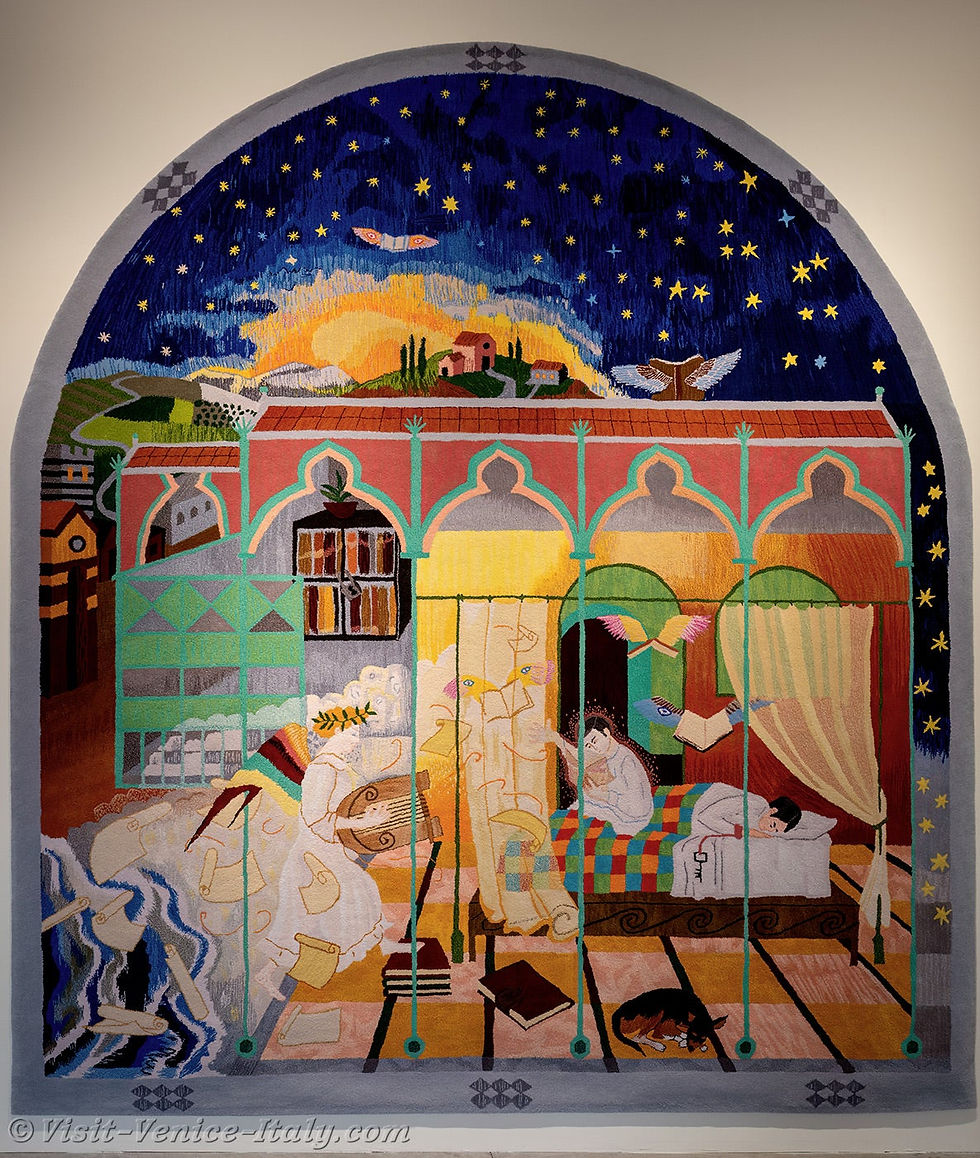
The works draw on the Middle Ages and early Renaissance, humanism, Christianity, the Book of Kells, and Aldo Manuzio (a 15th/16th-century Venetian printer who championed books and words over weapons)
It investigates thresholds, dream-states, and how humans make order out of chaos
the uncanny feeling upon waking when reality is unsettled and strange or enticing possibilities linger. Hand-tufted tapestries sculptures and paintings.

At the Irish Pavilion with its colorful tapestry flowered with book images corresponding with the Irish collective conceptual notion of its nation as a literary "People of the Book” the young Irish staffer (in her 2oth) at the Pavilion's desk like a super trained bird, parroted with much conviction, typical to only the ignorant, the widely spread lie on preformed "Genocide" pinned onto the Jewish nation, the one who actually was originally named the "people of the book", after giving birth to the Book of all books.
In a WSJ piece published Sept 2026 named "Why Ireland Hate Israel so Much"
considering that Jews were also oppressed under the British Mandate until 1948 the ideological parallel by many who draw in Ireland, between the history of Irish nationalism/dispossession under British rule and the experience of Palestinians, while being oblivious to Jewish suffering, makes as gross sense as a pigeon brain. and requires a wake up call shock not from imaginary Dreams but to a brutal reality which characterizes the terror infested region.
The Pigeons Chaser

Following the useless "Irish parrot" experience, we took a lunch-break respite at one of the few of the eating places, on premise, all equally mobbed with exhausted visitors.
At every eating corner throughout the Arsenale, to our amazement, we spotted a trained hawk, chained to its master, who kept circulating among the dinners, and not for entertaining reasons..
Apparently the hawk was on. a very purposeful mission, guarding its territory and chasing away the invading aggressive pigeons, that despite their hunger and intention to share the tourists' food, knew better, as to keep away.
And other threatening surrealistic Creatures
Views On the way to the Italian Pavilion

Italian Pavilion
The Italian Pavilion at the Venice Biennale evolved from the central hub of the entire exhibition into a dedicated national showcase housed primarily in the Giardini and the Arsenale
The first International Art Exhibition opened in 1895 in the Giardini, with all participating artists showing together inside a single central building without national divisions.

The Central Palace officially transformed into the Italian Pavilion in 1932under the fascist state's reorganization, The Italian Pavilion shifted its main contemporary art presentation to the Tese delle Vergini in the Arsenale, in 2013,

Featuring the project Con te con tutto -"With You, With Everything" Artist Chiara Camoni and curator Cecilia Canziani guided by a choral, collective process that involves friends, families, neighbors, and artisans rather than a traditional monumental solo show, exhibit a dark, penumbral forest of 24 life-sized sculptures built using the coil technique.
These figures integrate natural elements (plants, flowers) with man-made materials (plastics, debris, and found objects), acting as guardians of living and inert matter
Shifts to a bright, work-in-progress layout filled with reclining figures, studio remnants, and a relational, community-driven structure
Outside the Pavilion at the Garden


To be Continued...


Comments