
Travel:Travel: San Felice Circero, Sabaudia. Italy May 25-31/2026
Updated: Jun 23
A continuation of a trip to Italy that started on May 17th
NorthWest Hilltop villages 05/17-19 (here)
Forte dei Marmi 05/20-22/ (here)
Viterbo to Orvieto 05/19-20, 22-25 (here)
Departing the gorgeous bloom of Umbria Area

On the way from Orvieto to the southwestern coast, the quint in-land hilltop Artena - small town of ancient origins perched on a steep slop, caught my eye. Situated in the northwest of Monti Lepini, (part of the Lazio Anti-Apennines range in the upper valley of the Sacco River the town Artena is part of Metropolitan City of Rome,(30 km away)

Charming little alleys, succession of narrow streets and stairways, and masonry buildings with very small windows, make houses accessible
only on foot. Or donkeys usage..
The old part of the town is 420 m above sea level and dominates the surrounding landscape of rolling hills
San Felice Circeo - Coastal Hill -Top
We frequented, briefly San Felice village during our recent visit to Italy's Southwestern charming Coastal Towns in April prior to flying for 2 weeks to Israel (here)
Once touring this town's top historic center we felt intoxicated by the stunning views and enamored with the small mountainous village purged over the bluish bay.
Thus decided to return and vacation there for few days, in the unique Punta Rossa hotel setting, on the steep mountain slop, right inside the promontory's National Reservation Park, both overlooking and rolling into the sea.
Persuading our friends, who were touring Italy at the same time, also dear Chani and Kobi joined us.
The View from the Hill-Top

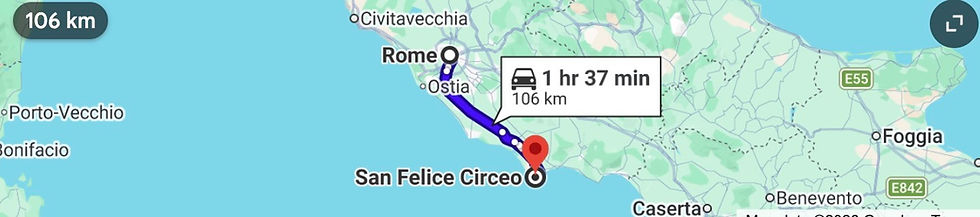
San Felice Circeo is one of I Borghi più belli d'Italia. "The most beautiful villages of Italy" ~ 1.5 hours drive south of Rome

This quint medieval village, perched on a natural rocky platform promontory about 100 m over the Tyrrhenian sea, was an ancient city called Circeii. near Mount Circeo,
It is a classic seaside village with breathtaking views and old historic center
Acropolis of Circeii

Probably founded by Greeks at the end of the Bronze Age, when they established ports and emporiums along the Italian coast the area around Circeii and Mount Circeo was reconquered by the Romans in about 393 BC, and then was thickly populated with Roman villas and other buildings, of which the remains of many can still be seen.
Entrance to the Upper Village Medieval Historic Center still enclosed in its Walls

The preserved small historic center with the 13 C Torre dei Templari - medieval watchtower built by the Knights Templar, and the Baronial Palace, that once served as the residence of Lucretia Borgia- the Italian noblewoman of the House of Borgia who was illegitimate daughter of Pope Alexander VI.
The House of Borgia a noble family of great notoriety and importance in the 14th & 15th c. (Also TV Series)

The Borgia rose to power when Alfonso Borgia (allegedly with Jewish crypto heritage) was elevated to the status of cardinal, and then eventually pope.
As Pope Callixtus III, Alfonso Borgia had a reputation for simony and nepotism
The House of Borgia produced 2 popes
Pope Callixtus III (born Alfons de Borja): Ruled from 1455 to 1458.
Pope Alexander VI (born Rodrigo Lanzol Borgia): Ruled from 1492 to 1503. He was the nephew of Callixtus III and is arguably the most infamous member of the dynasty
Baronial Palace Piazzetta Lanzuisti Torre dei Templari
The palace now functions as the local city hall and tourist board offices, overlooking the Piazzetta Lanzuisi.
The Medieval City Center


The town is included in the Circeo National Park which was founded in 1934 in the Lazio region, and occupies a strip of coastal land from Anzio to Terracina, including also a sector of forest in the mainland of San Felice Circeo, and the island of Zannone

San Felice Circeo history is intertwined with Greek/Roman myth, as it was here that Ulysses landed, seduced by the Sorceress Circe. who was feared for her ability to cause metamorphosis.
In the painting from 1891 by John William Waterhouse Circe offers a cup to Odysseus potion of poison
This sourcing apparently also worked, with the change in the ruling of the land.
Circeo area had been a Roman colony, a property of the Templars during the Middle Ages, a fief of the Caetani family, and finally a fortress of the Papal States.

Popular things to do in the area: are a stroll in the charming medieval town at hill-top, a boat trip around the promontory, or the splendid ascent to Monte Circeo, which on one side goes through a fragrant ilex grove, while on the other it winds along the hillside, but in both cases guarantees spectacle panoramas.

The lower part of town in the newer center is characterized by a strip of white fine sand beaches, which are carefully maintained. The sea water is crystal clear . Lidos, one after another, restaurants as well as residential quint white villas., an historic tower and a small Port/Marina are all found here.

Torre Olevola
Perfectly preserved Torre Olevola is one of the 52 coastal towers in Lazio, a fortified complex built between 1500 and 1600, located between Moltalto di Castro and Minturno, to defend the territories of the Papal States.
Torre Olevola was built around 1560 at the behest of Pope Pius V, on the ruins of a watchtower. Perfectly preserved,
San Felice Port - Marina

The port of San Felice Circeo is located at the tip of the peninsula. and is dotted with several high-quality sea food restaurants which are not located on the the sea,side
We sampled the freshest fish in a few (See below)
Views from the Port up the Mountain
The Hotel we stayed in - Punta Rossa


Via delle Batterie, 37 +39 0773 548085
In a stunning secluded peaceful area,, surrounded by unspoiled beaches inside the Circeo National Park, and only 4 km from the historic town's center and 8 km from the sandy Spiaggia -coast this unassuming terrific hotel, has been known as a coastal refuge mainly for the rich &famous from Rome.
The location of this amazing hotel (so close to Rome) we stumbled upon by cheer chance, is unique. Food is amazing especially weekend brunch and sea water pristine,
The family hotel which is now run by most friendly welcoming couple- Sando and Livia , is set on a verdant mountain steep-ridge, slopping into the bluish sea, is built on few levels with many steps, but Gulf Cart service, offer rides on narrow paths, all day.
A large pool is right by the stunning unspoiled rocky beach, with ladders facilitating entrance straight into the deep sea.

Breakfast with Chani and Kobi at the Hotel
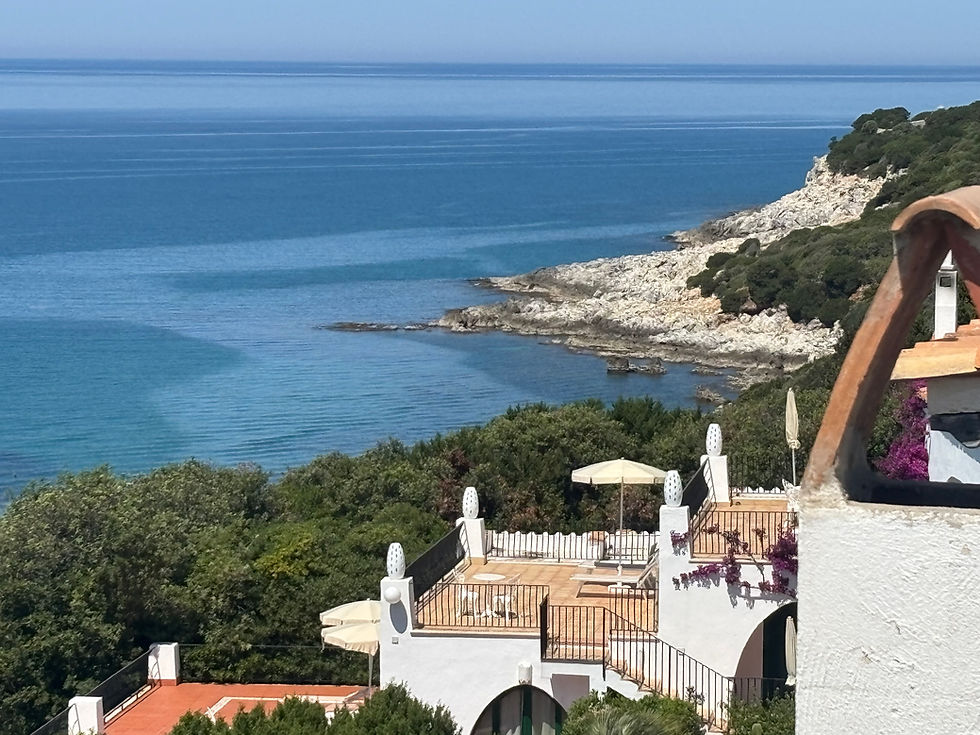
David, when not in the bath tub or in the sea water preferred sleeping outdoors, so he can gaze at the galaxies and stars - a reminder of his NASA days, so he had two beds made-up on our balcony. while I enjoyed writing on the balcony gazing at the inspirational view below, during the cool early morning hours.

Saturday and Sunday Lunch at the hotel is phenomenal
The largest Freshest and tastiest Sea food spread
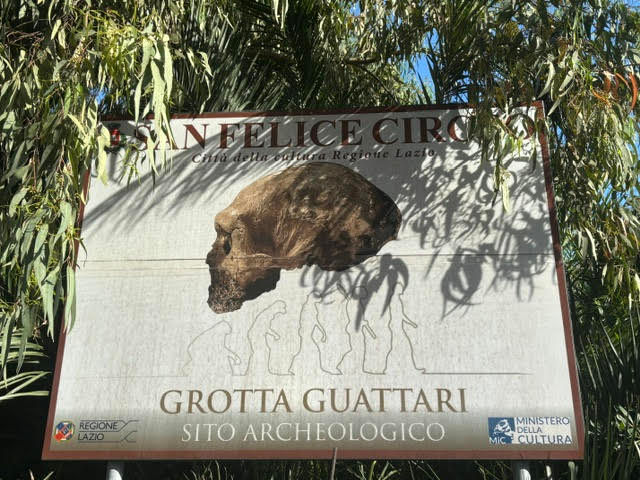
Grotta Guattari
Most famous cave of the headland of San Felice Circeo is Grotta Guattari, where one of the oldest Neanderthal sites in Italy, was discovered.
Neanderthal skull belonging to a man, who lived about 60,000 years
was found.
Visit there needs to be coordinated.

Food
At the Hill-top Historic Center

A recommended fish restaurant set in the upper village old center
06.9361413 Castel Gandolfo Via Saponara, 2 (CENTRO STORICO).
There is also one at the Circeo Port

Very good Meat restaurant
At the Circeo Port-Marina lower town
Mariolino al Porto Cicero Pescharia (A fisherman place)
Via Ammiraglio Bergamini, 24, 04017 San Felice Circeo LT
Via Ammiraglio Bergamini, 48, 04017 Porto LT. 340 612 1388
A Villa For Rental by Punta Rossa
We met Luciana, an Italian local owner of a villa, on the road to Punta Rossa Hotel, when one day, missing her bus ride, she stopped our passing by car, and asked for a lift to town. When asked what was she holding to in her hand extended outside of the car's window, she replied it was her garbage bag, that she hold onto, all during the ride,
and of which she needed to dispose in town's center..
Leaving Rome she now spends her time between her Circero Villa and Thailand,
For the "good deed we did" she recommended restaurants in the area and shared about her villa she rents.
Lucy - owner of the villa for rent
Lucillaantonacci@gmail.com. +39 376 232 8203
++++++++
Very close to San Felice Circeo, only 15 minutes drive through the lower new center of town, the road leads to the Dunes Beach stretch on the north side of the promontory, where the south end of the next township begins.
Sabaudia
Golden beaches, wonderful dunes, lakes and the Circeo National Park.

This coastal town is 1.5 drive from Rome and only 12 km North of Circeo
Sabaudia offers a long strip of white-sand beaches and dunes on the coastal side, and lakes on the inland side. Paola (or Sabaudia), Caprolace, Monaci and Fogliano. the four large lakes are comprised as part of the Circeo National Park, and characterizes its nature and atmosphere.

The coast has maintained its natural appearance. and there are still long stretches of public beaches with wooden boardwalks that run through the Mediterranean brush and allow comfortable reach to shore .Thus In summer the beaches, outdoor restaurants and private villas attract many tourist to this lovely area.

The historic coastal tower built in 1563, at the beach headland, is one within a first group of four coastal watchtowers, erected on the coast of Mount Circeo to protect the area from Saracen pirate raids. Arab, North African, and Andalusi (Spanish Muslim) raiders terrorized the Italian coastlines between the 9th and 16th c.
Their devastating coastal raids forced Italians to abandon seaside settlements and construct an extensive network of fortified watchtowers.
The construction of the towers was ordered by Pope Pius IV who in 1562 issued a brief entrusting the lords of Sermoneta and San Felice with this task.
The tower was attacked by the British in 1809 during the Napoleonic Wars. Differently from other watchtowers on Mount Circeo, the tower repelled the attack and avoided major damages or demolition under the lead of its commander, Ubaldi Piemontese.
This tower is located on the westernmost point of the Mount Circeo headland right by Saporetti Restaurant, overlooking the beach below and Lake Sabaudia to its west.
The circular tower is connected to a large sea cave which can be accessed by water.
Roman Port Canal

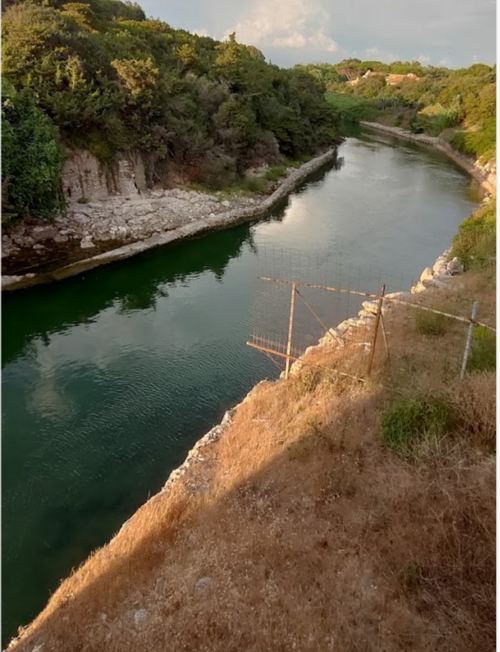
Fossa Augusta, Fossa Neronis or Cavo d'Augusto, is a Roman artificial canal
connecting the South East side of Lake Paola to the Tyrrhenian Sea by crossing the plain at the foot of the promontory to avoid dangerous circumnavigation of Monte Circeo.
Historically the start of the canal was attributed to the emperor Nero (r. 54-68 AD) who began work on a 160-mile-long canal to join Ostia to Lake Avernus, traces of which remain between the lakes of Caprolace and Paola.
That part of the canal can be clearly observed at where the tower is located
by restaurant Saporetti.

This recommended restaurant right on the attractive beach by Paula Tower opens daily for Breakfast & lunch and for dinner only on weekends.
On the slight rainy afternoon we visited there, a marvelous Rain Bow appeared.

Like many other Celebrities, Politicians and Film makers who were attracted to the beauty of the area, also Alberto Moravia, (novelist and journalist) loved walking along this natural shore, as well as Pier Paolo Pasolini, (Italian poet, writer, film director, actor and playwright.) was intrigued by the contrast between Sabaudia’s natural environment and the rationalist style of its buildings, They both often frequented the beach and dunes of the area.

A pleasant Spanish style sea-side hotel
8 miles drive away from Circeo, is set on a dune by the beach .
Its very heavy Spanish decor and the sandy beach has a very different appeal
in contrast to that of Circeo's Punta Rossa
Sabaudia - Town Center

Sabaudia was founded in the early 1930s under Fascist rationalist architecture (seen in town center) that Benito Mussolini. initiated when reclaiming flooded land, from under the swamps and wetlands marsh area, which was drained under his orders, as to built one of several towns on the land.
The small city was built in only 253 days and inaugurated in 1935, under the fascist regime.

The city was conceived and designed by architect Gino Montuori (1907–82). best known for the Stazione Termini, Rome (from 1947) according to the classical layout of the Roman urban area,
That is, along a Cardo intersected by a Decumanus, whose crossing point represents the heart of the city. Italy's fascist architectural movement, is a blend of modernist and classical influences including usage of travertine and marble facades
Other Roman Remains in the Surrounding

Villa of Domitian
In ancient Roman times, the extensive Villa of Domitian was built nearby and embellished by the emperor. Some of its remains have been excavated.
North of the city on the Lago di Paola near Sabaudia emperor Domitian built a sumptuous villa. The enormous villa or palace dates from the 1st century AD and extends for over 45 hectares along the shores of Lake Sabaudia. excavated in 1934


"La Casarina" is located at the south end of Lake Sabaudia
It is most likely a public bathing complex from the end of the 1st C BC. The docks, the cistern and the pools date to the first phase; in the 2nd phase most likely abandoned in the 13th c

The Fonte di Lucullo (spring of Lucullus) is a Roman artificial cave built by the Romans to be able to supply themselves with water in Sabaudia. The water cistern. located within the Circeo National Park halfway between Sabaudia and San Felice Circeo..
It owes its name to the patrician Lucullus who had financed the work by hiring Gneo Domizio Armando in 78 BC to build two springs and a water tank.

The spring was discovered in 1904 burred under 15 m of sand, and still gushes inside the ancient vault, in the midst of a beautiful wooded area
The Lucullus pool is now a large pool used for fish farming which is located not far from Torre Paola.

Upon the recommendation of the Punta Rossa Hotel's owner - Alessandro - a third generation to mange this unique family hotel, which was established by his grand parents -Venuti Battaglia family (see the book - "My Oasis" )
a man who knows and appreciate Beauty, we ventured on Saturday to visit the Romantic Ninfea Gardens
Ninfa - the abandoned medieval ghost town located just about 62 km south of Rome. which was established in the 7th Ad and deserted due to military feuds in the 14th Ad, was during the Middle Ages, a bustling, fortified urban center strategically located on the vital trade route (the Via Pedemontana) between Rome and Naples

Back in the Roman era, in the current village of Ninfa stood a temple dedicated to the Goddesses of Spring water, the Naiad Nymphs.
Back in those days, Romans believed that nymphs - personifying nature and usually depicted as maidens, as well as often seen as having healing properties- dwelled by springs and rivers, hidden in groves and grottoes.
There is plenty of that to go around in the Giardino di Ninfa!

In the 12th and 13th AD the walled town featured at its peak over 150 houses, a castle, mills, bridges, and seven churches. It was even the site of the papal consecration of Pope Alexander III in 1159. The town's prosperity ended in 1382 when it was sacked and destroyed during the Great Schism. Malaria from the surrounding marshlands forced its permanent abandonment, leaving behind a haunting landscape of roofless stone walls and crumbling towers.
The Gardens of Ninfa
Via Ninfina, 68, 04012 Cisterna di Latina +3907731880888
Advance booking is required. (tours in English are given between 1:30 to 3:30pm)


Named by the New York Times as one of the most romantic gardens in the world, the Garden of Ninfa - a natural paradise at the foot of the Lepini mountains in Lazio. was created by the Roman Caetani family on the ruins of a medieval village in the Latina countryside which the
Caetani family originally acquired in 1297.

The House of Caetani is a prominent Italian noble family originating from Gaeta, who held immense political and cultural power in Rome and the Papal States for centuries. They produced two popes, famously controlled vast feudal territories, and are still remembered through their historic Roman palaces and estates,

The Garden of Ninfa is one of their most celebrated legacies, In the 1920s, the noble family (who had owned the town for centuries) began transforming the ruins into a botanical paradise, planting greenery from all over the world
After the death of its last full-time caretaker, Lelia Caetani, the Roffredo Caetani Foundation was established to preserve the Garden, leading to its official, opening to the public in 1977.
1,300 plant species, a pond, streams and the ruins of houses, churches, castles and bell towers, on which vegetation flourishes. can be appreciated at the gardens.
On the way back , 40 minutes drive south, roughly 30 km from Sabaudia got us, also thanks to Sandro's recommendation to Abazia Di Fossanova - monastery
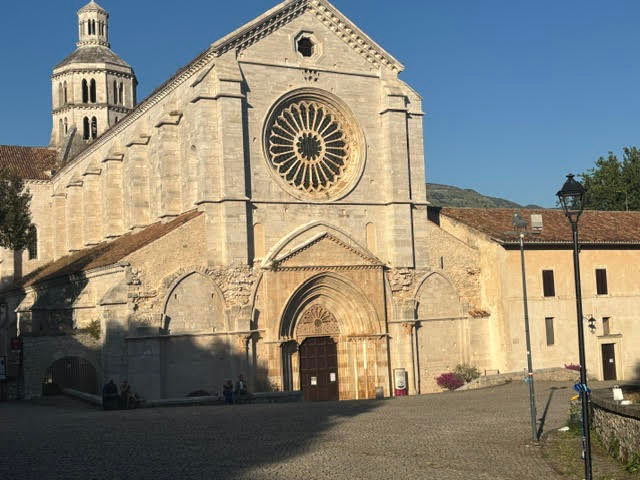
Consecrated by monks from France, in 1208 and later declared a National Monument in 1874, the church that was formerly a Cistercian abbey is located near the railway station of Priverno in Latina, (about 100 km south-east of Rome) . It is the oldest and one of the most stunning examples of early Burgundian Gothic architecture in Italy.
The church is famous for its majestic, unadorned travertine facade, large rose window, and minimalist interior, completely lacking the frescoes typically found in Italian churches Renowned Italian Dominican friar and priest, philosopher and theologian ,
St. Thomas Aquinas , considered one of the most influential thinkers in the history of Catholic theology and Western philosophy, died within the abbey's walls in 1274

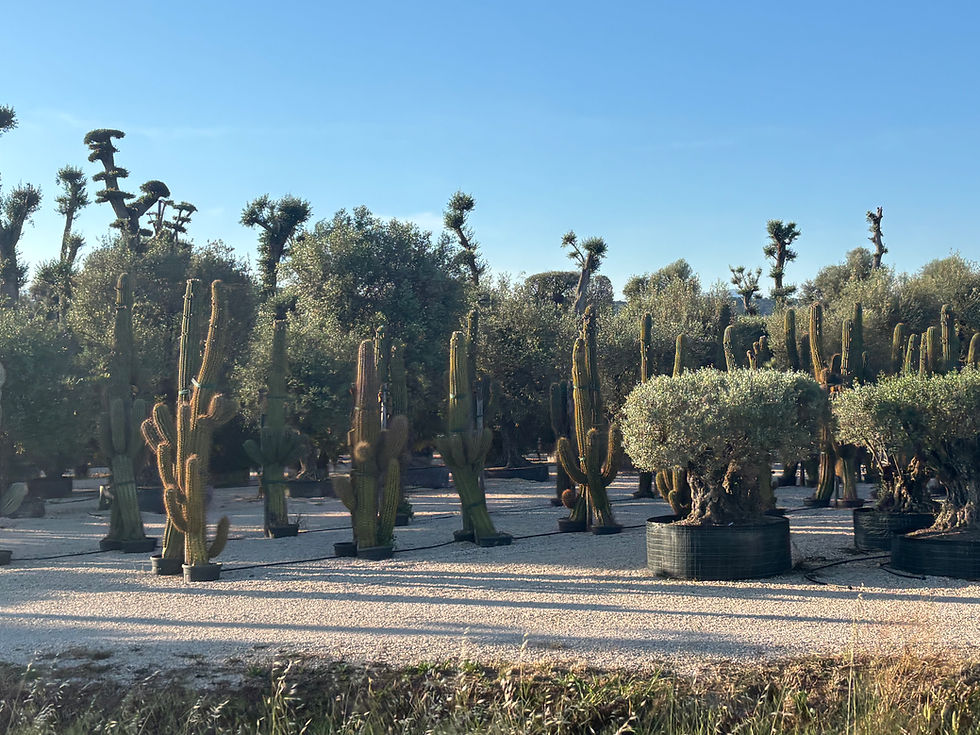
Also near by, to our delight we encountered an amazing huge plants nursery Vivaio Aumenta
The horticulture company, which now covers more than 200 hectares with rows of magnificent mature Olive trees, Palms, Bonzai and many more, dominated the area in its haunting beauty.

Just prior to arriving at Rome a day before our flight back to the US, we couldn't suppress the urge for shopping , that paid a visit to a grand Outlet Mall
Shopping Mall - Rome

Castel Romano Designer Outlet
is a huge open air complex ,set about 35 minutes drive a way from Rome with over 150 designer brands offering up to alleged 70% less.in cost
The complex is also adorned with attractive squares between the shops restaurants, and coffee shops, dotted with jungles creatures like dinosaurs and elephants.. thus, associating the shopping experience with the" might, wild and extinction"..
On this end of May weekend labeled as
" Black Friday" the mall, was heavily mobbed but offering discounts of mainly 30% off . The bigger sales are at the end of July and January.

Hotel in Rome near Fiumichino Airport

Cardo Roma Autograph Collection
The contemporary 4 star Marriott, in a business suburb of Rome, (20 minutes car ride from center) was recently refurbished and has a large pool.
It is very pleasant hotel, 15 minutes drive only to the airport and is reasonably priced. It offers also free shuttle rides from the hotel to Rome's center and back Highly recommended.

BYE BYE Italy
We safely returned home with Air France via Paris, on June 1st, after a long period of wondering, and will stay stationary , but probably not for long...
THE END!


Comments