
Travel:Lake Manyara to Ngorongoro. Tanzania. 07/06-08/2026
Updated: Aug 16
Continuation of a trip that started on July 1/2026
Fly from SFO via Dubai > Nairobi > Drive Lake Nakuru (and Lodge) > Fly > Nairobi > Arusha (Serena Lodge) > Drive > Tarengeri Park > Drive > Lake Manyara (Serena Lodge) > Drive > Ngorongoro Crater (Serena Lodge) > Drive Serengeti Central (Melia Lodge) > Drive > Serengeti Western Kirawira (Serena Tent Camp) > Fly back > Arusha > Fly back to Nairobi (Norfolk Hotel) >
Fly back via Dubai > SFO.
SFO to Nairobi Kenya - Lake Nakuru 07/02-05. (here)
Nairobi to Arusha, Tanzania 07/05- 06 (here)
Tarengeri Park and Lake Manyara 07/06-07. (here)


The drive from Lake Manyara National Park to the Ngorongoro Conservation Area covers roughly 65 km and took about an hour and a half, on now a days, paved B144 road.

Passing via Karatu

Nicknamed ‘Safari Junction’ Karatu is located in the Ngorongoro Highlands, and is the last major town and village before entering the Ngorongoro Conservation Area via the main Loduare Gate of the park.
A colorful bustling agricultural and safari hub the town serves as the final stop for fuel, supplies, and pre-park needs. Karato is often used as a quick stop over in-between safari trips or as a cheaper accommodation option compared to staying on the rim of the Crater or within Lake Manyara National Park.
Cultural tourism and outdoor action have especially developed Karatu during past 10 years.
Irkeepusi / Nainokanoka: are traditional Maasai villages near the crater rim inside the reserve, often visited by tourists.
Ngorongoro Conservation Area


Ngorongoro Conservation Area a UNESCO World Heritage Site (from 1979) and a key stop on Tanzania's "Northern Circuit." It is one of the most popular attractions in Tanzania with about 800,000 tourists annually
The name of the crater has an onomatopoeic origin; called by the Maasai pastoralists after the sound produced by the cowbell (ngoro ngoro) The sound is required as to locate the pasturing herd within a dense tropical forested environment. (in a low grass pasturing planes the herd can be easily spotted)

Ngorongoro Crater, is the world's largest intact, unfilled volcanic caldera spanning over 260 square km with towering walls plunging 610 meters deep. and steep.
The caldera formed roughly 2.5 million years ago after a gigantic, larger then Mount Kilimanjaro-sized volcano collapsed inward during a cataclysmic eruption.
This implosion created the unbroken, bowl-shaped crater floor seen and visited today.
The Crater's rim itself sits at an elevation over 2,200 m and features a distinctly cooler climate than the surrounding plains.
Actually, on the July's dry season day, ( (June–October) we visited the Crater, it was so cold and windy , I was glad I had with me the only lite coat I brought to Africa.
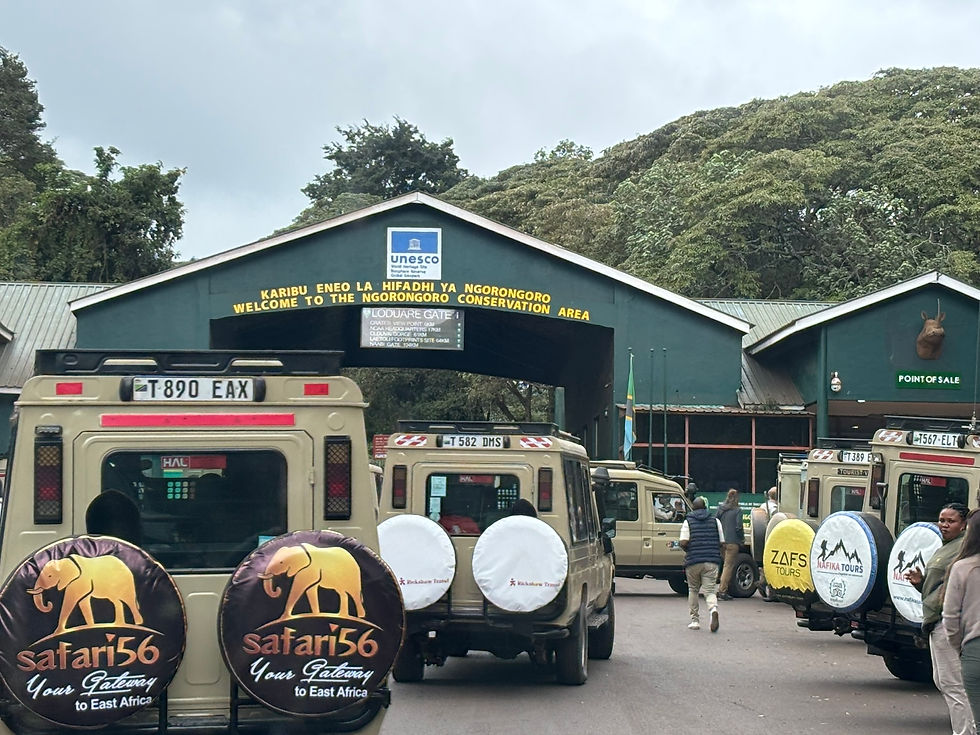
On the morning we arrived at 10;00am into the main entrance of the park, , there was already quite a long line a head of us of Safari Land Cruisers, from various companies, with familiar Safari driver/guides, merrily greeting each other in the local Swahili language.- the major African Bantu language.
Having all our papers in order, paying the entrance fees, went fast and luckily we proceeded into the park fast.
Park fees collected in Ngorongoro are always invested back to develop its surrounding communities.
Once through the gate, it took about an hour drive on the Rim's bumpy narrow unpaved road - "a free African Massage" until the road descents into the Craters floor.
The Tropical lush verdant Crater Rim
Because of the sheer 600 meter drops along its rim, the caldera functions as a natural, self-contained ecosystem. Long since having collapsed and eroded, this three-million-year-old caldera now shelters one of the most beautiful wildlife on earth.


The crater is incredibly scenic, with towering Euphorbia - a massive and diverse species of flowering plants, clinging to the crater walls, as well as picturesque ficus tree forests, down on the crater's floor and other greenery vegetation which provide shade for an incredible array of wildlife.
There are yellow savanna patches, bluish water holes, water streams and small lakes each supporting the diverse wild life and birds inside the crater.

The crater's floor, diverse habitats contains open grasslands, wetlands, swamps and the soda waters of Lake Magadi—which allow a massive population of large mammals to thrive without migrating.. supporting roughly 30,000 animals, including the "Big Five" While wildlife congregates year-round, the dry season offers the easiest visibility as animals gather near watering holes.


Black rhino are protected within the crater rim, giant tusked elephant wander the forests, black-maned lion stalk the grasslands, hippos swim in the various ponds and flamingos crowd the soda lakes.
The wet seasons (April–May and Nov–Dec) transform the landscape into a lush, emerald backdrop with far fewer tourists. Safaris require descending the steep, narrow tracks using a 4x4 vehicle.

Running Thomson Guzzles Flamingos Sleeping Lions

More about the Masai

An iconic, semi-nomadic indigenous group native to the Great Rift Valley in southern Kenya and northern Tanzania the Masai originated from the Nile Valley, and migrated south around the 15th C, settling across the vast savannas of East Africa. Known for their distinctive bright red shúkàs (robes), beaded jewelry, and deep connection to pastoralism, their traditional economy and culture revolve entirely around herding cattle and goats.
Traditionally, their diet consists primarily of the milk, meat, and blood of their cattle, which they view as a sacred gift from their god,

It is speculated, that this protein rich diet is conducive to their high intelligence and successful schooling, among many tribes, whose diet traditionally has mainly been based on vegetation.
Lean Maasai, resplendent in their beads and furled in scarlet shuka robes, tend their herds within the conservation rim however they are not aloud to settle or build their houses nor walk down on the crater floor .

Picnic inside the Crater with the Hippos (left) and white Pelican (right)

Since we arrived inside the Crater early morning, one full day was sufficient to explore the entire Crater.
The following day David and Leo enjoyed 2 hours morning hike along the Crater's Rim with the local conservationist guide.
properly armed in case an unexpected encounter with some wildlife occurs, while I stayed in and did my writing at the beautiful Serena Lodge, set on the rim and offering stunning views of the Crater from its windows.
The Serena Lodge we stayed at

Inside Ngorongoro Crater Conservancy, . 0789 620 663
Set along the rim of the Ngorongoro Crater, this all-inclusive, rock-built hotel, 11 km from Lerai Forest
is an exceptional place to stay inside the crater area.
Its charming rooms with cave paintings on walls offer stunning views over the crater
Meals are served in a rustic, stone-walled dining room/bar with a fireplace, or outdoors in a forest clearing.
We stayed here als0 during the past 2 previous visits.
Another unexpected expectancy which occurred was upon checking into the lodge, our reservation was missing...
It was realized that the reservation, when eventually was found, was mistakenly made by the travel operator, only for the following day, We were lucky that this very busy high in demand lodge could accommodate us after all, upon arrival
The View from the Lodge


The lodge was amazing and the 2 nights we spent in it.. were fantastic . It also gave us an opportunity to get to know the dedicated lodge's staff ,who provided excellent service, much better, then in previous Serena lodges we stated at.
Thus at breakfast on the morning we departed
(July8th) the restaurant's service staff all circled our table and while presenting us with a special personal farewell
baked cake, to take on our continued journey, they sang together their traditional Masai songs.
The very moving gesture were sealed with hugs and with wishes for our soon return again.
Sun Rise over the Crater
Serengeti National Park is our next destination.
TO BE CONTINUED...


Comments