
Travel:Viterbo to Orvieto & Bolsena. Italy. May 19-20 , 23-24/2026
Updated: Jun 23
A continuation of a visit to Northwest of Rome which started on May 17th
Hilltops towns Northwest of Rome 05/17-19 (here)
Forte dei Marmi 05/ 21-22 (Here)
Lake Vico

Once departing the beautiful small volcanic made lake Vico area (here)
with the charming hilltop towns near it, while proceeding toward our next destination further up north Umbria area, stumbling upon well known thermal bath named Terme Dei Papi before Viterbo an off-the-radar , delighted us .
This top spa destination where the steam of ancient springs meets modern wellness rituals., definitely worth a visit.
Terme dri Papi -Thermal Baths of the Popes - Viterbo

Str. Bagni, 12, 01100 Viterbo VT, Italia
About 4 km west of Viterbo town
Thermal bathing around Viterbo predates Rome’s imperial splendor..

The Terme dei Papi were already known from the Etruscan times for its therapeutic and spiritual properties, and they were valorised particularly from the Romans times, (310BC)
Centuries later, when Viterbo briefly hosted the papacy in the 13th AD its waters became associated with clerical rest and recovery, a favorite destination of many popes of the Middle Ages.
This pedigree has survived in the so called modern name "Terme dei Papi" - Baths of the Popes. Still today it offers delightful relax and health, deals
becoming the most frequented spa of the entire region of Lazio
The natural resources, including the waters of the Bullicame spring and the fantastic muds from the volcanic lake of Bagnaccio: provide allegedly, curative benefits
The Bullicame spring water at 58°C. whose very name comes from Latin for “bubbling”, had also cropped up repeatedly in medieval accounts and Italian literature and art.
Italian writer Dante Alighieri mentioned Bullicame spring in Canto XIV of the Inferno.
A stone stele bearing the verses from The Divine Comedy, stands today inside the thermal park.

Esthetic and dermatological cures, thermal mud treatment, hydrojets and nutrition classes are just a few of the many activities found at the Terme dei Papi. Mud-balneotherapy, effective against joint rheumatism, cave therapy, in a natural cave into which hyperthermal water carries sulphurous vapours, or inhalation cures, excellent for chronic pathologies of the upper and lower airways. are all being offered

The Terme dei Papi also offer the pleasure of plunging into the 2,000-square-metre Monumental
Swimming Pool ,generous not only in size but also
in hyper-thermal water, which flows steaming from the spring into the pool from the scenic stone mouths.
In 1994 the Terme dei Papi completed their restoration project and an extension of the new thermal complex. Establishing a name in the spa and health wellness market. the modern Terme dei Papi spa, renovated complex which still features characteristic of ancient Roman architecture. has since than been one of Italy's most advanced facilities.


David who loves to soak in all forms of water-bodies, and in particular in Thermal Springs, was determined to bath in the thermal sulfur baths from the Roman times, which this huge Terme dei Papi's Spring Pool, promised.
Alas it was Tuesday and the pool was closed to the public, (water changing day However the Spa center's services was operating. and David was more than determined..
After being asked from where were we, to which we responded - US, the English speaking receptionist at the Spa center desk, informed, to our grave disappointment, that the Spa facilities are reserved for only medically refereed Italians who the
“ Servizio Sanitaro Nazionale” authorizes treatment for medical specific conditions.

As refusal is only a challenging invitation, to be refuted, for David,
he immediately asked if there was an authorizing Doctor on site, and after cajoling her and waving his IDF Disability card. requested the receptionist to refer us to one.
Five minutes later without pre-booked an appointment, David pulled out, again, his
IDF disabled veteran card כרטיס נכה צהל at the office of the Doctor on duty, and requested of the Dr to authorize a thermal treatment for both of us .
David convincingly explained and demonstrated his "acute rheumatic and orthopedic" painful condition, and my pains related to a "calcified shoulder", all true, while throwing-out few names of Italian Professors of Medicine, from his Bayer days.
Lo and behold, after checking our blood pressure, and making a payment to the center of 15 Euro each, the Dr furnished us an official document from the Italian National Health, allowing treatment usage at the facility, which we both enjoyed immensely, , before continuing the drive up north.

The thermal center is open all year round from 9 a.m. to 7 p.m. The monumental pool is closed on Tuesdays for maintenance. On Saturdays, it is open for night swimming from 9 p.m. to 1 a.m.
Str. Bagni, 12, 01100 Viterbo

Terme dei Papi features also a beautiful 4-star hotel of 33 rooms, which is directly connected to the Thermal Center and the huge thermal pool.
Accommodation + packages dedicated to the care and well-being of the mind and body are offered.
We didn't stay at the hotel as we just passed by, but it looked decent and conducive for a Spa vacation stay.

Free of charge Hot Springs
Besides up-to-date Spa center and wellness hotel, about 4 km west of Viterbo's town center, the open countryside is home to several free hot springs and natural pools.
The most famous as was mentioned is as Terme del Bullicame, which discharge water into two open-air pools, one naturally hot, the other cooler.
Entry is free, with parking but no facilities.
The site stays open daily up to 5.00 pm in winter and 6.00 pm in summer,
Viterbo Town - City of the Popes

The ancient city of Viterbo, was built around the thermal springs in 345 BC, and its first recorded mentioned date was in the 8th AD when it was known as Castrum Viterbiiwhich. fortified by Lombard King Desiderius in 773 CE
It is one of the most beautiful medieval town, valued for its landscape, history culture leisure and therapeutic cures, known long before the concept of spa tourism existed.

Situated at the foot of the Cimini Mountains, densely wooded volcanic hills, part of the Antiapennine range, Viterbo is just one hour north of Rome, near Lago di Bolsena,

Viterbo is one of the the best-preserved medieval town recognizable in many of Viterbo’s medieval structures and churches which are built on top of ancient Etruscan-era ruins, identifiable by massive rectangular stone blocks

Etruscan civilization merged with Mediaeval architecture and beneficial spa waters, best characterize the city.
It is also best known for having been the seat of the papacy for two decades during the 13th AD.
In fact, in Italian it is known as ‘la città dei papi’.
Dante mentions five popes in his Comedy who either lived or were buried in Viterbo.
Dante
Viterbo's medieval quarter, on its older structures hosts an historical-artistic heritage of great value,. Historic buildings, churches, Romanesque arcades, 13th- and 14th-C houses,, palaces. and ancient monuments, all enclosed by 11th- to 13th C walls and towers, are practically unchanged and are of incredible charm:

The aristocratic palaces in Piazza del Plebiscito - the central and most important square, the authentic Medieval San Pellegrino district, along the Via Francigena, the Romanesque Cathedral of San Lorenzo, (constructed over an ancient temple dedicated to Hercules), with a Gothic bell tower, frescoes and a 15th-c baptismal font. the Papal and Priori Palaces, the Governor's Palace and the Palace of the Podestà. are all historic architectural gems.
Piazza dei Plebiscito Priori Palace -City Hall
San Pellegrino District
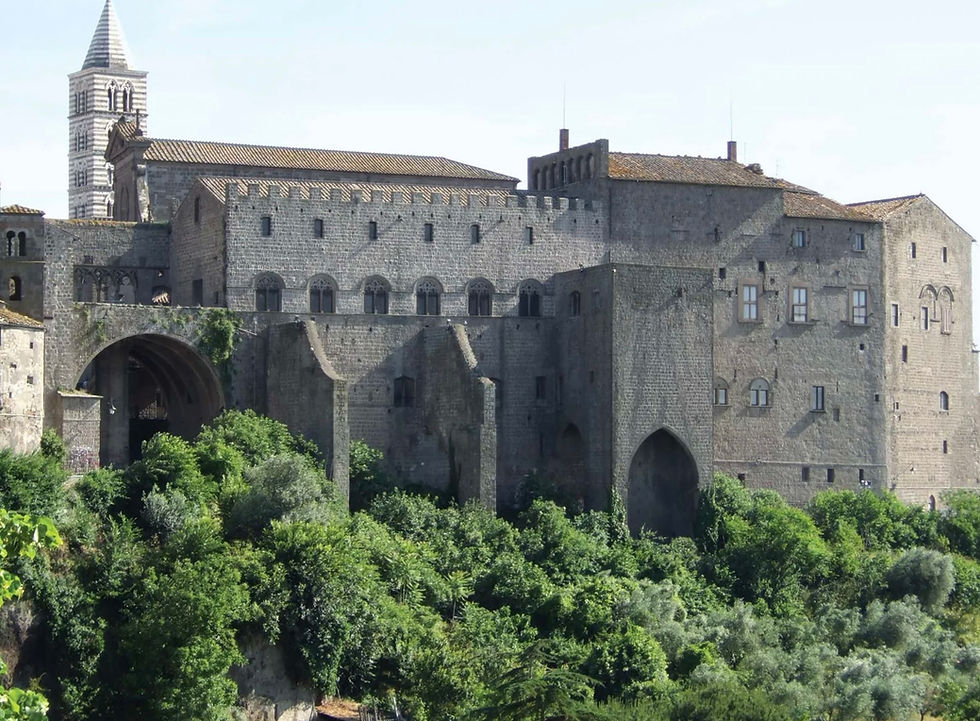
Palazzo dei Papi


Palazzo dei Papi Papal Palace, one of the city’s main attractions -situated alongside the Duomo di Viterbo (Viterbo Cathedral). The palace with an elegant loggia, which was the seat of the popes in the 13th c also served as a country residence or refuge in time of trouble in Rome.
Domo Cathedral San Lorenzo

The Colle del Duomo Museum which houses archaeological artifacts and a sacred art collection, is set next door to the cathedral,
Highlights on display include the Madonna della Carbonara, an early-13th-c icon, and the Crocifissione di Viter a renowned 16th-c crucifixion painting traditionally attributed to Michelangelo.
Apart from sacred artifacts, healing Spa tourism and agriculture, the main economic resources of Viterbo's area
are pottery, marble, and wood.
The town is also home to the Italian Gold reserves, Academy of Fine Arts, the University of Tuscia, and the Italian Army's Aviation Command headquarters & training center.
.Montefiascone


Driving further up on SP6, 7 km North of Viterbo and about 100 km north of Rome, still through the Lazzio region, we passed by this quint hill-top town, set 590 m above sea level, and overlooking the southeast side of Lake Bolsena,
The name of the town refers to the wine region of the area

Monteflascone dates back to the Middle Ages, first as Church property and an important Christian center during the 7th c . It was fortified and defended by the troops of Pope Innocenzo III in 1207,
one of the most powerful and influential of the medieval popes.

The towns importance derived from its being the residence of the papal rectors of Tuscia, who for centuries stayed here among the gardens and views of the stronghold fortress - la Rocca dei Papi (fortress of the Popes) looks over Montefiascone from a height of 633 m, on the summit of the hill above Lake Bolsena.. it served as the popes' summer residence, and even a papal mint from the 13th to the 16th C. it remained one of the most significant monuments to papal authority in the area , now a days celebrating the region's history and art, by hosting exhibition and cultural events in its space
Civita de Bagnoregio - "The Dying City"

Another picturesque small hill-top town further up north - Civita di Bagnoregio is
much less known of all the Italian hill towns, however the site is a stunning little gem which has escaped the modern age mostly because of its topography.

Bagnoregio teeters at an elevation of 484 m, atop a crest rising high above a vast canyon ruled by wind and erosion. The town has been crumbling bit by bit into the valley below. Buildings fell away into the valley decades ago, riding a chunk of the town's ever-eroding rock
The isolated on saddle of tufa spur that once connected Civita to its bigger and busier sister town, Bagnoregio, has worn away. Photographs around town show the old donkey path that once linked the hamlets. Today, the only way in or out is by a footbridge. Supplies are ferried in on mopeds.
The views of the valley are breathtaking

The main entrance is a huge stone passageway, cut by the Etruscans 2,500 years ago when Bagnoregio was Bagnorea, decorated in the 12th c with a Romanesque arch. Passing through the Middle Ages. portal, walking on cobblestones stairway, reveals Ivy drapes over arches and scrambles up walls; and potted flowers
The town flourished through the Middle Ages and the Renaissance until disaster struck. The 1695 an earthquake, which hit Civita, separated it (with the formation of a spectacular cliff) from the other two districts of Mercato (today Mercatello) and Rota
That earthquake signaled the beginning of a mass exodus from town.

Now it is most popular tourist attraction as thousands of visitors flock to see what’s left of the town.
Civita di Bagnoregio will inevitably disappear when its final pieces crumble into the spectacular Valle dei Calanchi (bad lands valley) below - a surreal, shifting landscape of steep clay ridges and deep gullies.

The Swiss-cheese ground beneath Civita is honeycombed with ancient cellars, perfect for storing wine, and cisterns for collecting rainwater. Many date from Etruscan times. A pre-Roman tunnel below the town served as a bomb shelter in World War II.
Orvierto


Orvieto which I previously visited in March 2025 and about which I wrote extensively (here) thus will not expand on, in this post, attracted us back, at this visit as well, The intention was to stay longer at the enchanting AltaRoca Resort Hotel and to further explore Unbria's captivating surroundings

Loc. RoccRipesena 62 Orvieto +39 0763344210. +393286195820
The resort nests in the midst of unbeatable most
pastoral tranquil landscape, surrounded by vineyards, olive groves, lush greenery, colorful roses and alleviated volcanic Rocca Ripesena Rock (Alta Rocca) looming over it

The breathtaking views of the Valle del Paglia. - named after the meandering Paglia River, consists of the lush, rolling agricultural basin located directly below the striking cliff-top city of Orvieto , The sweeping Umbrian valley offers stunning panoramic views of the dramatic geological formations, and the rolling hills, dotted by thedense vineyards, and olive groves,

.

The hotels spacious rooms and good breakfast are also great.
However the stay is truly rewarding ONLY when accommodation is assigned in the main hotel building, at the lower part of the property, where the hotel's reception and breakfast services are given..
The upper part of the hotel is in a remote elevation, away from the main building, and requires car ride each time services at the main building are required.
The Upper part of the Property

Also, the pool at the upper level wasn't operating during our stay, and the other pool which did operate, is closer to the main building. as is the hotel's evening restaurant. Menu at this allegedly upscale eatery, is limited and disappointingly mediocre
Furthermore, the resort mainly caters to organized small sized groups, with which the hotel has long standing relationships and prioritized obligation (like to Rick Steves or religious groups)
Thus, the hotel's management is less inclined to cater and accommodated requests of private visitors, which was very disappointing to us, during this second time stay here.
As we stayed away from Unbria for 2 nights (between 05/ 21-22) upon returning from Forte dei Marmi (here),
to our delight, we discovered that our dear friends- Chani and Kobi- who also were traveling in Italy and with whom we pre-planned to stay together, (as of 05/ 25th ) but in San Felice Cireceo (here) surprised us and checked into the AltaRocca Hotel as well. without knowing, we were staying there as well. This allowed the 4 of us to spend touring time together foe 2 extra, days in the same area.
Dinning together at - Trettoria La Palaomba - Orvieto
Via Cipriano Manente, 16. 0763 343395
Considered one of the best eating places in town's historic center, by its locals. and specializing in pigeons, we found the place over rated.
For additional restaurants see the 2025 post on Orvieto (here)
Additional sites toured together with Chani and Kobi
Allerona

Allerona combines history, culture & nature in a strategic extraordinary beauty setting.

About 30 minutes drive north of Orvieto , another small quint hill-top village, Allerona is one of I Borghi più belli d'Italia (" most beautiful villages of Italy").[

Surrounded by hills covered with beech, ilex and juniper woods, Allerona has architectural traces from the ancient Roman period, with archeological remains in the immediate vicinity of the village, including Ponte Giulio bridge at the Paglia river, which stretches of the ancient Via Cassia (between Orvieto and Ficulle) and marker stones with Roman inscriptions regarding the Via Traiana Nova.
The Sun Gate was the main entrance to the ancient feudal castle in the Middle Ages,

Allerona's medieval origin is attested by the Castle of Lerona (12th c), bulwark of Orvieto, subject to the Monaldeschi and Filippeschi powerful noble families of Orvieto ,engaged in a century-long, bloody feuds, who had it built in 1275,
Later it was destroyed at the end of the 15th c by Charles V. - Holy Roman Emperor and Archduke of Austria from 1519 to 1556, King of Spain and other lands .
Afterward the castle rose again, such that in 1585 the community wrote its own Statutes, and in 1595 freed itself from the rule of Orvieto and the Monaldeschi.
Sights in the village include the remains of the feudal Castle, parts of the walls and of two gates, Porta del Sole and Porta della Luna – and the Church of Santa Maria della Stella (12th c), renovated at the end of the last century, with frescoes in the apse by the Sienese painter A. Viligiardi (1896).
Santa Maria della Stella
Walking the Narrow alleys

Established in 2003, the museum is housed in the town’s former Dopolavoro beautiful building. which previously functioned as the local recreational and after-work organization, established during the Italian Fascist era, before it was repurposed. In 2011, The Municipality of Allerona, in collaboration with the University of Perugia, renovated the building as to host the museum

The museum is dedicated to the geological history of south-western Umbria
A section called the 'Gulf of Cetaceans', highlights cetacean fossils from the Ancient Tyrrhenian Sea, dating back approximately 1.8 million years.


Nearby just outside the medieval village of Allerona, Italy is the Church of the Madonna dell'Acqua, a small octagonal temple from the early 1700s attributed to Sangallo, built over an existing 15th-c chapel near a spring considered to be miraculous

Villa Cahen, the only example of Art Nouveau architecture in Umbria with an Italian garden, was
built in the municipality of Allerona in the 1880
by the Edouard Cahen of Antwerp, who, in love with Italy and its landscapes, bought the estate from the aristocratic family Bourbon del Monte.
The estate extends between two ridges in the valley of the Paglia River in an area currently known as the Selva of Meana.

Rich natural heritage: is found in the near by state-owned Selva di Meana Park
Villalba Park, is another wooded area rich both in its flora -tall trees, maples, ash, beech, fraxinella, many species of rose and wild orchids, and its fauna, wild boar, fallow deer and roe deer

Lake Bolssea


When we were done with the land hilltop villages, venturing off to Lake Bolssea which is set about 30 minutes south of Orvieto and roughly 110 km north of Rome., was a marvelous change in scenery of color.

Lago di Bolsena, a perfectly oval-shaped largest volcanic lake in Europe, was formed over 300,000 years ago, from ancient volcanic craters, by the activity of the Vulsini volcano .
The lake is renowned for its pristine crystal-clear, swimmable water, dark sandy beaches, and charming surrounding medieval towns.
The lake has a long historic tradition. The Romans called it Lacus Volsinii, adapting the Etruscan name, Velzna, of the last Etruscan city to hold out against Rome which was trans-located after 264 BC, Its original location today has not been securely identified
Bolsena Village by the Lake
The visited village offers a serene, relaxing Italian escape, steeped in Etruscan history, stunning natural beauty, and spiritual significance. The legendary Ancient Via Cassia,
a Roman consular road originally built in the 2nd century BC - today's highway SR143, follows the lake shore for some distance, passing through Bolsena

The town's name is associated with the lake Bolssera,

The charming, unspoiled medieval town Bolsena is set on the Northern eastern shore of the lake, at the foot of Mounts Volsini (350 m above the sea level) slopping gradually down toward the lake.
The beautiful Ave. running down to the lake shore. is lined up with majestic, centuries-old plane trees, forming a breathtaking, natural shaded canopy.

The huge sycamores tree line , which were planted in 1871 by local notable Nicola Colesanti, stretch or about half a km straight from the town's main square, Piazza Matteotti, down to the waterfront promenade
The town most likely occupies the site of the ancient Etruscan town of Volsinii and still preserves the 4th-c BC walls and a temple belonging to the Etruscan Velzna
A number of Etruscan tombs have been found in the vicinity of Bolsena.
Bolsena is also famous for a religious miracle of 1263, In the Vatican the marvel is commemorated by Raphael’s fresco “The Miracle at Bolsena” in the Stanza d’Eliodoro,
an event where a doubting priest witnessed the Eucharist host bleeding

The majestic Monaldeschi Castle, former stronghold of the Orvietani (13th-14th c)
houses the Territorial Museum
At the foot of the castle, stands the aristocratic Palazzo del Drago, dating back to the mid-16th c, with highly regarded frescoes.

The village's lake waterfront is dotted with old-fashioned souvenir shops, Gelaterie, and cafes, in which we enjoyed relaxing. Also several small attractive hotels, offering neat sandy/grassy beaches can be found. Cleanest swimming water and boat trip to explore the two islands in the southern part of the lake. are also fun activity at the lake.
Hotel Royal Hotel Columbus Loriana Parc Hotel
TO BE CONTINUED....


Comments