
Travel:Forte dei Marmi. Italy May 21-22/2026
Updated: Jun 14
A continuation of a trip to Italy that started on May 17th
NorthWest Hilltop villages 05/17-20 (here)
Orvieto 05/19-20 +23-24 (here)

After 5 days spent in the central lake area (here) frequenting enchanting volcano made lakes, surrounded by forested verdant landscape and dotted by medieval hill-top villages,castles and forts, we decided to change course...
We took upon the advise of a dear friend and ventured to the Northwestern Tyrrhenian blue sea-side coast.

The straight 3 hours drive from Orvieto through the central Hwy (A1) going up North passes by Arezzo, Florence Lucca, MonteCatini and then via the coastal Hwy (A12) to the quint upscale beach resort town of Forte dei Marmi

I was sure it was my first visit to this town, until I was biking through the public park by town's center -" Imperial Gardens" and recognized the "parked ponies".. Then I recalled that several years ago while driving up the coast from Livorno to Genua, David and I stopped for a quick lunch on one of the garden's "less-imperial" wooden benches.
Even then I realized when just passing by that the place bears some unique attractive features, when noticing the fancy brands of the shops in town's center, and the marbled sidewalk edges

Forte Dei Marmi - "Fort of the Marbles"


Known as Tuscany's most exclusive and glamorous Tyrrhenian sea-side resort, set in the Versilia area (named after the Versilia river) province of Lucca, right along the Tuscan coast, Forte dei Marmi nests against the back-drop of the majestic peaks of the Apuan Alps,
The famous mountain range in Northern Tuscany, is world-renowned for its high-quality white marble, which has been quarried here for over two millennia.
The dramatic contrast of the sea against the Apuan Alps (known in Italian as the Alpi Apuane) and its marble (Carrara marble) further highlight the fact that it is the same stone Michelangelo used for his masterpieces,
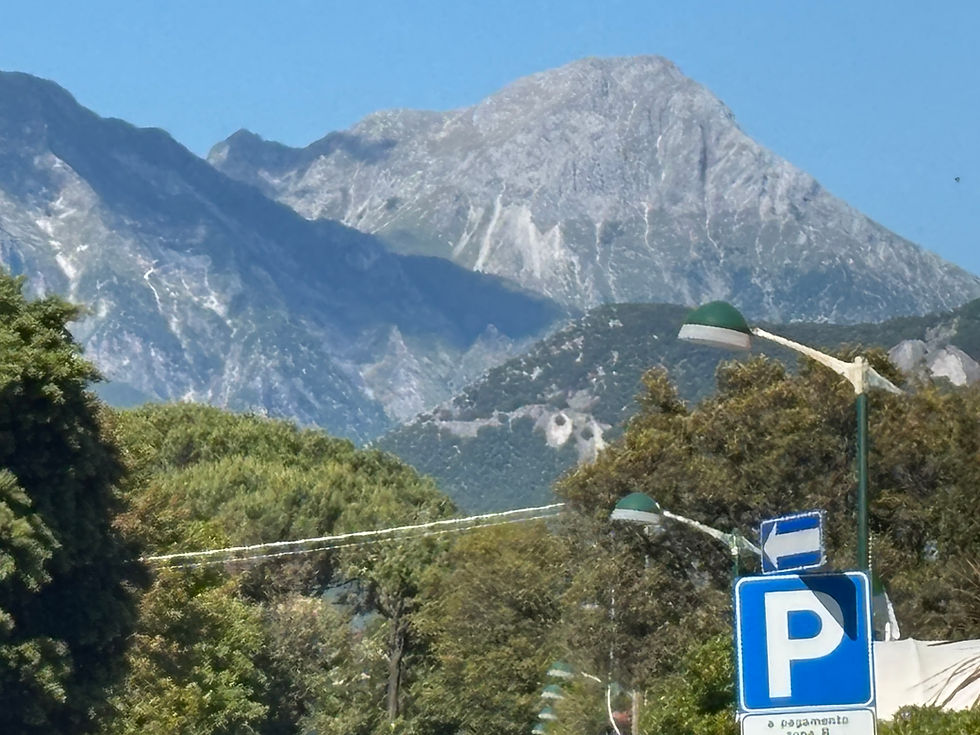
The shipping of this stone is actually what gave Forte dei Marmi its name ("Fort of the Marbles"). built to defend the coast from outer attacks
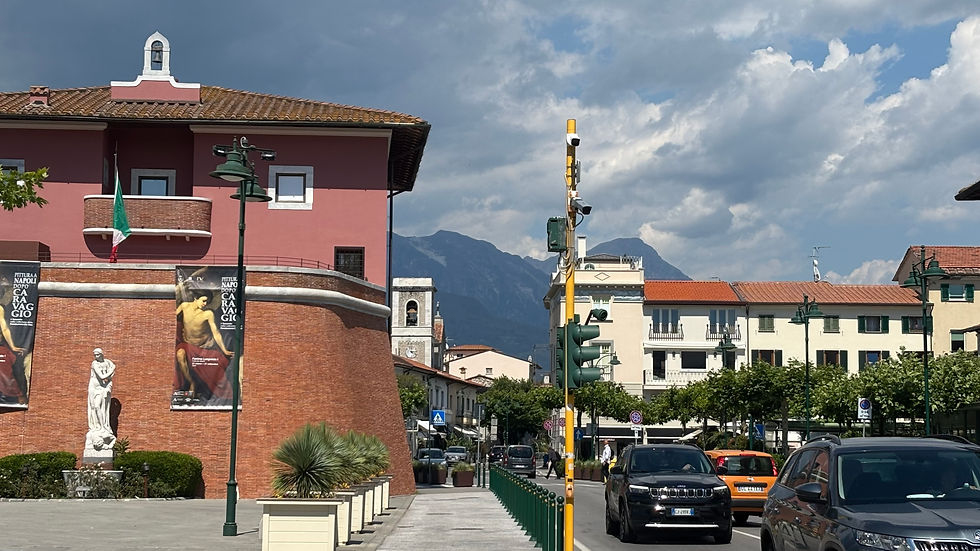
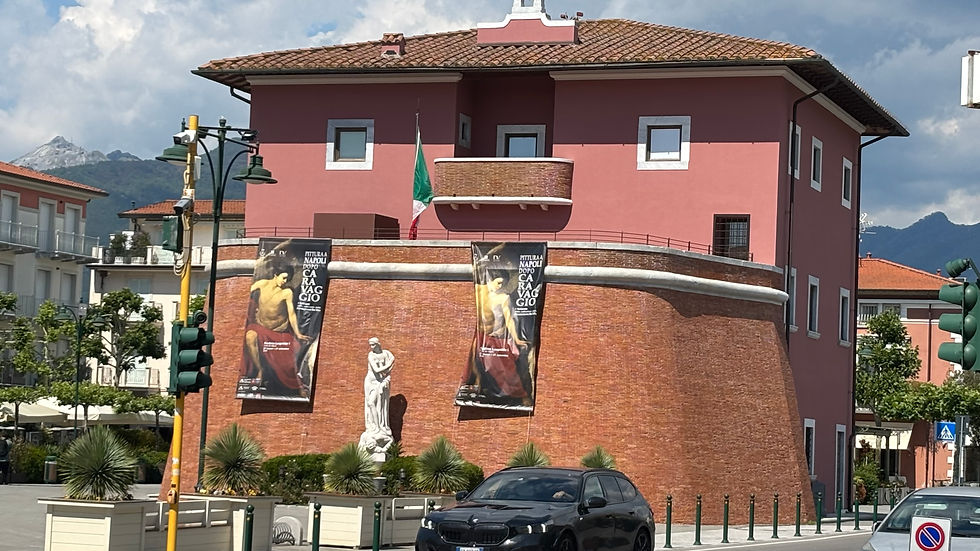
The town takes its name from the fortress that rises in the middle of the main square, (Garibaldi Square) built under Grand Duke Peter Leopold, who was to become Leopold II, Holy Roman Emperor, in 1788
It was built to defend the coast from outer attacks but in the 19th C and the beginning of the 20th C the town became a marble Depot for the place where the marble was quarried from the Alpi Apuane
The Fortress (Italian Fortino), after being employed as a postal service office, sustained structural damage primarily during the devastating September 7, 1920 Garfagnana earthquake, which strongly impacted the entire region.
Now it is museum of satirical art.
.
The town's historic marble pier (Pontile) and crane (La Mancina) were destroyed by the Nazis during World War II
The Marble statues on display at the Town's various traffic Squares
Even the town's sidewalk edges is marveled
The Long Lido Beach Strip

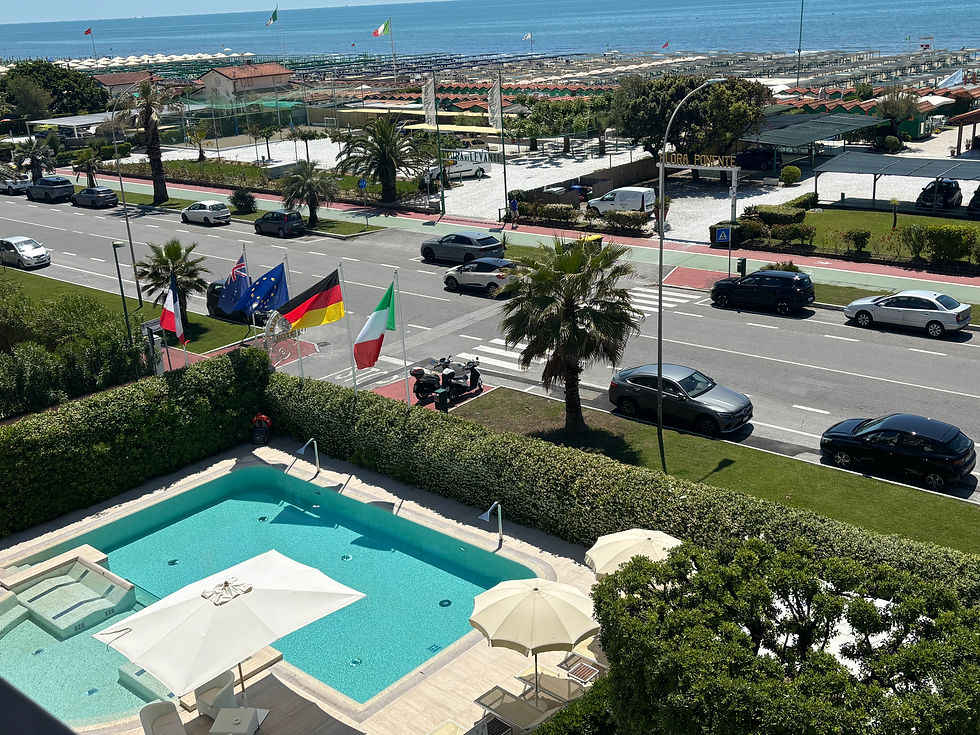
The town developed from a simple marble depot to a renowned seaside resort.
Forte has enamored artists and poets who immortalized it in their works
Tourism became the principal activity of Forte dei Marmi's township.
The town was popular with aristocratic families of the 19th c. At the beginning of the 20th c wealthy industrialists as well as renowned artists took up residence there.

Since the 1960s, Forte dei Marmi has established itself as an icon of fashion, where VIPs live “la bella vita" during the summer months. this area is a true paradise for luxury lovers.
Hotel Negresco next to Villa Grey

The population of the town, amounting to 6,613 nearly triples during the summer, because of the hundreds of tourists. This major destination attracts the Italian upper class. who mainly come from Florence, Milan, Germany, and Russia.
The iconic wooden cabins have always given their colorful welcome to tourists

They are members of the international jet set who find themselves in this city of a thousand faces. with many celebrities who are attracted during the summer months.to the fine sandy beaches, clear water. top-tier infrastructure, plush boutique hotels and Lidos, gourmet dinning, and designer boutiques,

However the Versilia coastal shelf starches long into the sea thus the water is very shallow good for huddling i but not for swimming. Furthermore the cost of beach chairs, umbrellas and cabanas at the private endless Lidos are over the top (some 500Euro per day) with
Street car parking though is free, if one mange to find spot during high season times..
NO free of charge public beach seating area (though access is aloud) as to ideally bank on a towel, let alone on ones own private chair, is aloud on the water edge, conquered by the Lidos' money machine industry. ..

The refined city center offers , in addition to glamorous shopping brands also art galleries, many restaurants and Cafes as well as vibrant nightlife, bars and nightclubs,
The sleepy serene resort town we encountered for 3 days in the month of May, apparently perks up in mid June and in August -high season- swells with visitors and offers a variety of operas and concerts on weekday evenings.as well as is marked by a variety of events, including plays, and exhibitions.
The Puccini Festival, for example, takes place in Torre del Lago from mid-July to mid-
The festival is followed by the St. Patron celebrations, a major event that ends with a huge fireworks display.
Each Wednesday, a market is held Piazza Marcon which sells discounted designer clothes, leather goods, and other products
The resort town under the dramatic mountains in its back, is completely flat, along the beach strip and the rest of town and is a bikers' heaven which we too enjoy when exploring the center and the small narrow streets dotted with enormous plush villas.
Hotel 1908
Food

Enoteca Alex - Fish Restaurant
Via Versilia, Marina Di Pietrasanta. (next village). +390584 746070 +39 347 7774337
Very good fish place
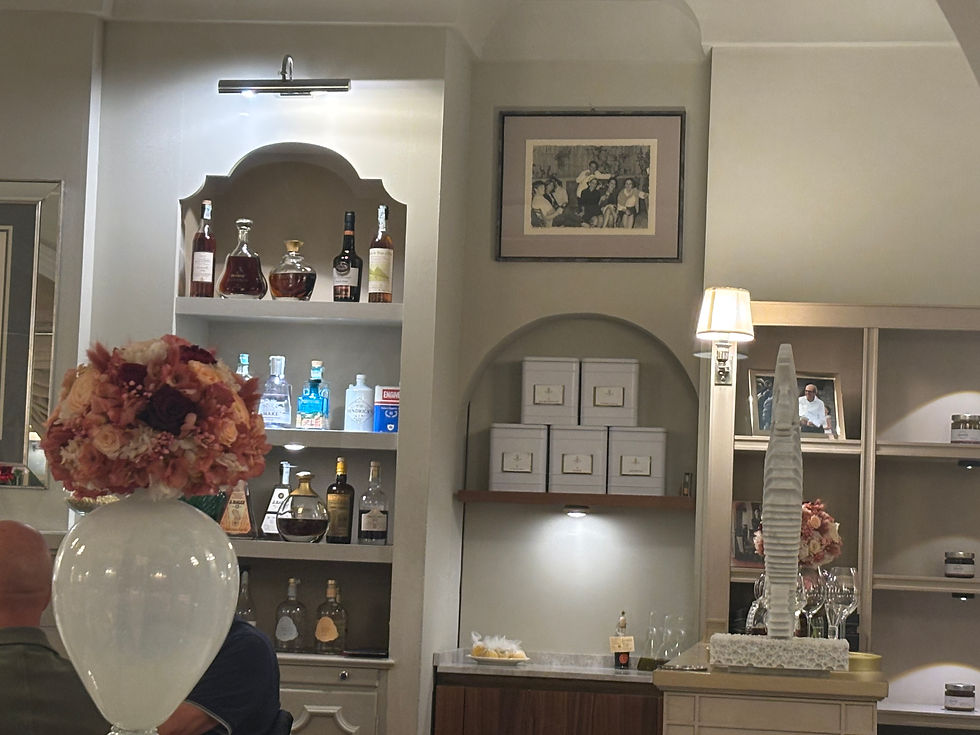
Viale Franceschi 14 Forte dei Marmi +39 058489879
An excellent gourmet creative restaurant, this is the flagship establishment of the Vaiani family,

Via Giosue Carducci 2 +39 0584 89238
An iconic 1950s-style pastry shop and bar in the heart of Forte dei Marmi
Acquired and meticulously restored by the Prada Group in 2023, it is famous for its classic Italian breakfasts, artisanal pastries, and evening aperitifs
Hotel Stayed in:
All worthwhile Hotels on the main coastal road are lined up across the road from the beach strip, which is dotted only with Lidos and restaurants on the beach side.

Viale lungomare Italco Forte dei Marmi 82. +39 0584 78820 info@hotelilnegresco.com
This small charming refined 4-star hotel, located along the long Seafront, with
30 elegant rooms, all with a balcony and fantastic sea view and great breakfast.
I highly recommend
Another upscale hotel (5 stars) recommended in town is:

an elegant boutique hotel
The villa in which the hotel is housed is a historic residence constructed in the first half of the last century at the behest of the Duke of Zoagli, José “Pepito” Caferino Canevaro, an aristocratic Italian-Peruvian playboy and cosmopolitan figure of the early 20th c
A prominent member of the noble Canevaro family of Zoagli, he is best remembered for commissioning the seaside retreat in Forte dei Marmi that is now the luxury Hotel Byron.
The Canevaro family originated from Zoagli on the Ligurian Riviera. His ancestors established massive shipping and financial empires in Peru in the 19th c, with his forefather Giuseppe Canevaro serving as the Peruvian Consul.
The title "Duke of Zoagli" was granted to his family by King Vittorio Emanuele II of Italy for their financial contributions and political services to the newly unified Italian state.
"Pepito" Canevaro as he was nicknamed, was known for his bohemian, unconventional lifestyle and international socialite status
The private summer residence villa in Forte dei Marmi was personally dictated by him in the “Art Nouveau” style which was popular in Europe between the 19th and early-20th century, and which quickly became a popular gathering spot for the European aristocracy, especially for the Savoy family. including the Italian Royal Family.
.
At the beginning of the 1900s, the residence was transformed into a refined hotel, taking its name from the English poet and politician, George Gordon Noel Byron, who visited the Grand Duchy of Tuscany – and in particular, Pisa and Livorno – between 1821 and 1822.
Sun-Set In Forte dei Marmi

An hour an half after departing Forte Dei Marmi, and just prior to visiting the famous Tarot Garden (below) a short stop ,while driving down south, along the Tuscan coast, at the port town Piombino revealed the following:
Piombino

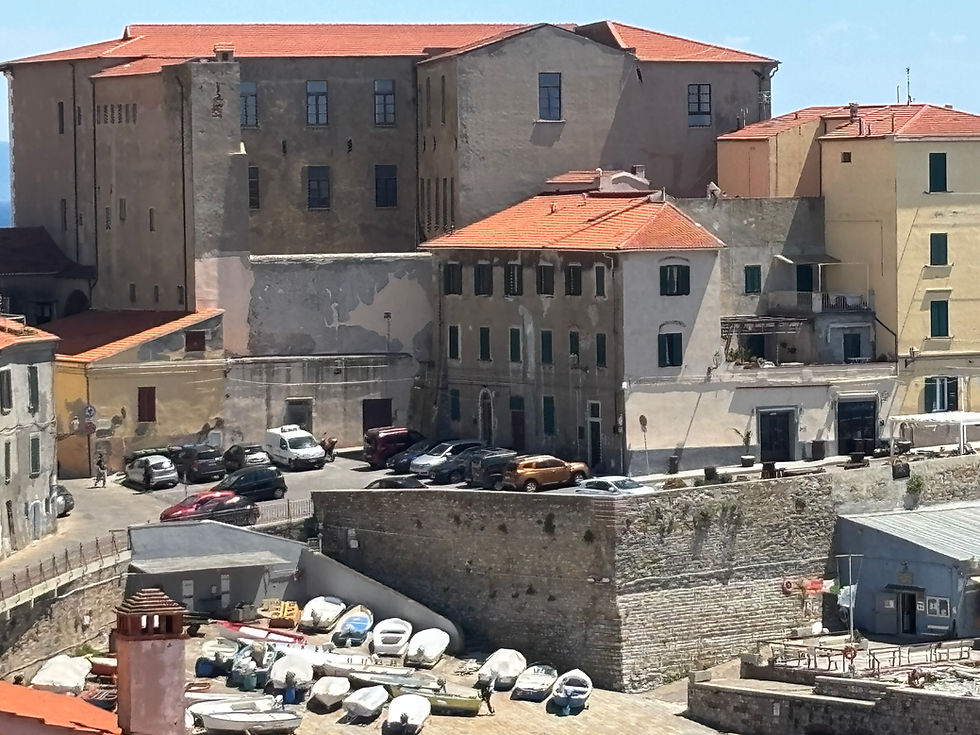
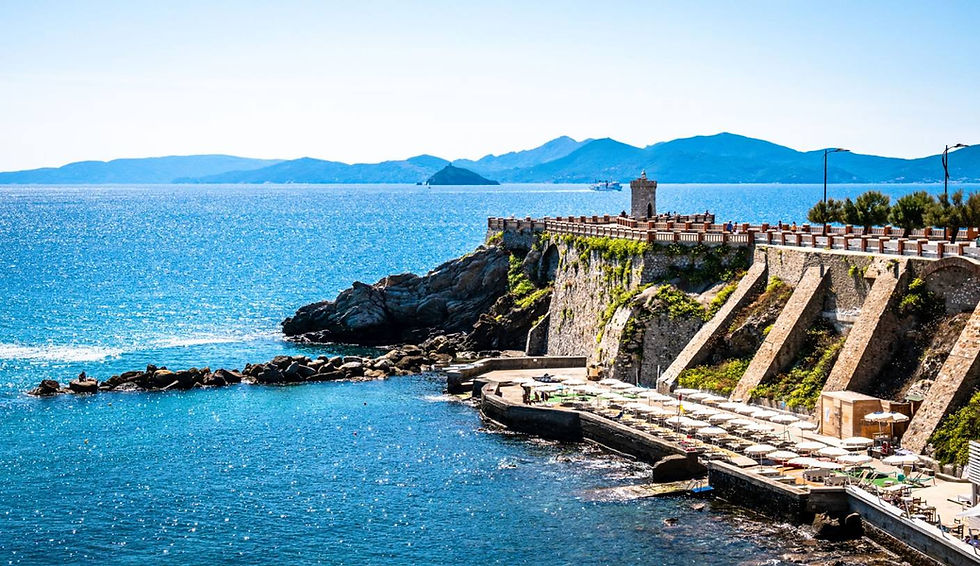
This seaside town of Piombino is set on a headland promontory extending into the sea, on the border between the Ligurian Sea and the Tyrrhenian Sea,
in the province of Livorno, southern Tuscany and is the main gateway to Elba Island which floats in front of it
Most of its ancient history is linked to the Etruscans with remains preserved in the Baratti-Populonia Archaeological Park,

Furthermore the Medieval era, when the town was an important port of the Republic of Pisa .is evident is. by the architecture potted in the the historic massive city walls and the Torrione, elements of defense and protection from external attacks, and by the Fonti di Marina,( historic medieval fountains located at the ancient port built in 1247, and where ships were once supplied. and the castle Medici fortress.
Its hinterland hosts a considerable industrial area,which takes a way from the town's touristic appeal. Its port is still heavily used, both for industry and for tourism, with ferry-boats to Portoferraio (Elba) and Olbia (Sardinia).
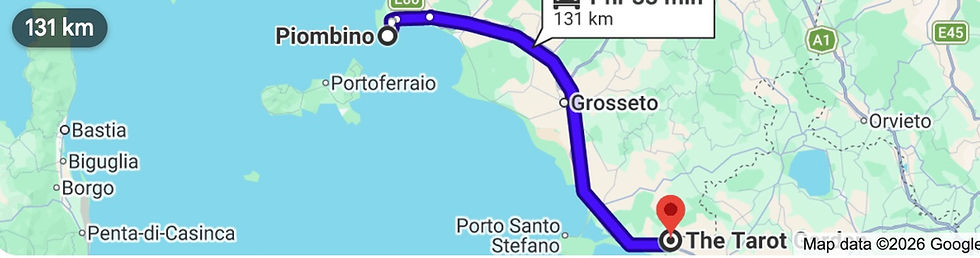
It took another 1.5 hours drive along the west coast from Pombino to the Tarot Garden, highly recommended by my dear knowledgeable friend Iris
The Tarot Garden - An Artistic Kaleidoscope


In Pescia Fiorentina, località Garavicchio, in the municipality of Capalbio, province of Grosseto, Tuscany,
Opens daily from 2:30 -7:30 0564 895122. (Better to check before going)
Only online purchase of tickets guarantees entry
Opened to the public in 1998 the Tarot Garden is a fantasionic sculpture garden based on the esoteric tarot, created by the French-American artist Niki de Saint Phalle (1930 – 21 May 2002)

Niki de Saint Phalle was the French American sculptor, painter, filmmaker, and author of colorful hand-illustrated books is widely noted as one of the few female monumental sculptors, also known for her social commitment and work.

Niki had a difficult and traumatic childhood and a much-disrupted education, which she wrote about many decades later


Her idiosyncratic style has been called "outsider art"; she had no formal training in art, but associated freely with many other contemporary artists, writers, and composers
She first received worldwide attention for angry, violent assemblages which had been shot by firearms. later transformed into whimsical, colorful, large-scale sculptures of animals, monsters, and female figures. Her most comprehensive work was the Tarot Garden, a large sculpture garden containing numerous works ranging up to house-sized creations.
Upon returning to Umbria's hinterland center area we were delighted to encounter our dear friends Chani and Kobi, (returning from Venice) who independently checked -in to the same hotel we had stayed at - the Orvieto Alta Rocca, and with whom we spend touring, the next 5 days.
To be continued...


Comments