
Travel:Napoli&Surrounding. Italy 04/27-30/2026
Updated: Aug 8
A continuation of a trip which started on April 14th
Amalfi Coast&Town.04/23. (here)

Gulf of Napoli


On the short way from Pompeii to Napoli along the coast the drive passes through Torre del Greco - (Two-thirds destroyed by the eruption of Vesuvius in 1631) and Torre Annunziata -( twice destroyed by the eruptions of Vesuvius (ad 79 and 1631)
These 2 coastal towns are located directly along the route that offer panoramic glimpses of the sea the bay and Vesuvius. The Bay/Gulf of Napoli stretches from Mt Proceda to the Sorrento peninsula with the imposing Mt Vesuvius dominating the area. The semicircular inlet of the Tyrrhenian Sea is a roughly 15-kilometer-wide coastline which entirely faces the Metropolitan City of Naples. The islands of Capri, Ischia (visited in previous trips) and Procida (not yet visited) are located in the Gulf of Naples
The towns under Vesuvius in the Gulf of Napoli across from Napoli Town, are known as the Vesuvian villages (or Paesi Vesuviani),

Located on the eastern and southern slopes of the volcano. in addition to Pompeii and Ercolano (Herculaneum), which I mention in the previous post (Here) as well as the Tore towns (mentioned above)
there are also the coastal towns of Portici, (site of the Portici Royal Palace - built between 1738-1748 by
Charles III of Spain, King of Naples and Sicily,, and the town's of Boscoreale, and San Giorgio a Cremano all along the route..
The painting of the Vezubio's eruption by the Us born artist Andy Warhol, is from the exhibit visited at Villa Rignatell in Napoli (see below)
Napoli

We last visits Napoli during the Sukkot Holiday of Oct /2023 (here) 4 days prior to the Oct 7th attack on Israel,
Since then , many changes have taken place in the Middle East , and the wold entire, however not in Napoli...

On the Monday (o4/27) we drove into town, the streets around Piazza Plebiscito and Palazzo Reale
(the Royal Palace) were mobbed with down-shore tourists, just off the cruise ships, and hundreds of school children dressed in ancient Egyptian garments, for the end of the school year's festive occasion, of viewing Giuseppe Verdi opera - Aida at Napoli's historic San Carlo Theater
Piazza Plebiscito
The largest and most iconic public square in Napoli, set near the waterfront at the end of Via Toledo (main street)

The square was pedestrianized in 1994, making it a key, open-air center for concerts, for public cultural events and tourism.

In the start of 19th c, the King of Naples, Murat (Napoleon's brother-in-law), planned the square as a tribute to the emperor.
It is named after the plebiscite taken on 1860,
that brought Naples into the unified Kingdom of Italy under the House of Savoy.

The square is framed by the Royal Palace and the church of San Francesco di Paola a neoclassical church with a semicircular colonnade reminiscent of the Pantheon in Rome.,
In the center stand two statues representing Charles III and Ferdinand I of Bourbon, crafted by Antonio Canova and his pupil Antonio Calì. Inaugurated in 1829
The Royal Palace - Palazzo Reale
The Royal Palace of Naples, and Church of San Ferdinando. (17 C) are set at San Ferdinando historic seaside neighborhood famous for Piazza del Plebiscito, mentioned above.

The Neapolitan neoclassical palace was built from 1600 on wards by the architect Domenico Fontana as the residence of the Spanish viceroys,
Charles of Bourbon made it, from 1734, the main residence of the Bourbons of Naples for more than a hundred years
It was also the residence of Joseph Bonaparte and Joachim Murat during French rule (1806–1815), under which extensive redecoration were carried out.
After the Italian unification (1861) it passed into the hands of the Savoy, until Victor Emmanuel III ceded it to the state in 1919. which later the western half of the palace was opened to the public as a museum of the Royal Apartment. In 1924 its eastern half became the home of the National Library, uses that continue today.
Coronation Chair
As I never visited inside the palace before, I enjoyed wondering inside its vast rooms., exploring during this visit
Caruso Museum

A first national museum - on the first floor inside the Royal Palace was dedicated to Enrico Caruso, on the occasion of the 150th anniversary of the his birth. It opened in July 2023,
Set up in the Sala Dorica, which once served as the 19th-c carriage house,
the museum offers an immersive journey through the life and career of Enrico Caruso - native of Naples, (1873-1921) and, one of the most renowned tenors of all time. In the early 20th
Caruso moved to the United States, where he achieved worldwide fame, becoming the first artist in history to sell over a million records.
The exhibition space features a collection of costumes, records, period gramophones, and original sheet music, alongside photographs, posters, and other memorabilia from Caruso’s personal life and multifaceted talent
Teatro di San Carlo

Next to the Royal palace, and among the oldest in Europe,is the historic Neapolitan opera house. It was
.Inaugurated in 1737, and named the San Carlo Theater , ( Via San Carlo, 98,)
It is connected to the Royal Palace and adjacent to Piazza del Plebiscito.
"Royal Theatre of Saint Charles", as originally named by the Bourbon monarchy, holds over 2000 spectators, and is one of Italy’s largest theaters. Given its size, structure and antiquity,
it was the model for theaters that were later built in Europe.
Attending a Ballet Performance at the Theater
George Balanchine (1904 -1983) choreography shaped the ballet performance we saw at the San Carlo Theater, was staged by the San Carlo's theater ballet company
George Balanchine was a Georgian-American ballet choreographer, recognized as one of the most influential choreographers of the 20th century. Styled as the father of American ballet, he co-founded the New York City Ballet and remained its artistic director for more than 35 years.

The City of Castles
Napoli is historically known as the "City of the Seven Castles" (Città dei sette castelli). In its ancient city limits, it featured 7 defensive fortresses, though today only 3 major castles are widely open and preserved as major tourist attractions.
Castle dell"Ovo Castle Nuovo Castelo S. Elimo
Castel dell'Ovo: The oldest castle in the city, sits majestically on the small islet of Megaride. The current medieval structure was built in 1128 by the Normans.
However, the site's history goes back much further, beginning with a 1st-c BC
Roman villa built by Lucius Licinius Lucullus - a Roman general and statesman
Legend says the Roman poet Virgil hid a magical egg in its foundation
that protects Naples from disaster, thus its name
Castel Nuovo (Maschio Angioino): built in 1266 by Charles I of Anjou It is a prominent fortress with five towering walls and a Renaissance triumphal arch, near the port.
It stands as a symbol of the city’s rich medieval heritage and royal past.
And the third and only castle we frequented on this visit is: Castelo Elimo

The star-shaped, medieval fortress built in 1329 is located on elevated position on the Vomero hill - an upscale, high-altitude neighborhood, that offers 360-degree panoramic views of Naples, the city, Mount Vesuvius, and the Gulf of Naples. Famed for its distinctive six-pointed star shape and construction from volcanic tufa, it is a cultural landmark that combines history, art, and natural beauty..
Napoli operates 4 funicular railways—Central, Chiaia, Montesanto, and Mergellina—that efficiently connect the city's waterfront and historic center to the elevated Vomero and Posillipo hills. 3 of the funicular railway lines (Central, Chiaia, and Montesanto) connect the lower parts to the top of Vomero hill In just a few minutes.
Metro Line 1 stops right in the heart of the neighborhood at the Vanvitelli station

Robert of Anjou built Castel Sant’Elmo in the 14th C as a military fortress.
Over the centuries, the castle played a crucial role in defending the city from invaders and served various functions, including as a military prison.
Its strategic position made it one of the most important fortresses among the the castles in the city.
Castle's Terrace
Views from the Castle


The castle’s terrace offers one of the most spectacular panoramic views of Napoli, stretching from the historic center to the islands of Capri and Ischia.
Located within the castle, the 20th-Century Art - on display, showcases works by contemporary Neapolitan artists, blending modern creativity with the historic setting.


How to Get to the Fortress on Vomero hill by Funicular
The Central Funicular off Via Toledo (main street ) most popular line, connects Via Toledo (near Piazza del Plebiscito) in lower part of town, directly to Piazza Fuga on Vomero Hill .
Off at Piazza Fuga (last Station),
From there follow the posted signs to the Castle, via a set of steps/escalators which will lead to the hill-top and the castle's entrance.

National Archeological Museum of Napoli

Museo Archeologico Nazionale di Napoli, abbr. MANN
Piazza Museo, 19, 80135 Napoli NA +39 081 442 2111 .Open daily from 9:00 - 6:30 PM; closed on Tuesdays.
One of the most important archaeological museums in the world was founded in 1777, This important Italian Archeological museum houses world-class treasures works from Greek, Roman and Renaissance times, and especially Roman artifacts from the nearby Pompeii, Stabiae and Herculaneum sites, including collection like the Massive, breathtaking ancient marble statues of the Farnese Atlas , Farnese Bull, and Farnese Hercules, .
Real wall frescoes, glass tableware, everyday tools, and real floor mosaics from Pompeii. including pieces from the House of the Faun, that were moved from the ruins for safekeeping, are all on display requiring about 2 to 4 hours to see the main highlights.
The grand museum building was built as a cavalry barracks in 1585.
From 1616 to 1777, it was the seat of the University of Naples.
From 1816 to 1861, it was known as the Royal Bourbon Museum.
,
Emperor Titus. (79-81 AD) Statue of God Ocean Emperor Claudius (41-54AD)
Amazing Roman Mosaic
Ancient Roman Erotic Art
Famous paintings featuring three naked women - Three Graces , which were painted throughout history, most probably influenced by this Roman ancient 1-2 C painting.
Botticelli (1470) Rephael. (1500) August Make (1900)
Rubens (1600) Carle Van Loo (1765) Carl Newman (1900)
Villa Rignatell - Museum

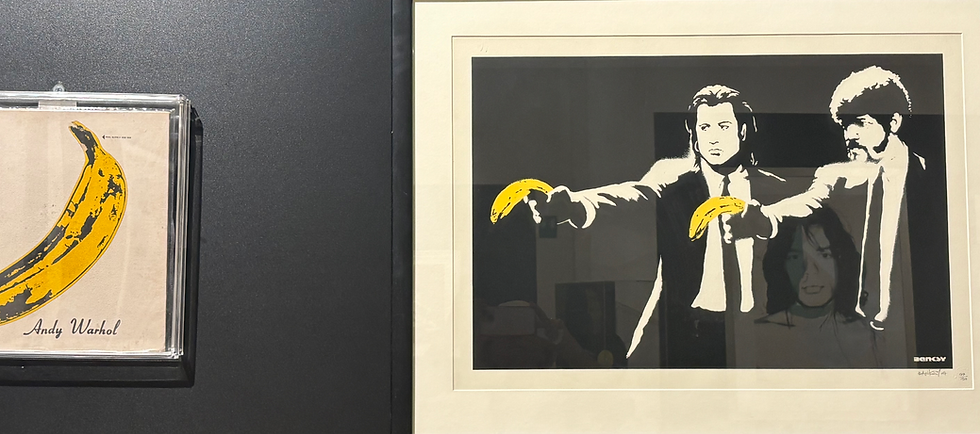
While walking through the city's streets , many announcements about the current exhibition of Warhol VS Bansky were advertised off public buildings.
The "Warhol Vs Banksy - Passaggio a Napoli" exhibition (Jan 22–June 2, 2026) compared Andy Warhol’s commercial pop art with Banksy’s anonymous, subversive street art.
Featuring over 100 works, it explored how both artists revolutionize art through criticism of consumerism, fame, and media, connecting their styles to Napoli.
The work was exhibited at a beautiful
Villa Rignatell - Museum
Although I visited Napoli many times, it was the first time I frequented Villa Rignatell.

This Elegant grand 19thc Neo-Renaissance villa (1826) just few steps from the most beautiful promenade. is set in the Chiaia district. It is a significant examples of Neapolitan neoclassical architecture, and it is surrounded by a lush English style garden designed in 1830,, by Guglielmo Bechi
It serves now as a museum featuring 19th-c furnishings &art
Villa Pignatelli (after built by Baron Acton) became the property of wealthy Rothschild German bankers.

Frankfurt-born Carl Mayer von Rothschild (Charles) Mayer , (1788 – 1855 ) the fourth of the five sons of Mayer Amschel Rothschild ,was the founder of the Neopolitan branch of the prominent Rothschild family. The 1821 occupation of Napoli by the Austrian army provided the opportunity for the Rothschilds to set up business in the Kingdom. Carl Rothschild was therefore sent to Napoli,, where he established C M de Rothschild & Figli to operate as a satellite office of the Rothschild banking family's headquarters in Frankfurt
Carl who lived in the villa until 1860. ordered the construction of a secondary building at the north end of the park, called now the Rothschild building.
Carl proved himself in Napoli as a strong financial manager and someone very capable at developing all-important business connections. He gained a significant influence with the Bourbon king in Napoli, and established good working relationship with Luigi de' Medici, the "Direttore della Segreteria di Azienda del Regno di Napoli" (Finance Minister), and his operation became the dominant banking house in Napoli
On Display at the Villa

Though the villa belonged to several noble families, it owns its fortune to the last owners, the Aragona Pignatelli Cortés cultured family. who over the years collected marbles, bronzes, porcelains, books and even records, which today form the heart of the collection displayed to visitors.since 1955,
The Villa became the property of the Italian state and turned into a house-museum,
home to 2 exhibition sections: the Pignatelli Cortès Museum and the Carriage Museum.
Museum Real Bosco di Capodimonte


The Palace of Capodimonte, (Via Miano 2, Naples,) which houses a major national art gallery. is surrounded by a massive 134-hectare historic royal park/ wood, set on top of Capodimonte Hill -"Top of the Hill," in Napoli
The park features English-style gardens, scenic walking paths, and rare exotic plants overlooking the Bay.
The museum is about 5-6 km drive north of Napoli's historic city center. However the park and art on display worth the visit. Guidelines and ticket information at Capodimonte Museum Guide.
Museo e Real Bosco di Capodimonte is housed in this grand 18th-c royal palace and former hunting lodge built by the Bourbon King Charles. This world-class art museum features the Farnese collection and masterworks by Titian, Caravaggio, and Raphael,
Andy Warhol's painting of Vezuvio welcomes visitors at the entrance to the museum
We arrived there for the first time, almost at closing hour (6;00pm) but the guards were gracious and let us in, for. a quick pick of Carvaggio's paintings.
Pietrasa Rail Way Museum


The National Railway Museum of Pietrasa is close to the Napoli–Portici railway. Local and regional trains on the Naples-Salerno line stop at Pietrarsa-San Giorgio a Cremano Station,
about 10 km southeast of Napoli's city center. Driving there takes around 18 to 30 minutes via local coastal roads or the A3 motorway,

This is the place where the history of the Italian railway was born. and it is one of Europe’s most evocative railway museums.
The museum is housed in what was originally the Bourbon workshops. "Bourbon works' Officine di Pietrarsa" founded in 1840 on the orders of Ferdinand II of Bourbon to build steam engines for ships and boilers for locomotives.
The Museum’s collection is made up of over 55 pieces of heritage rolling stock, housed in each of these pavilions once hosted specialized departments in the production cycle.. The historical locomotives, engines, machinery, carriages and model railways on display span from the 1800s through to the 1980s.

Neapolitan Eateries
Great Paticcereia

Pintauro 1785
Via Toledo 275
The historic Pasticceria Pintauro 1785 an institution, a cornerstone of the Neapolitan pastry art that has been present in the city for three centuries
Pintauro, invented the famous Neapolitan pastry the Sfogliatelle

Gambrinus since 1860 Storico Grand Cafe
Gran Caffè Gambrinus (founded 1860) is Naples' oldest and most prestigious historic café, located near Piazza del Plebiscito. in front and to side of the Royal Palace of Naples
It is famed for authentic Neapolitan coffee, pastries (sfogliatella/baba), and Belle Époque decor, serving as a popular high-end, tourist-friendly spot. Options include standing at the bar or elegant table service.

The name Gambrinus is a legendary somewhat tipsy figure of joviality, and his name is used for various brands and many establishments. Legends tell that Gambrivius learned the art of brewing from Osiris Isis the ancient Egyptions gods.
The cafe was also known for being a meeting site for intellectuals and artists, including Gabriele D'Annunzio and Filippo Tommaso Marinetti. It was the meeting point of Oscar Wilde, Gabriele D'Annunzio, Ernest Hemingway, Matilde Serao,[2] Princess Sissi, Jean Paul Sartre,[3][4] Guy de Maupassant, Émile Zola, and Benedetto Croce

Great Ice-Cream Place
Desio Gelato and Pastry
Royal Continental Hotel Via Partenope 38. 081 1980 7261
a wide range of high-quality gelato flavors, artisanal pastries, and refreshing beverages,
Restaurants
Traditional &non-traditional Pizzas Traditional Food Fusion-style restuarnte
By water Front City Center -Off via Toledo In Santa Lucia
Historic Santa Lucia Neighborhood
Santa Lucia a Mare Basilica

Borgo Santa Lucia - the historic seaside neighborhood is famous for its ancient fishing village roots, stunning waterfront views, and iconic landmarks like Castel dell'Ovo, Basilica, many grand hotels, and restaurants.
The area began as the site of Roman general Lucius Licinius Lucullus's massive, luxurious villa estate, were the Fort now dominates.
The name is taken from the historic Santa Lucia a Mare Basilica, which has stood by the shore, since the 9th c
The popular pedestrian oceanfront promenade which stretches along the coast toward Chiaia, is always full of strolling locales and incidental tourists
An upscale Chef Restaurant Qmme

Ristorante Qmme Trattoria di Charme
Elegant place of creative cooking by a Polish chef
in the historic Santa Lucia village area, neighborhood behind the Hotel Excelsior near the waterfront.
TransAtlantico Restaurant. in Polricciolo di Santa Lucia


The little picturesque Port of Santa Lucia or the Santa Lucia Marina. is a small historic popular tourist harbor nestled along the Italian coastline. located in the central waterfront district of Borgo Santa Lucia and just across the hotel we stayed in - Eurostars Excelsior Hotel.
Once a simple fishing village, the surrounding evolved into an upscale destination for its atmosphere, hotels and Sea Food restaurants


TransAtlantico Restuarant
Via Luculliana, 15, +39 081 764 8842
This very good Fish restaurant right on the pier next to Castel dell'Ovo, overlooking the small harbor, offers views of the marina and Mount Vesuvius in a truly beautiful atmospheric setting.
There are other restaurants at the marina's pier and behind
the visible buildings, however we liked TransAtlantica the best, and frequented it twice during our stay in the city.
Hotel we Stayed At
Hotel stayed at

Via Partenope 48 Napoli. +39 081 7640111
Located on the Lungomare, in front of the promenade by the Sea
It offers views of the Gulf of Napoli, , Mount Vesuvius and the island of Capri,
10 minutes walk from the 18th-c Teatro di San Carlo, the city center , Funiculars and and the Metro stop.
We stayed at this hotel few years ago, when it was in a much better condition and was better maintained. It is sad it has been deteriorating, with the competition of hotels rising.
Views from the Hotel
The Small Marina and Fort

The Hamlet of Bacoli
A short excursion to this recommended small town is worthwhile the drive.

Myth, history and nature make Bacoli a great destination

The scenic small coastal town Bacoli
(of about 30,000 residents) is hugged between the sea and two beautiful lakes, (small lake Fusaro Lake Miseno,)

It is positioned directly 15 km west-northwest of Napoli across the bay area. on the Phlegraean Peninsula along the Gulf of Pozzuoli,, roughly a 30-to-40 minute drive from central Napoli,

It is part of the volcanic Campi Flegrei region, "The Fiery Field " - a huge underground supervolcano located just west of Napoli , which is a wide bowl-shaped crater, caldera, measuring nearly 8 miles wide.
Its hundreds of thousands of people living right on top of its rim. The volcano of Cape Miseno and the Miseno port date from c. 35,000-10,500 years ago.

Bacoli is a town graced by stunning natural beauty, with serene beaches and panoramic views of the Bay and the nearby islands of Ischia and Procida
Bacoli picturesque Marina/Port
Bacoli has Roman origins, founded by the ancient Romans in the 2nd or 1st c. BC, who called the town Bauli - once a favored playground for imperial elites, and an ultra-luxury holiday popular resort, where wealthy patricians and emperors built lavish seaside villas, as famous as in the nearby Baiae.

Opulent luxurious villas rich in marble, and beautiful mosaics were built on the coastal visible ground and at the headland. while, ancient catacombs, atmospheric caves, monumental tombs hidden tunnels. sprawling bath complexes, and ingenious engineering marvels, were found dug in the underground
Remanent of Roman splendor, at the archaeological park are the ancient thermal baths the Temple of Venus, the Temple of Diana,
Temple of Venus Temple pf Daiana
Cento Camerelle - a large two-story complex of ancient Roman hydraulic water cisterns carved into the rocky hillside is one of the largest ancient cisterns in Europe and is open for guided tours.
Piscina Mirabilis, an immense subterranean water pool-reservoir with soaring vaulted ceilings and towering columns. was built in the 1st AD to supply water to the Roman Imperial fleet,
Cento Camerelle Piscina Mirabilis, Roman Bath
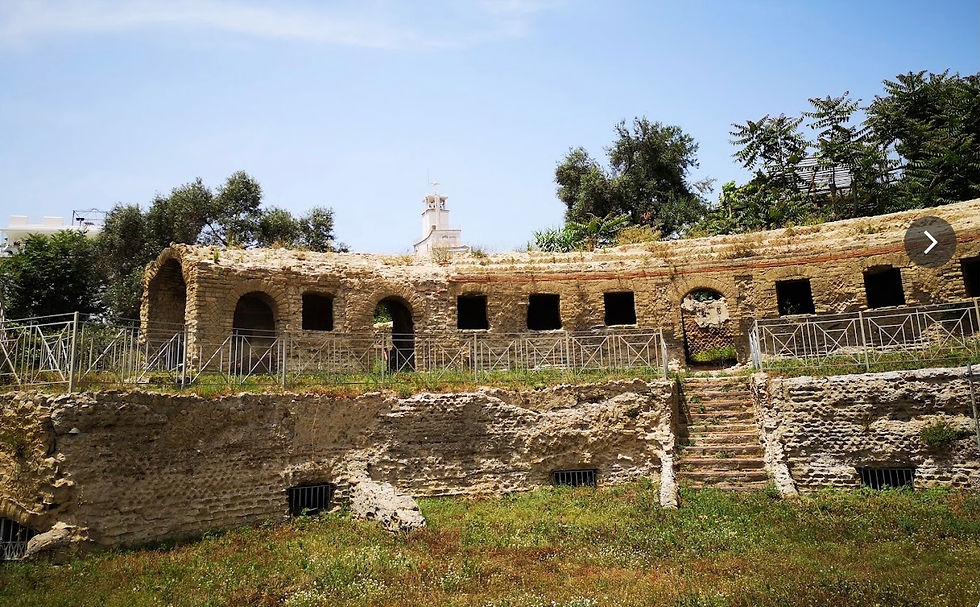
Near the beach, the Tomb of Agrippina is a semicircular ruin once believed to be the resting place of Agrippina the , mother of Emperor Nero; modern archaeology suggests it was part of a grand villa overlooking the bay.
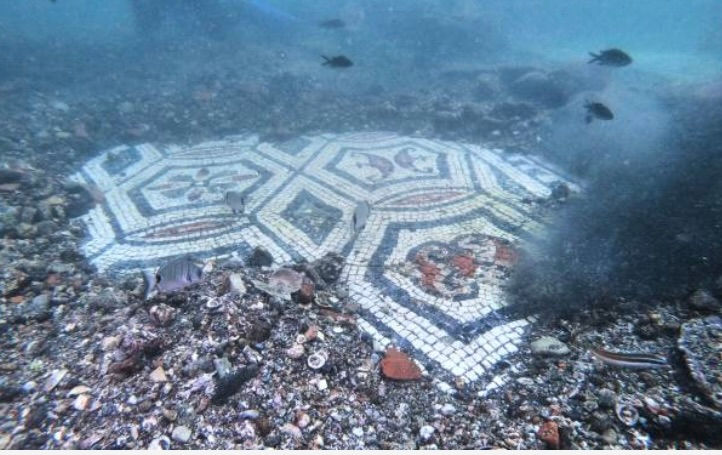
Submerged Ruins of Baia: includes the Underwater Archaeological Park of Baia, where volcanic ground movement submerged ancient port, Roman villas and mosaic floors beneath the shallow sea, buried under a thin layer of sand

Casa Vanvitelliana, a unique hunting and pleasure pavilion built for King Ferdinand IV of Bourbon in 1782 on a small island, in Fusaro Lake, used in the 18th C. to farm oysters and mussels.
As of 1752, thee lake area then sparsely inhabited, became the hunting and fishing reserve of the Bourbons

The massive 15th- C fortress built in 1495 by the House of Aragon, is perched 51 meters above the Gulf of Pozzuoli. It now houses the Archaeological Museum of the Phlegraean Fields (Museo Archeologico dei Campi Flegrei), featuring Roman artifacts from ancient towns and the surrounding volcanic region.
While traveling in Italy (since 04/20) we decided to book, on a spare of a moment, a flight to Israel, after hearing of Trump's tentatively calling off plans for the U.S. military attack of Iran, for the sake of "civilized negotiations" . In my humble opinion it is a guaranteed waste of misguided expectations time.and effort,
THE END!!!


Comments