
Travel:Pompeii Italy. 04/25-26/2026
Updated: Jun 30
A continuation of a trip which started on April 14th
South West Italy. 04/20-21 (here)
Amalfi Coast&Town.04/23. (here)
We have visited Pompeii's excavations at least 3 times in the course of the past 30 years, each time discovering a new earthed-out section, However we never stayed overnight in the rebuilt modern town
until this year's visit, which was an opportunity to discover present time Pompeii, and its surroundings.
From Sorrento to Pompeii

When departing gorgeous Sorrento and the Amalfi coast, on Saturday (04/25) the weekend's incoming traffic into town was one long bumper to bumper car salami, as was also swelled with visitors. the Grand Hotel CapodiMonte Hotel in which we stayed in Sorrento..
Thus it was the right time to,leave and move on with our touring plans .

Luckily, the traffic departing the town, was meager and free flowing, so the ride was enjoyable most of the rest of the way, through the small charming neighboring communities while
proceeding closer to the looming Vesuvius domain
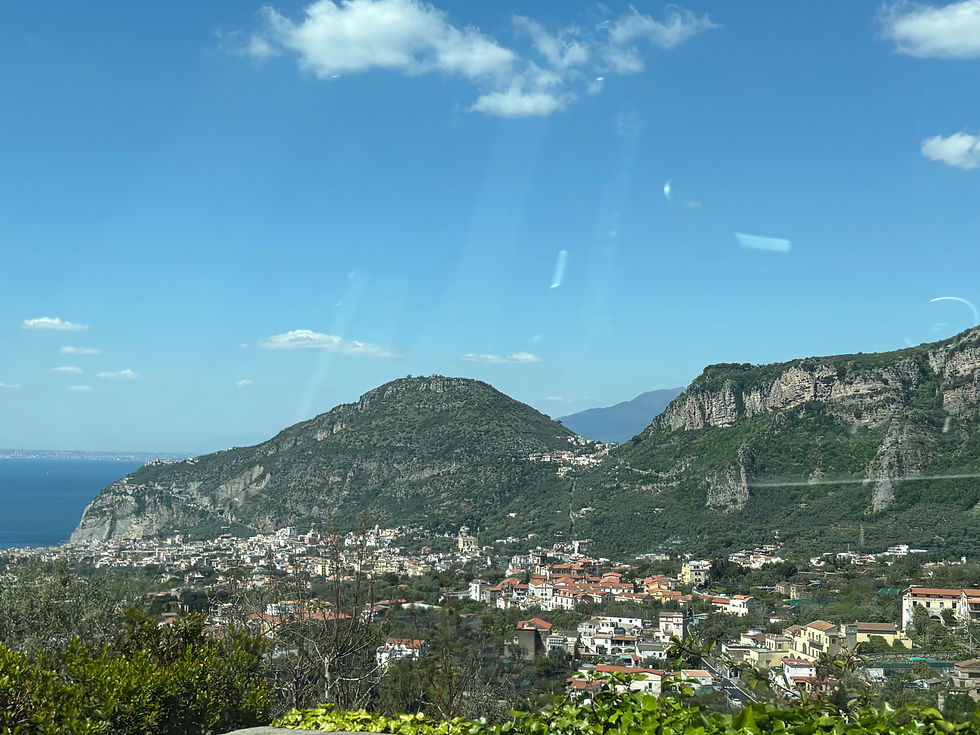
Between Sorrento and Piano di Sorrento a charming, picturesque town situated on a tuff cliff
40 minutes southeast of Pompeii, Piano borders the municipalities of Meta, Sant'Agnello, and Vico Equense

Located on a tuff cliff, the charming town.Vico Equense, a gateway to the Sorrentine Peninsula, is a tourist destination stop, to enjoy local cuisine (such as pizza by the meter) and the spectacular coastal views

The 9th C Medieval Castle which the town is named after, with lush gardens & panoramic views of the gulf & Vesuvius,. was built following the Byzantine style by the Duke of Sorrento, as a border fortress of his dominion
The Duchy of Sorrento was an independent maritime state during the Middle Ages.
The Castle rises to 100 meters altitude above sea level

Castellammare di Stabia an historic, authentic Italian coastal town, is tucked on the mountain side between Naples and Sorrento, and its modern center, on the Saturday we visited, was one long
traffic jam,
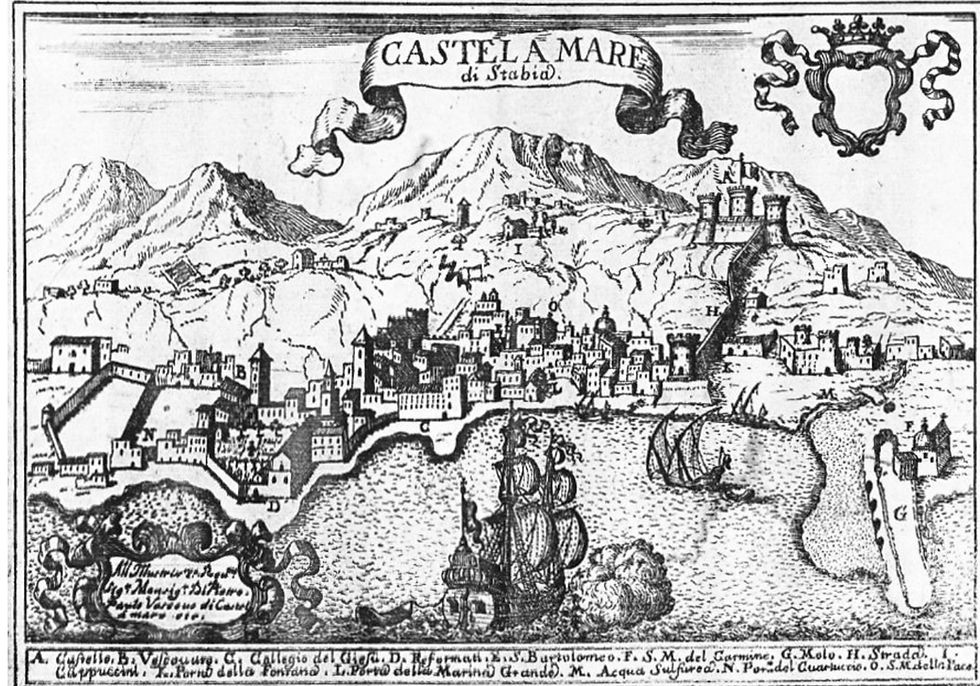
The town is known for its ancient Roman villas: Villa San Marco, and Villa Arianna, (set in an elevated area above the center of town) that were buried by Vesuvius eruption in 79 AD .
Villa San Marco The Castle Villa Arianna
. Faito Cable Cra

Funivia del Monte Faito: Faito cable car, rising from the city center to Mount Faito, offers stunning panoramic views of the Bay of Naples, and a theSeafront Promenade (Lungomare) offers a walk by the beach.
Reggia di Quisisana: A 13th-c historic former royal residence nestled in the hills above Castellammare.
Promanade - Lungomare Royale Palce Castellammare from Above

Sulfurous 28 natural mineral springs were celebrated in the area, since Roman times for healing at Thermal Baths (Terme di Stabia) located along the coast,
Much later they were re-built around the 19th c at the behest of King Francis I of Bourbon, and now serve as a wonderful tourist thermal center,

This Quaternary volcanic chain situated in the Campania region of southern Italy along the eastern Tyrrhenian Sea margin, features a series of active, dormant, and extinct volcanoes formed in a back-arc extensional setting above the subduction zone where the African plate converges with and subducts beneath the Eurasian plate
The Naples bay area is primarily defined by three active volcanic systems: the famous Mount Vesuvius (Somma-Vesuvius) to the east, the sprawling Campi Flegrei (Phlegraean Fields) caldera to the west, A "supervolcano" caldera with 24 craters and cones, including the active Solfatara and the 1538-formed Monte Nuovo. and the islands of Ischia. & and Procida last erupted in 13o2
Paying Visit to Mt. Vezuvius Vulcano
On the way to Pompeii, we drove up to Mt Vezuvio . The climb starts from Ercolano

located on the Gulf of Naples 9 km southeast of Pompeii, as the bird flies. However, the driving distance is approximately 24 to 27 km taking about 30 to 45 minutes by car
The active soma-stratovolcano at 1,281m high, is famously known for destroying the Roman cities of Pompeii and Herculaneum in 79 AD
It is considered one of the world's most dangerous volcanoes due to its high population density surroundings, Active but in a phase of "active rest," its last eruption occurred in 1944.
Ercolano - Herculaneum
Ercolano lies at the western foot of Mount Vesuvius, and is best known for the archaeological site of Herculaneum, (Smaller but better preserved than Pompeii) The town offers a combination of ancient history and modern-day life. Ercolano's archeological site wasn't visited on this trip.
Video Simulation of the Vusuvio eruption in 70 AD
Entrance tickets for the Vesuvius crater (Gran Cono) must be purchased online in advance via the official Vesuvius National Park website or ticketing platforms. Tickets to view the crater cost 12euro per person.
It is quite impossible to acquire the tickets on site, at the Entrance gate to the crater itself.
There are No cashiers nor other help there on top of the mountain

Reaching the volcano by car driving, requires to get off the Hwy at the Ercolano, Exit
Then to drive up the narrow steep Via Vesuvio all the way up, to the last car parking lot at the top, Parking there cost. 7 Euro

From that parking lot, a Taxi shuttle, (3 Euro) which departs every few minutes,, unloads 5 minutes later further up on the mountain, at where the Entrance Gate to the crater walk begins. There were many visitors gathered at the Entrance, however without pre-booked tickets, like ourselves. were struggling
with downloading an application as to buy the entry tickets on line. All our efforts to deal with the application and horrible internet connection out there in the open- air as to get tickets, absolutely failed, There is no cashiers nor staff to help.
Thus buying the tickets on line prior to arrival is critical
Thus, without entry tickets, we gave up on the walk, and compromised on the images from the internet...
.

The walk which we missed, from the Entrance lot, to the Crater's Rim, takes about 20-30 minutes Apparently the panoramic views of the Bay of Naples, seen. from there are stunning.
The volcano is surrounded by Vesuvius National Park, which offers numerous hiking paths, and the area is known for its vineyards.
So we only enjoyed the surroundings and views during the car ride, up and down
The View of the Gulf from the Top of Mt. Vezuvious

Riserva Naturale Tirone Alto Vesuvio

Located on the slopes of the volcano, are ten massive basalt/lava-stone sculptures that flank the road, in this outdoor exhibit seen when driving up/down the Mount Vesuvius reservation.
The monumental sculptures sit along the hairpin bends of the road leading up to the Vesuvius crater, starting roughly from the 1,000-meter elevation mark.
Creator Vesevo

The impressive contemporary heads and abstract figures, carved directly from Vesuvius's own lava stone, were created following an international symposium (2005) where artists from around the world (including works by prominent artists like Spanish Miguel Berrocal, Napolitan Lello Esposito, and Dutch Mark Brusse) came together to shape the volcanic rock,
This open-air museum is known as Creator Vesevo.
Hotel stayed in Pompeii


Bosco De Medici - Wine Resort Pompeii
A quint 4 stars Resort Hotel, property set close to town's center and only at 700m from the Ponpeii ruins. It has a bit of an Kibutz feel, adorned with large green lawns, fruit trees, huge pool, and roaming noisy chickens. It seems to be the best place to relax and spent 2 overnights, when in town.
Bosco De' Medici cellar is the story of two families, Palomba and Monaco, built after a long partnership. It offers visitors a complete food and wine experience: of its own production,
A visit to Bosco de' Medici winery, where home grown vines and wine is produced also offers in its restaurant organic garden vegetable grown on its own land at the foot of Vesuvius,
Archeological Roman Pompeii
Venturing to the Archeological Park took place the following morning with a pre-booked Guided Tour

Sarah the Tour Guide

Sara was the excellent English speaking Tour Guide who lead the group of 20, for 2 hours, through the huge archeological site, concentrating on its main highlights.
+3908118368816
This tour operator offers many departures times throughout the day, but it is better to start early before it gets too hot and too crowded.
Considered an "expert archaeological guide" Sarah, efficiently walked us through:
the Forum, Basilica, Stabian Baths, the Theaters and main Villas, all frozen in time, from when they were buried under the ashes of the fatal Vesuvio's eruption of 79AD, until unearthed in the 17th c ,
Vesuvius Eruption 79Ad
The Forum Image & Remains
The Archaeological Park of Pompeii covers approximately 66 hectares, of which 50 are accessible to visitors. The site is constantly evolving: new areas are opened to the public, buildings are restored, and archaeological discoveries continue to amaze the world.


The Pompeii excavations represent the world's most important archaeological site in terms of size and state of preservation. The excavations encompass over 250 years of archaeological work, having unearthed roughly two-thirds of the ancient Roman city buried by the eruption of Vesuvius in 79 AD, which emerged after more than 1,500 years of oblivion, The ongoing modern excavations focus on consolidating the site and uncovering newly accessible city blocks,
offering snapshots of daily life in the Roman Empire.

The walk through the ancient paved streets, structures remains, colorful frescoes of patrician homes, preserved shops, baths, theaters, and temples as well as by the casts of eruption victims, are truly amazing.
Even at my 4th visit to the site, I was fascinated all over again, by these amazing findings.
Decorated Street's Stone Fountains for People and Livestock

Remarkably advanced urban water system, is evident in the over 40 public street fountains connected to the Serino Aqueduct, (Aqua Augusta) are positioned at major intersections.
This aqueduct is one of the largest, most complex and costliest aqueduct systems in the Roman world. It supplied water to at least eight ancient cities in the Bay of Naples including Pompeii and Herculaneum
These stone basins provided fresh drinking water to the populace and continuously overflowed to wash debris down the sloped streets
Theaters
Large Theatre (Teatro Grande) and the Small Theatre (Odeon)
Street with Shops

Streets' "stoves"and "fast-food" stalls
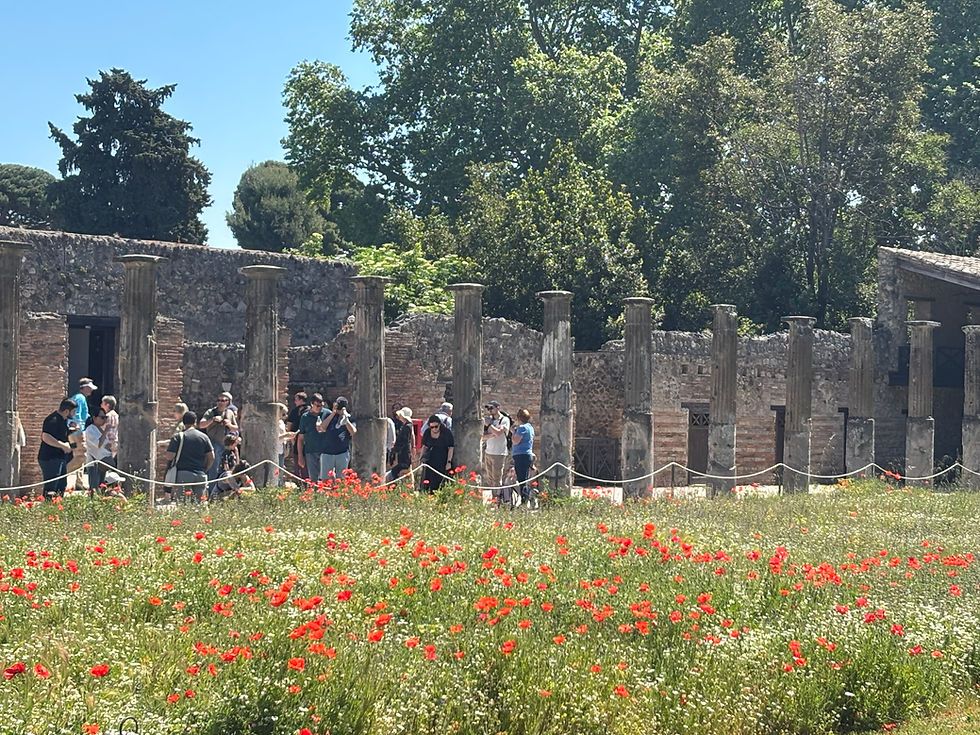
Famous well preserved Villas with fascinating fresco scenes.


Excavated from 1909 onward Villa Mysteries is a well-preserved suburban ancient Roman villa on the outskirts of Pompeii. It is famous for the series of exquisite frescos in Room 5, which are usually interpreted as showing the initiation of a bride into a Greco-Roman mystery cult. These are now among the best known of the relatively rare survivals of Ancient Roman painting from the 1st century BC

Built in the 2nd c BC, the house is a magnificent example of Roman architecture, reflecting the wealth and high social status of its owner.
The House of the Faun is the largest and most luxurious private residence in ancient Pompeii. Covering an entire city block (about 3,000 square meters), this grand mansion is famous for its preserved mosaics, two colonnaded gardens, and its bronze dancing faun statue set in the main atrium's rainwater basin.

The spectacular floor mosaic which depicts the Battle of Issus between Alexander the Great and Darius III , was once the centerpiece of the house. The massive estate likely belonged to the original owners the Satrius family- a prominent and wealthy aristocratic clan in ancient Pompeii with political and financial influence. occupants of the house during the 2nd c. Electoral inscriptions indicate this lavish home was owned by Decimus Lucretius Satrius Valens.
A major local figure, he was a duumvir (top magistrate) and perpetual priest of the Emperor Nero.He sponsored massive, extravagant gladiatorial spectacles for the citizens. His funding of 20 pairs of fighters from his own personal resources highlighted his immense wealth and strong ties to imperial authority

In 2024, the "Greater Pompeii" project was launched—an initiative by the Pompeii Archaeological Park that transforms the historic ruins into a massive, interconnected “parco diffuso” (scattered park).
The extensive archaeological park connects Pompeii with the sites of Boscoreale, Oplontis (Torre Annunziata), and Stabiae (Castellammare di Stabia).
A free shuttle service, Pompeii Artebus, allows visitors to move easily between these extraordinary places, discovering Roman villas, antiquariums, and archaeological museums.
Modern Pompeii


The center of modern Pompeii which was founded in Campania in 1881, spans between the ancient archaeological excavations and the Sanctuary of the Blessed Virgin of the Rosary. with Via Roma -
a bustling main artery that bridges the spiritual and ancient worlds. Pompeii also represents a unique bridge between ancient Rome and the 21st c
Modern Pompeii is a vibrant town with approximately 25,000 inhabitants that has built its modern identity without forgetting its extraordinary past. Outside of the center the city's many areas look crumpling run down slums.
The focal contemporary point of local life, features, at the foot of Mount Vesuvius, welcoming atmosphere, hotels, dining places, souvenir shops and artisan workshops coexisting alongside historic buildings and churches. roughly 650 m away from the ruins.

Sanctuary of the Blessed Virgin of the Rosary is one of the world's most important Marian shrines. the spiritual heart of the modern town.
It was founded in 1876 and consecrated in 1891,
It attracts over 4 million visitors and pilgrims annually, who come to pay homage to the Madonna of Pompeii . The majestic Basilica with its imposing facade, richly decorated interior and lush gardens, overlooks and dominates the expansive Piazza Bartolo Longo, with its central fountain
Pompeii's Restaurants

A very good sea food restaurant, very close to the town's main square - Piazza Bartolo Longo.
The restaurant's name also alludes to an antique cuisine condiment....
Garum is an ancient Roman fermented fish sauce used as a savory, umami-rich condiment, in the cuisines of Phoenicia, ancient Greece, Rome, Carthage, and later Byzantium, often described as "liquid gold" or a precursor to modern fish sauces.
It was created by fermenting fish entrails and small fish with salt in the sun. In modern Italy, it is considered the ancestor of colatura di alici, a similar condiment still made in Campania. The taste of garum is thought to have been comparable to that of today's Asian fish sauces.

la Bettola del Gusto Restaurant -Braceria
Via Sacra 50. 0818637811. info@laBettoladelGusto.it
Very good restaurant also off the cathedral square
To Be Continued......
Via Sacra 50 Pompeii. 081 863 78 11. info@


Comments