
Travel:Punta Arenas, Patagonia. Chile, Nov 7/2025
A continuation of a trip to Antarctica and other parts of Chile which includes posts from Oct 22nd -Nov23rd
Puerto Williams. 10/26 & 11/6 (here)

After safely returning (Nov 6th) from the Antarctic expedition cruise (see previous posts) to Port Williams, on the 12th day (instead of after 10 due to the storm at the Drake crossing), luckily, we manged to re-book our flight segment to Punta Arenas, for the next day.
Thus on the early morning of Nov 7th we headed to a next Chilean destination.
The Silver Wind at Port Williams Boarding the Flight
Landing in mid morning, an hour later. at the a historical frontier Capital of Patagonia , welcomed us with relativity sunny dry cold weather,

Chilean Patagonia is special for its amazing natural beauty and dramatic, untouched wilderness, featuring vast glaciers, fjords, turquoise lakes, and the iconic granite peaks of Torres del Paine National Park, (which was also on our touring plans) as well as unique wildlife like pumas and condors, making it a global hot-spot for eco-tourism
An half an hour later of a drive from Punta Arenas Air Port via flat green landscape dotted with roaming cattle, the scenery rapidly changed, as we neared this most Southern Sea Port town, of about 150,000 inhabitants, seated by the Atlantic ocean,

Furthermore, as in many other founded pioneering settlements of the New world, I was totally amazed to find out that, so also Punta Arenas development was, inherently influenced by remarkable people of Jewish decent.
Punta Arenas - "Sandy Point"

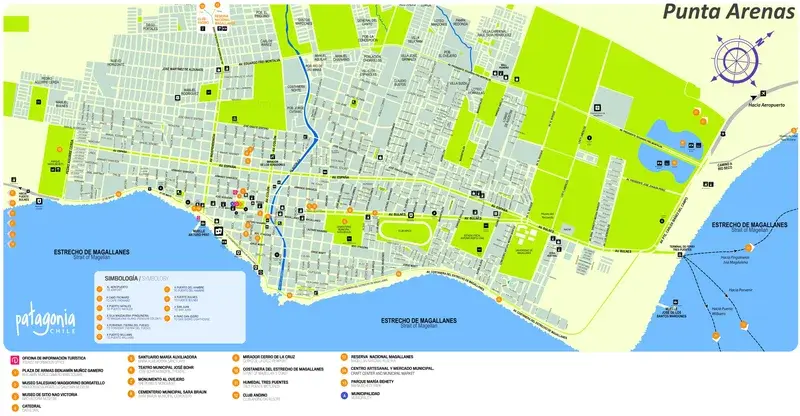
Established in 1848, Punta Arenas, on the edge of the Strait of Magellan, (which connects the Atlantic and Pacific oceans, in southern Chilean Patagonia) is the
capital of the Magallan Province . It is believed it was named 'Sandy Point' by a British sea captain - John Byron,(1723, 1786, grandfather of, the poet Lord Byron) who sailed to Patagonia and claimed to have seen giants inhabiting the land.
The town's name was later changed to the Spanish Punta Arenas.

Once being checked into an hotel in town's center, we joined a Free-Walking Tour (pay as you wish) with a local guide named Randell - highly recommended
Free Walking Tour
Randell - +56993256806 whats-app reservation
Randell, a very dedicated volunteer, from a local established family, who was very passionate about his town and great in sharing its historical past with the incidental tourists, He had hard time to end the tour, which was extended to over 3.5 hours instead of the claimed only 2.

The small town's center we realized, is a strange combination of the ruddy and the grand, with elaborate wool-boom 19th C mansions, and renovations alongside urban extension, also around the the historic Sea Port.
One night stay over is definitely sufficient touring of this remote town. .
Mansions on central Plaza Muñoz Gamero

Due to its far southern latitude, Punta Arenas has a subpolar oceanic climate with very cold temperature.
Thus the coldest coastal Port city is one of the world's most southerly Sea Ports which serves as an Antarctic gateway city. a starting and ending city hub,for any trip to Chilean Patagonia.,
On the one day stay there, I had my very warm winter coat on all day, during this southern hemisphere spring season.

Often used as base for excursions to the surrounding wilderness and Antarctica.
the town also served as a base to defend Chilean Patagonia., sovereignty claims in the southernmost part of South America ,with high geopolitical importance.
Major unrest and rebellious strikes of men prisoners, who initially were funneled by Chilean Gov. policy, to develop the pioneering town turned the policy into a failure. Also the Gov. resistance to set an educational process into the penal budding community, as to create a functional working middle class force, lead to the Gov. to apply another policy of incentivizing immigrant families, to move to this southern remote peripheral region..
Thus Punta Arenas had grown in size and and importance during the 19th c due to increasing maritime traffic to the west coasts of South and North America..which also brought waves of European immigrants, mainly from Croatia and Russia, attracted by a gold rush, and sheep farming boom .
Their crucial influence in the region of Magallanes and development of the city in particular. still, is reflected in the town's names of shops, streets and many buildings..
It is said to have the largest percentage of Croatians in the world outside Croatia and the former Yugoslavia .
Punta Arenas also has the largest percentage of residents of British descent in the whole of Chile.. Recently many immigrants from Venezuela joined in the past few years.
In the 1880s and early 20th c. between about 1890 and 1940, the Magallanes region became an important sheep-raising region,with one company -Sociedad Explotadora de Tierra del Fuego)- controlling over 11,000 square km of land.
The largest sheep company, in Chile and Argentina, was based in Punta Arenas, and its owners lived there
The Punta Arenas harbor, although exposed to storms, was considered one of the most important in Chile before the construction of the Panama Canal. and was used as a coaling station by the steamships transiting between the Atlantic and Pacific oceans. Today it is mostly used by tourism cruises and scientific expeditions.

Agricultural production, including sheep and cattle, continues to play a significant economic role. as has been Salmon farming, which started with Japanese-Chilean cooperation in the late 1960s.
It has rapidly expanded under military rule in the 1980s by leveraging ideal fjords
Chile become the world's second-largest producer, (after Norway) driven by exports to the U.S. and Japan, but faced major challenges like the ISA virus outbreak (2007-2009) and ongoing environmental/Indigenous rights concerns over intensive, large-scale farming.
In addition some low-grade coal. continued to play in the town's economy and since 2006 the economy of Punta Arenas and the region had diversified. with Chile's principal Oil reserves, relatively small proven and estimated around 150 million barrels (0.15 billion) in recent years (2021-2024), ranking low globally, with most domestic production coming from the Magallanes Basin.
Increase in Tourism also contributed to the city's economy and steady growth..
Noticeable Places in Town
Main Square - Plaza Muñoz Gamero

Plaza Muñoz Gamero - Main Square
The town's beautiful main square is dotted by a variety of trees all were in their Spring's beautiful bloom.
It is frequented by locals and tourists alike, all hours of the day.
A helpful charming, ornate Tourist Info structure is set in a quint maroon colored Gazebo, at a corner on the square

Monument to Hernando de Magallanes

A memorial to the explorer Ferdinand Magellan, is set at the Plaza Muñoz Gamero square (and in the Museo Nao Victoria which features a replica of one of his galleons)
Ferdinand Magellan, the Portuguese explorer sailing for Spain, passed, while in 1520 circumnavigated the Earth, close to the present site of Punta Arenas
The monument commemorating the 400th anniversary of Magellan’s voyage was donated in in 1920 by the wool baron - José Menéndez
Magellan has been worshiped by P.unta Arenas residents , and his monuments , streets' names and name of business are noted clearly all over town.
The large bronze sculpture which was created by Guillermo Córdoba, depicts the explorer surrounded by Patagonian ethnic groups. A local tradition holds that kissing the toe of the reclining Indian figure brings good luck for a return trip to the city.
Magellan
Hotel Jose Nogueira on the Square

The historic hotel we stayed in one night - Hotel Jose Nogueira is one of the
old architectural landmarks and one of the oldest buildings of the entire Patagonia, situated in front of the main square right in the middle of downtown
The neoclassical two-story mansion, is built in brick masonry, on stone foundations.

+61 2711000/001. 5684785471
This centenary old mansion from 1905 which was declared national monument.
was formerly owned by:
Sara Braun,
José Nogueira and
2 characters who “wrote” the history of Patagonia
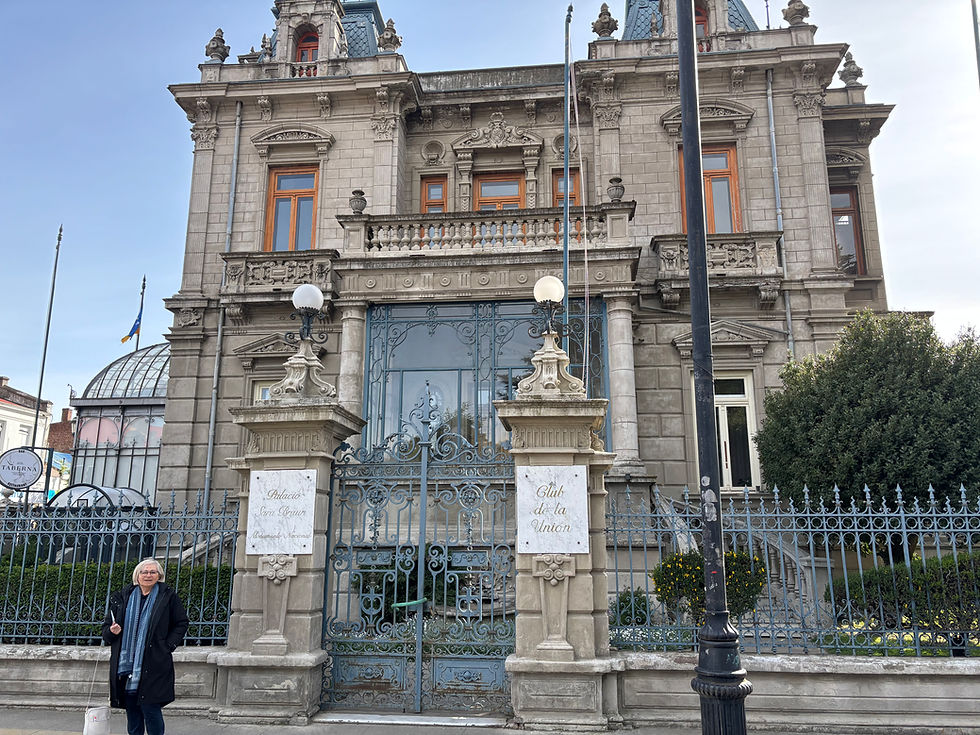
The construction of a splendid mansion In 1890, transformed with the passing of time, into one of the symbols of the city., and in 1982 was declared national monument.

The hotel still bears a beautiful external palatial feel, however is not well maintained, The rooms are not great, nor is the staff we encountered.
Its bar and restaurant are only o.k but are well liked by the locals.
Thus, it is nice to visit but not to stay in

Hotel Cabo De Hornos - another near-by hotel on the square in town's center, can be an alternative accommodation, and is more recommended to stay in
Who Was Sara Braun

Sara Braun ( 1862 – 1955) a Latvian-born Chilean business-woman of a Jewish decent, wasthe daughter of Sofía Hamburger and her father, Elía Braun.who was a tinsmith .
They fled antisemitism in Europe,
Sara was the oldest of seven siblings
who became one of the principal employers in Patagonia.
After emigrating with her family from the Russian Empire to escape persecution because of their Jewish heritage, the family toured Europe, and then looked for work in Argentina and Paraguay, before in 1874 moving to Magallanes, now known as Punta Arenas,
She joined her father to help administer the naval warehouse of the Portuguese shipping magnate José Nogueira, whom she married in 1887. and after which the mansion/hotel is named
It is estimated that around the year 1866, a Portuguese sailor José Nogueira arrived in this remote region of Patagonia. Coming from very humble origins and lacking formal education, but leveraging his extensive knowledge of the seas and his strong determination to secure a better future, he initially devoted himself to hunting sea lions, a demanding and dangerous yet highly profitable activity
By the year 1890, being a trader, ship owner, and rancher, he had become one of the most prosperous and significant entrepreneurs in the Magallanes colony. making a substantial contribution to the economic and social development of the city.
Sara Braun and Jose Nogueira worked together to build a business empire,
When her husband died in 1893, Braun took over his leases to land in Tierra del Fuego and took control of his commercial, industrial and shipping interests .
She undertook also sheep farming with her brother Mauricio, creating a monopolistic company which controlled sheep production in the region and significantly influenced the development of southern Chile. especially that of Punta Arenas, where Sara was very Involved in many charitable endeavors,
The Sara Braun Foundation, established at her death, (1955) has provided scholarship funds to students for higher education. The history and legacy of the Braun family and their business partners: the rest of the ranchers of Tierra del Fuego (Menéndez family Mauricio Braun, and José Montes) were stained when their involvement in the genocide of the Selkʼnam people. who had largely disappeared after of the establishment of the first livestock ranches. was uncovered.
In 1992 part of the Sara Braun Palace was authorized as a small and exclusive boutique hotel. the one we stayed in.
Menendez Monument at Plaza Muñoz Gamero

José Menéndez (1846–1918)
a 7th child to peasant parents from Spain of modest means who from an agricultural laborer, had self -transformed, after leaving his homeland in 1866 . into a powerful businessman
a "wool baron" .
He established a vast commercial and sheep-farming empire in Chilean and Argentine Patagonia.
He is a significant, albeit controversial, figure in the region's history due to his immense wealth and due to his role in the indigenous genocide
21 C scholarship has uncovered the history of Menéndez along with his business partners in the Braun family,
in the genocide of the Indigenous Selkʼnam people of Patagonia.
The missing Head of Jose Menendez

Recognizing his significant role as a pioneer influential settler, who helped establish Punta Arenas as a bustling port through sheep farming and immigration,
the city erected a monument in his honor. as a key figure, often called "El Ovejero" or the Shepherd.
However, being hated by the locals for his controversial genocidal history,
Jose's bust was "beheaded" from the monument, established in his memory at the main square.
The Mural on Sara Braun Lyceum Building- Municipal Library
Gabriela Mistral
Another notable women who resided in town (1944) was the Nobel Laureate
Lucila Godoy Alcayaga, known by her pseudonym Gabriela Mistral,
The Chilean poet-diplomat, journalist and educator. was the first Latin American author to receive a Nobel Prize in Literature in 1945, for her lyric poetry.
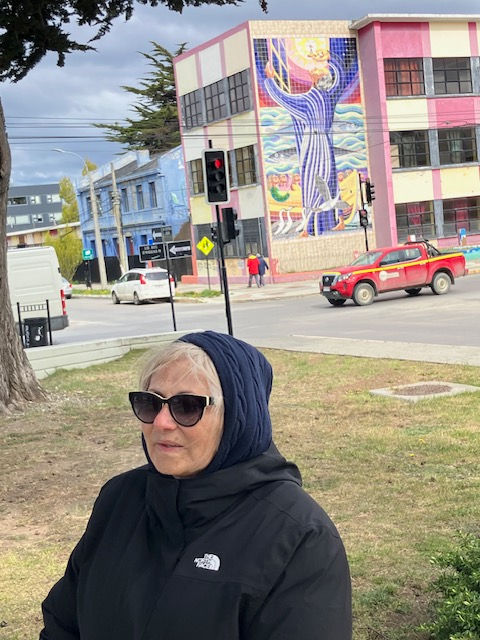
Her beloved image and influence on the town's education and educational services is captured carved on a building's street mural
The library mural is a "Tribute from the city of Punta Arenas to Nobel Prize winner Gabriera Mistral" Gabriera Mistral" (Homemaje de la ciudad de Punta Arenas a la Premio Nobel Gabriera Mistral).
The mural is based on a quote from one of Mistral's poems "God said to me:
The only thing I have left you is a lamp for your night" (Dios meadijo: Lo,Unico Que Te He Dejado es Una Lampara Para Tu Noche".
"Looking out from her classroom window or through the glass of her hotel room, she wrote those unforgettable verses that give the book its title: 'Desolation' in the soul and in the streets, powerlessness before the advance of the elements of sadness in a land 'that has no spring,' the long winter, the immense night, the advancing loneliness, the breaking of words before the unknown: the world that is coming down upon her tormented soul." (Marino Muñoz "Gabriela Mistral in Punta Arenas). Punta Arenas,
By the Water Front
Beautiful wide Promenade Columbus leads from the town's center all the way down to the beach, where other impressive monuments dominate the scenic waterfront area
Costanero del Estrecho
The monument depicts a ship surrounded by mermaids and their male equivalent.

The Nao Victoria Museum,
a private maritime museum located in just outside the city center, It has been open to the public since 2011. featuring replicas of the ships that contributed to the discovery of the area,
Panoramic Views from Top of the Hill

Cerro De La Cruz -"Hill of the Cross"
is just a short uphill walk from Munoz Gamero Square, perched above the city center, It is the most popular panoramic spot in Punta Arenas.
We walked up the hill-top to have lunch at a recommended restaurant inside an hotel worth the views but not the food.
The Restaurant at hill top

La Yegua Loca
located at Hotel La Yegua Loca
Magallanes y la Antártica Chilena
The Town's Public Cemetery & Sara Braun Connection

The following morning and prior to taking off to Puerto Monnt,( our next destination) we strolled on Magallan Ave, to visit the famous cemetery which Its parks are attractive urban legend
and highly recommended.
It is situated 5 blocks away from the hotel and the main city's center square.
The cemetery is well known because it tells the story of the city's wide range of immigrants and nationalities
.Many of the influential family members who have had driven Punta Arenas to what it has become, are buried in this beautifully manicured cemetery noticeable for its rows of majestic cone shaved cypress trees.
Sara Braun Municipal Cemetery


Designated a National Monument of Chile in 2012, and ranked by CNN as
"one of the most beautiful cemeteries in the world" it is a landmark iworth visiting.
Inaugurated in 1894 and had long ago reached its capacity, it consist of a wide range of young and old crypts, as well as expensive and small graves

Menendez Burial Chambers

The area north of the town center, on Av. Bulnes. was donated by the pioneer Sara Braun and in 1919 the engineer Fortunato Circutti designed the whole gates and white walls that surround the cemetery.
The Braun Family Mausoleum
Our original touring plan was suppose to include a visit and 3 days stay also in the acclaimed Patagonia's Torres de Pines National Park. However due to a delay in the cruise's return from Antarctica, induced by an unexpected storm, that also impacted the park's weather, the loss of the 2 days and other travel constrains, that original plan needed re-consideration.
Thus before departing the town, and giving up, we consulted with a local Travel Office at Punta Arenas, about making it to the park, in which we encountered and got the best service from an upbeat highly recommended agent.
Valeria Elizondo Pinda

A wonderful tour operator in town at
COMAPA Turisimo
on Magallanes 990E
Ventasmessonpug@compa.d
56 612200 226. 56995571174
Bye Bye Punta Arenas

To be Continued....


Comments